

Heirs Of The Horde? Kazakhstan Reconsiders Its Official History
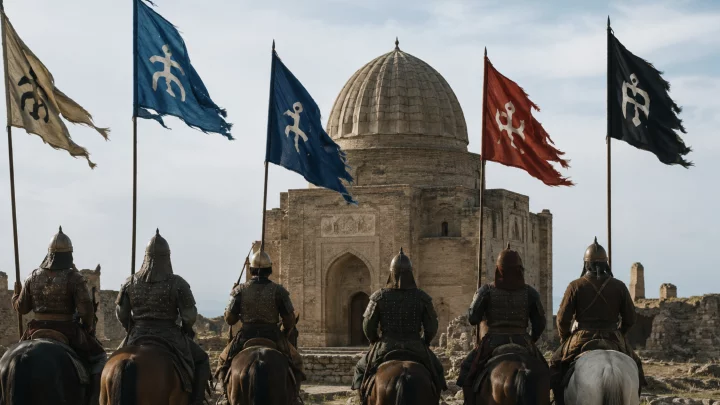 AI-generated illustration
Historian Zhaksylyk Sabitov told ORDA News why the Golden Horde is gradually coming to the fore in Kazakhstan’s historical policy, how new research is changing views on the origins of Kazakhs, clans, and zhuzes, and why the country decided to rethink its history through the legacy of Ulus Juchi. The main points from the conversation are in the Orda.kz review.
Kazakhstan is revising Soviet-era historical concepts, conducting new research, and shaping a unified national narrative. At the same time, debates around the legacy of the Golden Horde have raised questions about continuity, identity, and Kazakhstan’s place in Eurasian history.
*Sabitov is one of the key scholars working on this subject in Kazakhstan. He heads the Scientific Institute for the Study of the Ulus Juchi, an institution created to research the legacy of the Golden Horde and its role in the history of Kazakh statehood. His academic interests include the history of the Golden Horde and the Kazakh Khanate, Kazakh genealogies, and the use of genetics in historical research.
In the interview, Sabitov explained why Kazakhstan has begun to actively turn to the legacy of the Golden Horde, how views of the past are changing, and what this shift may mean for future school textbooks.
Why Kazakhstan Is Returning To The Golden Horde
The historian said the growing focus on the Golden Horde is part of restoring historical justice. According to him, as early as the 19th century, researchers and representatives of the Kazakh intelligentsia linked the origins of the Kazakhs to the Horde’s legacy.
Back in the 19th century, Shokan Ualikhanov said that Kazakhs, in principle, considered themselves heirs of the Golden Horde. Irina Erofeeva also described this in her last article,Sabitov said.
He noted that in the Soviet period, attitudes toward the Golden Horde were shaped by ideology. It was portrayed as a foreign and negative state, while the origin of the Kazakh Khanate was mainly linked to the White Horde.
That is, even school textbooks now say that the Kazakh Khanate comes from the White Horde. This concept was ideological. It was Soviet. Now it has been abandoned, so a completely different concept has appeared,the historian explained.
According to Sabitov, during Nursultan Nazarbayev’s presidency, state historical policy did not focus on the Horde or the Kazakh Khanate.
The entire focus of state policy in the field of history during the Nazarbayev era was not on the Kazakh Khanate, not on the Horde, not on other periods, but on the figure of the ‘founding father,’he said.
He added that real systematic work on the study of history began after science funding improved in 2019. Sabitov stressed that modern research became the basis for major academic forums and anniversary events dedicated to Ulus Juchi.
This is a way to restore historical justice, because no professional historian in Kazakhstan, Russia, or other countries doubts that Kazakhs are among the successors of the nomadic population of the Golden Horde,he said.
Interest in the history of Ulus Juchi has been developing for several years. Sabitov recalled that in 2019 there was an initiative to mark the 750th anniversary of the Talas Kurultai, and in 2024 Kazakhstan marked the 800th anniversary of Ulus Juchi. This work later led to major forums and academic conferences.
How The Horde Became Part Of Kazakhstan’s National Narrative
As interest in the Horde grew, disputes emerged over who had the right to consider themselves its heir. Sabitov said these debates mostly exist in the public sphere, while serious disagreements among specialists are rare.
Kazakhstan is truly one of the heirs of the Golden Horde. There is no struggle over the brand, because, in principle, academia is not trying to privatize history. Therefore, most academic scholars do not fight over brands,he said.
Sabitov noted that interest in the Golden Horde has moved beyond academia and is now connected to questions of national identity. According to him, turning to the era of Ulus Juchi forms a new perception of the past and strengthens the symbolic capital of Kazakhstan’s national history.
In general, I believe that knowing you come not just from people who only began learning something at the beginning of the 20th century, but from those who were the lords of the steppes in the era of the Golden Horde, forms a completely different perception of history and a different upbringing,he said.
He also pointed to the practical aspects of this approach.
The Golden Horde, like any concept, has its own political and technological advantages,Sabitov said.
According to the historian, the history of Ulus Juchi shows that Islamic tradition existed on the territory of modern Kazakhstan long before the emergence of modern religious movements. He cited Uzbek Khan, Berke, and other rulers as examples. Sabitov also stressed that a significant part of present-day Kazakhstan was part of Ulus Juchi and was one of its key regions.
He also called the legacy of the Golden Horde a more unifying historical concept than the history of the Kazakh Khanate. The Horde is connected to the past of many peoples who lived on its former territory, making it a more inclusive part of the region’s shared history.
If we take the Golden Horde, then Russians, the ancestors of other Slavic peoples, Uzbeks, and other peoples lived in it. Almost all peoples who now live in Kazakhstan, to one degree or another, lived on the territory of Ulus Juchi, the Golden Horde. Therefore, in general, this is an inclusive concept that unites most of Kazakhstan’s population, unlike the history of the Kazakh Khanate, which is perceived by the population only as the history of the Kazakhs,he said.
Sabitov explained that the question of the Golden Horde’s center remains a subject of academic debate, since the concept of a center can be interpreted in different ways. At the same time, he said, researchers do not dispute that the territory of modern Kazakhstan was part of the Golden Horde and, at an early stage, was one of its key regions.
What Modern Science Says About The Golden Horde And The Kazakhs
Sabitov said modern research increasingly examines Kazakh history through anthropology, genetics, and written sources. According to him, work by Kazakh and foreign scientists shows that the formation of the Kazakh people is closely tied to the population of Ulus Juchi.
The historian noted that anthropologists link the emergence of the modern physical type of Kazakhs to the mixing of local Turkic tribes and nomads from East Asia in the 13th century. Geneticists, he said, have reached similar conclusions.
According to physical anthropology and genetics, Kazakhs are among the heirs of the Golden Horde,Sabitov said.
He also said genetic studies increasingly confirm information preserved in Kazakh shezhire. According to him, many genealogies that were once viewed as legends are now being confirmed through genetics.
How Clans And Zhuzes Were Formed
The historian said many ideas about Kazakh clans and zhuzes that appear in textbooks are gradually being revised. According to him, most modern Kazakh clans have a direct connection to the tribes of the Golden Horde, but their settlement in the past was much more complex than commonly believed today.
Sabitov explained that nomadic societies constantly moved across vast territories. The same clans could live in different periods near the Irtysh River, in Turkestan, Crimea, the Volga region, and even on the territory of modern Pakistan.
He also noted that the familiar regional division of zhuzes in Kazakhstan formed relatively late. According to him, maps and written sources from the 17th and 18th centuries show a much more complex settlement pattern, with representatives of different zhuzes living together across a vast steppe territory.
A Mongol Or Turkic Empire?
Sabitov separately addressed the origin of the Golden Horde itself. According to him, attempts to present it as exclusively Mongol or exclusively Turkic oversimplify historical reality.
He noted that even under Genghis Khan, the Mongol Empire included peoples of different origins and language groups. After nomads arrived in the steppe of modern Kazakhstan, this process of mixing continued.
“It is not really possible to create a simple picture in which there were only two languages — Mongolian and Turkic,”Sabitov said.
According to him, the ruling dynasty came from a Mongolian-speaking environment, but over time, the population and elite of Ulus Juchi became largely Turkicized.
The Nomadic State And Its Place In History
Sabitov said modern historians are gradually moving away from old ideas about nomads as backward societies. According to him, many such concepts emerged during the colonial era and do not reflect the real scale of nomadic states.
The historian stressed that the Golden Horde had a developed political system, large cities, money circulation, and international trade. During the state’s heyday, dozens of cities existed on its territory and trade routes developed actively.
Archaeologists will confirm that there were many cities — more than 140,he said.
According to Sabitov, trade and the situation on the Great Silk Road helped make the Horde one of the largest states of its time.
Why The Golden Horde Fell Apart
Speaking about the reasons for the state’s decline, the historian named both economic and political factors. According to him, the destruction of the northern branch of the Great Silk Road and the cities connected to it dealt a serious blow to the Horde.
At the same time, the state faced internal conflicts among Genghis Khan’s descendants. The power struggle between numerous contenders gradually weakened central authority and accelerated the state’s collapse.
Sabitov noted that this process lasted decades and was not a single moment. After the political collapse, a shared cultural space remained for a long time, continuing to connect different parts of the former Ulus Juchi.
What History Will Schoolchildren Study?
Modern research is changing ideas about Kazakh clans, zhuzes, and tribal settlement. According to Sabitov, many familiar schemes fixed in school textbooks appeared relatively late and do not always reflect a more complex historical picture. New sources show that nomadic communities constantly moved across a vast territory of Eurasia, while modern settlement boundaries formed much later.
Sabitov paid special attention to school education. He said Kazakhstan is now preparing a new academic history of the country, in which a separate volume will be devoted to the era of the Golden Horde for the first time. Based on this work, officials plan to develop a new state standard for teaching history and updated school textbooks.
According to the historian, the goal is not only to add known facts, but also to revise outdated approaches that date back to the Soviet period. He stressed that national history always differs from academic history, but the gap between them should remain minimal and be based on modern research.
Original author: Daria Malkova
Based on: ORDA News YouTube channel
Read also:
- Ministry Calls Yassawi Mausoleum Cladding Collapse ‘Planned Dismantling’
- Kazakhstan Marks Day Of Remembrance For Victims Of Political Repression And Famine
- Kazakhstan Approves New Rules for the Protection of Monuments and Historic Sites
Latest news
- Orda.kz Editorial Team to Cease Operations on September 1
- The Price of a Degree: How Students in Kazakhstan Pay for University
- Second Przewalski’s Horse Foal Born as Species Returns to Kazakhstan
- Kazakh Mining Companies Can Recalculate Purchases if Tenge Weakens
- Kazakhstan Names First Vice President in Three Decades
- What Almaty’s Bus Shelters Are Missing
- 400-Truck Queue Builds at Kazakh–Kyrgyz Border
- Kazakhstan Ready to Help Feed and Rebuild Gaza
- Tokayev Establishes New Presidential Security Body
- Almaty Takes Back Its Nearly Century-Old Hippodrome
- No More Guesswork on Savings: Kazakhstan Tightens Energy Audits for Businesses
- Public Money Could Be Used to Rescue Failing Kazakh Banks
- Third Kazakh Woman Reported Missing in Nepal-China Flood Zone
- Falconer Convicted Over 35 Protected Birds, Spared Punishment Under Amnesty
- Kazakh Citizen Detained in Yakutia in Phone Fraud Case
- Yuan Instead of Dollars? KazMunayGas Draws Record Demand in Asia
- China Gains Oil-Market Influence as OPEC+ Weakens
- Kazakhstan to Divide Smartphones Into White, Gray and Black Lists
- Kazakhstan’s Government Formally Resigns as First Kurultai Session Opens
- Rare Lynx Sighting Recorded in Northern Kazakhstan
