

Why Kazakhstan Is Looking For Belgian Businessman Frank Monstrey
 AI-generated illustration
Kazakhstan’s Anti-Corruption Service has put Belgian entrepreneur and investor Frank Joseph Monstrey on the wanted list. Orda.kz looked into who he is and how he may be connected to fugitive banker Mukhtar Ablyazov.
Frank Joseph Monstrey is a Belgian businessman who was linked for many years to the Kazakh oil and gas company Zhaikmunai, later renamed Nostrum Oil & Gas. It has not yet been specified in which case he is wanted.
 Screenshot from qamqor.gov.kz
Monstrey’s main former Kazakhstani asset was Zhaikmunai, an oil and gas exploration and production company in northern Kazakhstan. In 2017, he resigned as chairman and member of the board of directors of Nostrum. His resignation took effect on April 17, 2017.
Nostrum Oil & Gas describes itself as an independent oil and gas company engaged in the production, exploration, and development of fields in the Caspian Basin. Its shares were traded on the London Stock Exchange under the ticker NOG. Its main production asset is the Chinarevskoye field, operated by its subsidiary Zhaikmunai LLP.
Dispute With BTA Bank
BTA Bank sued Mukhtar Ablyazov in an attempt to recover money that, according to the bank’s management, had been withdrawn from it. During the proceedings, BTA turned its attention to Nostrum shares owned by structures linked to Monstrey.
According to a Nostrum release, BTA tried to enforce a $4 billion court judgment against Ablyazov. In 2017, BTA obtained an asset-freezing order from the High Court of London. It included a stake in Nostrum Oil & Gas held by Claremont Holding Ltd, a company owned by Monstrey.
BTA’s lawyers went to court and secured the freezing of assets belonging to his structure, arguing that those assets were relevant to the enforcement of the judgment against Ablyazov.
In April 2017, Monstrey resigned as chairman and board member of Nostrum. The company explained that a court order affecting other companies under his control could indirectly affect Nostrum. In other words, Monstrey had become too toxic for the company’s continued operations.
After negotiations, the parties reached an agreement. The freeze on the Claremont stake was lifted, and a BTA subsidiary bought 3.76% of Nostrum shares from Claremont and related companies. In effect, BTA received part of the Nostrum share package held by Monstrey-linked structures.
BTA Waives Claims Against Nostrum
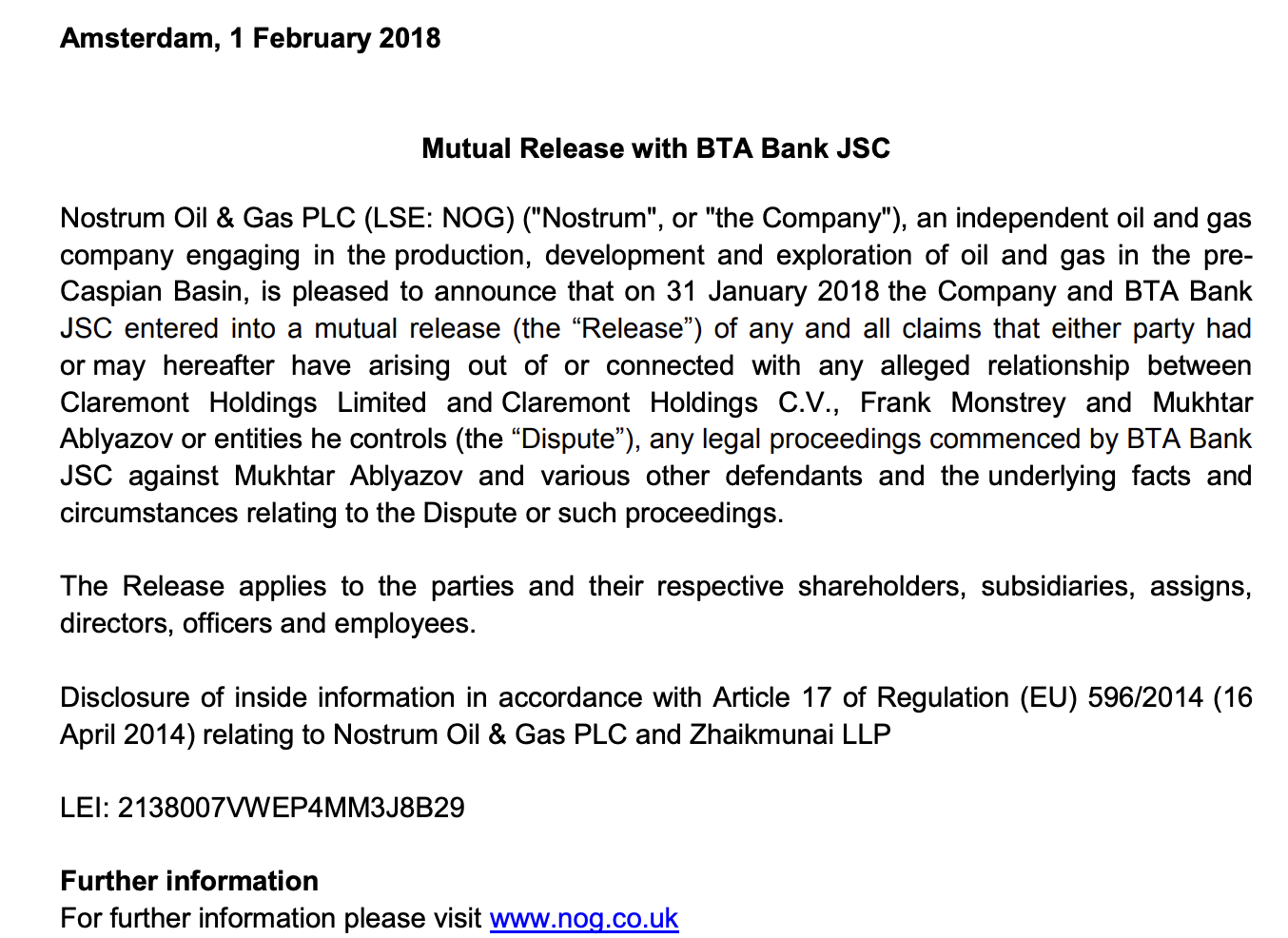
In February 2018, Nostrum announced a mutual waiver of claims with BTA Bank covering all possible claims related to the alleged links between Claremont Holdings, Frank Monstrey, Mukhtar Ablyazov, and structures controlled by him.
Connection To The Ablyazov Case
OCCRP reported in 2018 that journalists had traced $440 million that, according to their findings, flowed from two Monstrey offshore companies — Sartfield and Claremont — to a network of companies linked to Ilyas Khrapunov, Mukhtar Ablyazov’s son-in-law. OCCRP linked the money to real estate and business in the United States.
Monstrey himself denied being Ablyazov’s front man. In responses to OCCRP, he said the money was repayment of debt from previous business relations in Kazakhstan and that he had been “involuntarily” drawn into the conflict between BTA and Ablyazov and Khrapunov.
KIAR has also written about Monstrey as a Belgian businessman known in Belgium for the Sterea project and The National Golf Brussels, while also calling him a former Kazakh oil tycoon. KIAR linked his story to Nostrum, Claremont, and BTA’s dispute with Ablyazov.
What He Still Has In Belgium
Monstrey’s personal website says that after leaving the oil and gas business, he developed Tenerga, a geothermal energy company, and is also linked to The National Golf Club near Brussels.
Belgian registers list Monstrey and his spouse among the founders of Cervus Business Services, established in 2014. The company’s listed activities include consulting, transactions involving movable and immovable property, project development, and partner searches.
Nostrum Today
Nostrum continues to operate in Kazakhstan, but without Monstrey. In 2023, the company completed the purchase of an 80% stake in Positive Invest LLP, which owns subsoil use rights for the Kamenskoye and Kamensko-Teplovsko-Tokarevskoye fields. The project is known as Stepnoy Leopard.
In 2025, Kazakhstan’s Energy Ministry approved a phased development plan for the Stepnoy Leopard fields through 2044. Nostrum says it owns an 80% working interest in the fields.
Original author: Ilya Astakhov
Read also:
- Tokayev to Expand National Security Committee’s Powers
- Kazakhstan Merges Anti-Corruption Agency into National Security Committee
- KNB Special Forces Bring Four Terrorism Suspects Back To Kazakhstan By Plane
Latest news
- Orda.kz Editorial Team to Cease Operations on September 1
- The Price of a Degree: How Students in Kazakhstan Pay for University
- Second Przewalski’s Horse Foal Born as Species Returns to Kazakhstan
- Kazakh Mining Companies Can Recalculate Purchases if Tenge Weakens
- Kazakhstan Names First Vice President in Three Decades
- What Almaty’s Bus Shelters Are Missing
- 400-Truck Queue Builds at Kazakh–Kyrgyz Border
- Kazakhstan Ready to Help Feed and Rebuild Gaza
- Tokayev Establishes New Presidential Security Body
- Almaty Takes Back Its Nearly Century-Old Hippodrome
- No More Guesswork on Savings: Kazakhstan Tightens Energy Audits for Businesses
- Public Money Could Be Used to Rescue Failing Kazakh Banks
- Third Kazakh Woman Reported Missing in Nepal-China Flood Zone
- Falconer Convicted Over 35 Protected Birds, Spared Punishment Under Amnesty
- Kazakh Citizen Detained in Yakutia in Phone Fraud Case
- Yuan Instead of Dollars? KazMunayGas Draws Record Demand in Asia
- China Gains Oil-Market Influence as OPEC+ Weakens
- Kazakhstan to Divide Smartphones Into White, Gray and Black Lists
- Kazakhstan’s Government Formally Resigns as First Kurultai Session Opens
- Rare Lynx Sighting Recorded in Northern Kazakhstan
