

Toilets, Dogs And Parking: What Kazakhstan’s New Urban Rules Will Change
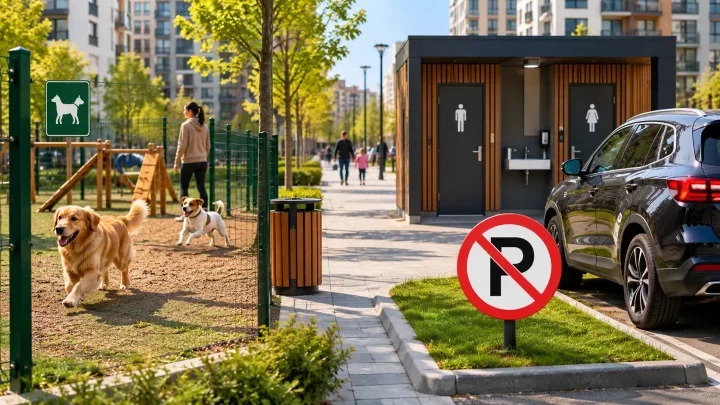 AI-generated illustration
New rules for the improvement and maintenance of cities and settlements will come into force in Kazakhstan on July 1, 2026, Orda.kz reports.
The document sets uniform requirements for yards, streets, parks, construction sites, retail facilities and residential buildings. The rules will apply to government agencies, utility companies, businesses, management companies, condominium associations, OSI bodies OSI bodies — Kazakhstan’s homeowner associations — and residents.
One of the most noticeable changes concerns pet owners. They will be required to clean up after their animals. Settlements must also create special dog walking areas with proper signs.
A separate section concerns public toilets. Owners of markets, cemeteries, construction sites, gas stations, car washes, service stations, beaches, parks, cafes, seasonal retail outlets and other facilities will have to provide stationary toilets or bio-toilets for visitors. Cesspools at such sites will be banned.
The rules also make property owners responsible for the condition of nearby areas. Owners of buildings and land plots will have to clean the adjacent territory within a five-meter radius and monitor the condition of facades, fences and green spaces.
Individuals and legal entities that own buildings, structures and land plots maintain and improve the adjacent territory independently or by hiring organizations at their own expense,the document says.
The rules ban construction waste at container sites, storage of goods and materials on sidewalks and lawns, ads in unauthorized places, and parking on green areas and playgrounds.
Parking rules are also spelled out separately. Cars may not be left on lawns, sidewalks, playgrounds or other public improvement areas. Abandoned and dismantled vehicles will also be banned from yards.
For cities, the document fixes the priority of pedestrians, public transport and bicycle infrastructure. New public spaces must take into account the needs of people with limited mobility and provide barrier-free movement.
The rules also regulate street maintenance in winter and summer. After snowfall ends, roads, streets and sidewalks must be fully cleared within 48 hours. Building owners must also remove snow and ice from roofs in time and warn residents in advance.
At the same time, akimats will be able to add their own requirements, taking into account the climate and geography of each settlement.
Original author: Alexander Smolin
Read also:
Latest news
- Orda.kz Editorial Team to Cease Operations on September 1
- The Price of a Degree: How Students in Kazakhstan Pay for University
- Second Przewalski’s Horse Foal Born as Species Returns to Kazakhstan
- Kazakh Mining Companies Can Recalculate Purchases if Tenge Weakens
- Kazakhstan Names First Vice President in Three Decades
- What Almaty’s Bus Shelters Are Missing
- 400-Truck Queue Builds at Kazakh–Kyrgyz Border
- Kazakhstan Ready to Help Feed and Rebuild Gaza
- Tokayev Establishes New Presidential Security Body
- Almaty Takes Back Its Nearly Century-Old Hippodrome
- No More Guesswork on Savings: Kazakhstan Tightens Energy Audits for Businesses
- Public Money Could Be Used to Rescue Failing Kazakh Banks
- Third Kazakh Woman Reported Missing in Nepal-China Flood Zone
- Falconer Convicted Over 35 Protected Birds, Spared Punishment Under Amnesty
- Kazakh Citizen Detained in Yakutia in Phone Fraud Case
- Yuan Instead of Dollars? KazMunayGas Draws Record Demand in Asia
- China Gains Oil-Market Influence as OPEC+ Weakens
- Kazakhstan to Divide Smartphones Into White, Gray and Black Lists
- Kazakhstan’s Government Formally Resigns as First Kurultai Session Opens
- Rare Lynx Sighting Recorded in Northern Kazakhstan
