

Optimization from KazTransGas Aimak: How is The Gas Issue Being Solved in Kazakhstan?
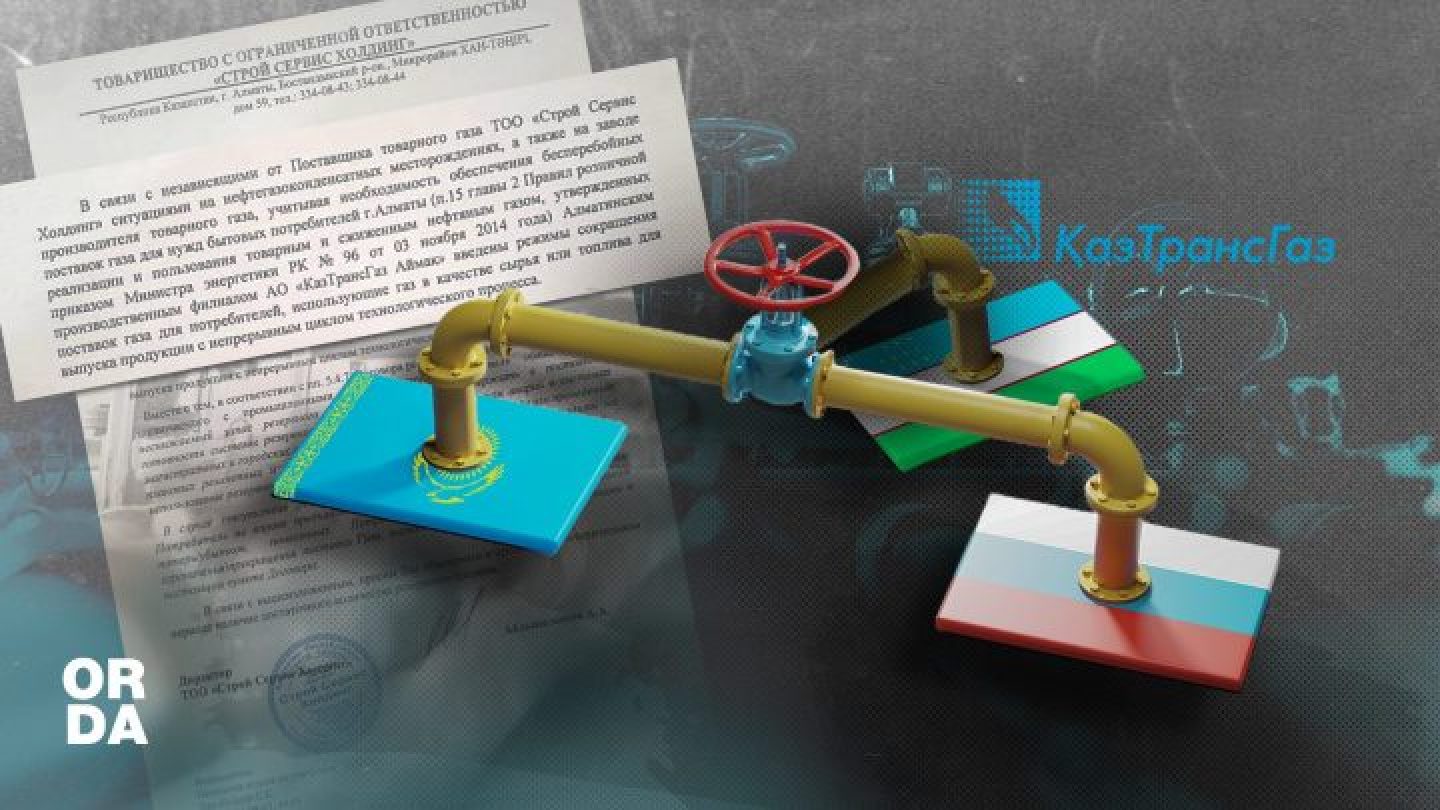
The organization supplying gas to large enterprises claims there is a reduction or termination of fuel supplies. They blamed KazTransGas Aimak JSC for the problem. Orda.kz looked into the situation.
A document sent to Orda concerns large enterprises that use gas as a raw material or fuel for the production of products with a continuous cycle of a technological process. Stroy Service Holding LLP sent a letter to household consumers, informing them that the Almaty branch of KazTransGas Aimak is reducing supplies or will stop them altogether. But not for everyone.
Only large consumers, such as oil and gas, metallurgical and food enterprises allegedly fell under the reduction. At the same time, if the company does not have backup fuel and production stops because of this, KazTransGas Aimak will not bear any responsibility. The letter quickly spread among Almaty residents. It later ended up at Orda’s editorial office.
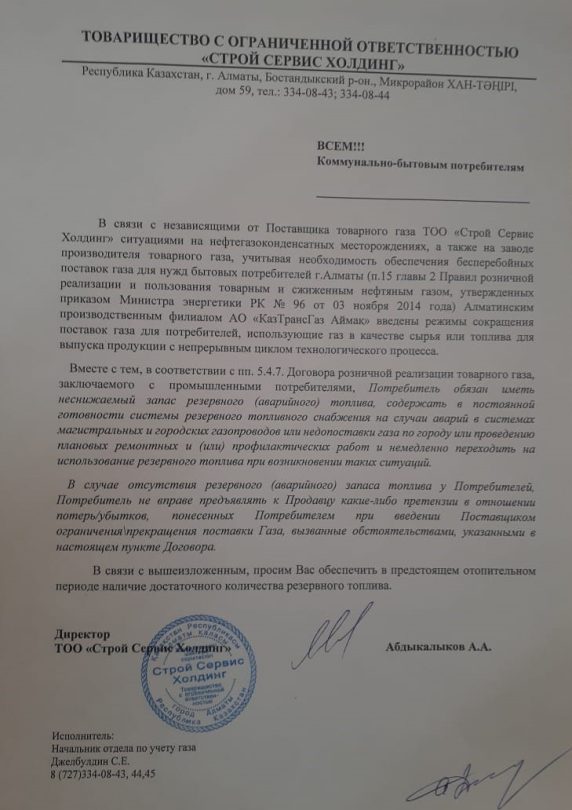
The lawyer of Stroy Service Holding LLP during a phone call said that the document was sent to them on January 24. They then sent it to consumers. But a few hours later they were informed that the document would not affect ordinary citizens. The reduction in gas supplies indicated in the document is expected for industrial enterprises.
KazTransGas Aimak JSC immediately disavowed the document. The largest gas supply company told an Orda correspondent that they do not have a contract with Stroy Service Holding LLP. The gas at the enterprise is received from another organization. The text of the letter was simply "stolen".
"Since the beginning of the heating season of 2022-2023, gas supply from major suppliers has been carried out in an unstable mode. KazTransGas Aimak, for its part, did not forcibly reduce gas to consumers. The JSC, together with local executive bodies and the Ministry of Energy, optimizes gas consumption of large industrial enterprises by switching to an alternative fuel source,"
KazTransGas Aimak explained.
The company noted that optimization takes place by mutual consent. But what does this mean? Large consumers, as stated by KazTransGas Aimak, simply agreed not to receive gas in full for a certain time.
"In general, the optimization of consumption of large gas consumers during the peak period was no more than 4%. This in no way affected the population and the communal sectors. The company did not forcibly reduce gas to its customers"
Causes of problems with natural gas supplies:
- Unscheduled repairs at the Orenburg GPP
- Reduction of supplies from large fields Tengizchevroil (TCO), Kashagan and Karachaganak
- Petroleum Operating (KPO)
- Abnormal frosts
- Increased consumption
The sharply increased level of consumption was mainly observed in the south of the country. It led to peak loads on the gas transmission system. The JSC noted that the full restoration of the supply regime is expected closer to the end of the heating season. If the main players restore the previous level of gas supply earlier, then the joint-stock company will refuse to optimize.
Gas shortage: Freight Forwarding Costs, Storage and Repair at The Orenburg Gas Processing Plant
We turned to Artur Shahnazaryan, an expert in the oil and gas industry, for comment. In his opinion, This may concern the purchase of an additional volume of gas as a strategic reserve.
"In this particular case, all this is due to a gas shortage that has arisen due to repairs at the Orenburg Gas Processing Plant. Gas is supplied there from the Karachaganak field. There it is brought to marketable form, after part [Ed. of it] is returned to Kazakhstan, and the other, according to the replacement scheme, comes from Russia to other regions of our country. Now there is a certain gas shortage in Kazakhstan as a whole. The CHP uses more expensive fuel oil instead of this fuel. Shymkent CHP even stated this,"
Artur Shahnazaryan said.
But the problems of liquefied gas, according to the expert, are more related to the attempt of companies to push through the increase in prices for gasoline and autogas.
"Quite recently, a number of enterprises complained that they could not export gas, because the Liquefied Gas Fleet does not accept it. Atyrau GPP was forced to stop its main production line altogether through catalytic reforming. This is an industrial process of refining gasoline and ligroin fractions of oil to obtain high-quality gasoline and aromatic hydrocarbons. Now the issue has been resolved. This is an artificial, man-made crisis. The whole chain from manufacturers to retailers requires price increases from the state. The other day there was even an appeal to the government demanding an increase in prices for gasoline and autogas. Allegedly, the price limit, which was set after the events of Bloody January, can no longer be sustained."
Artur Shahnazaryan noted that manufacturers, wholesalers, and retailers have come under strict state regulation of prices. Meanwhile, the state did not include the owners of oil depots in this list. The latter were thereby able to increase the price for storage.
"So also freight forwarding costs for transportation of liquefied petroleum gas (LPG) increased by 25%. This was due to the rise in prices for railway tank cars. The repair of the Orenburg Gas Processing Plant also worsens the situation as a whole."
The expert summed up that Kazakhstan receives up to 300 thousand tons of LPG from Orenburg under the replacement scheme. Half is exported to KazRosGaz LLP. The rest goes to the domestic market.
Gas issue: How Kazakhstan, Russia and Uzbekistan Are Trying to Create a New Trilateral Consortium
Roman Sklyar agreed with Gazprom on the supply of Russian natural gas to the Kazakhstani market. Then a similar roadmap was signed by representatives of the Governments of Uzbekistan and Russia.
According to experts, this is necessary for the use of the existing Central Asia–Centre main gas pipeline. At one point in time, gas from Turkmenistan through Uzbekistan and Kazakhstan went through it to the central regions of Russia. This gas pipeline can currently provide reverse supplies to Uzbekistan. This seems necessary considering the current conditions of declining natural gas reserves and frosts. This winter has made itself known this year. Long-term negative temperature records have been broken in Central Asia.
Tashkent was not ready for negative 20 degrees. Problems were abruptly exposed: beautiful and new architecture was built on old infrastructure. The temperature in high-rise buildings dropped sharply to 10 degrees Celsius. The reason was the lack of natural gas. People reportedly had to keep warm by using electric heaters, but they soon stopped working. The power grid simply could not withstand the overvoltage.
"We survived terrible days in the cold, there was no light, no gas, no heating. All factories stopped, all shopping malls were closed, gas stations too, there was not even street lighting. In the courtyards, the military set up mobile kitchens with hot food, and hot tea outlets were organized around the city. And all the big restaurants were handing out hot pilaf. People with babies lived in cars with their engines running. To be honest, we didn't understand where the gas went. Gas exports were completely stopped back in December, but it is not clear why people did not have enough of it. There were no emergency situations with gas,"
A resident of Tashkent told the correspondent Orda.kz .
Uzbekistan plans to stop exporting gas by 2025. Kazakhstan, Russia, and Uzbekistan should solve the gas issue by this period, starting to implement the project.
It remains unclear how bad the situation with natural gas in Kazakhstan is. During the frost, some companies received less fuel due to an increase in supplies for energy-generating enterprises.
Original Author: Maria Gorbokonenko
DISCLAIMER: This is a translated piece. The text has been modified, the content is the same. For Accuracy please refer to the original article in Russian.
Latest news
- Endangered Leopard Seen Again In Ustyurt
- Are Kazakhstan’s Ruling Party And Newest Party About To Merge?
- Where Will Astana’s Second Airport Be Built?
- Gibbons And Ring-Tailed Lemurs Born At Almaty Zoo
- Another Group Of Rare Wild Horses Arrives In Kazakhstan
- Heirs Of The Horde? Kazakhstan Reconsiders Its Official History
- Kazakhstan Wants AI To Help Assign Conscripts To Military Units
- Kazakhstan’s Labor Market Will Need More Than A Million Workers
- Belarusian Citizen Extradited From Kazakhstan After Alleging Abuse In Detention
- Illegal Database With Millions Of Kazakhstanis’ Data Found In Zhetysu Region
- Astana LRT Could Get A New Name
- Tokayev Sets Rules For Kazakhstan’s New Political System
- Kazakhstan Looks To Hong Kong To Open New Farm Export Routes
- Kazakhstan Simplifies Social Payment Rules
- Record Gold Reserves And Slower Inflation: What The National Bank Reported To Tokayev
- Gazprom To Increase Gas Supplies To Kazakhstan In 2026
- Gasoline Worth 37 Billion Tenge: Kazakhstan Uncovers Fuel Export Scheme To Kyrgyzstan
- Kazakhstan To Change Rules For Using State Symbols
- Cyprus Visit To Kazakhstan Sparks Dispute In Greek And Turkish Media
- Business Subsidies To Be Reviewed Once Every Three Years
