

Orda Speaks with Economist on Implementation of Kazakhstan’s National Plan
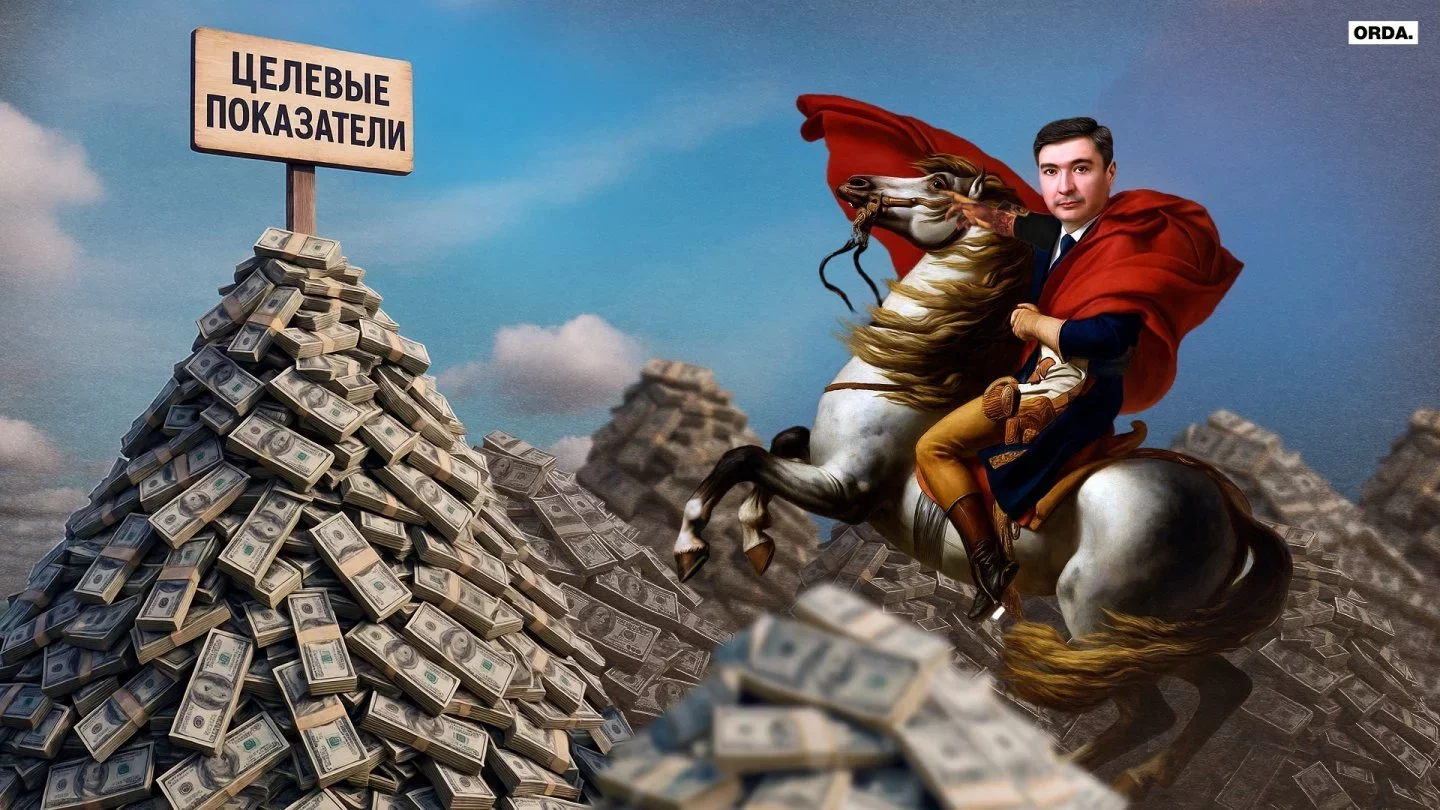 Photo: Orda.kz
Kazakhstan's national budget project contains 39 key indicators — indicators that the republic must achieve in the coming years. Orda.kz has spoken with expert Ruslan Sultanov, author of the Tengenomika Telegram channel, about how the government is handling the project.
Recently, the Kazakh authorities presented for the first time a report on how the National Plan is being implemented. It does not reflect all the indicators, but only 34 out of 39. And only 17 of them managed to achieve the target indicators.
Work In Progress
17 completed goals out of 34 is, one might say, two and a half points out of five. But the National Plan was approved only in July 2024, so part of the past year was spent on organizational processes. Taking this into account, one could give the government a break — if it were clear what it was doing all this time.
We do not see what exactly was done or, on the contrary, not implemented to obtain such results. It is important to understand which measures were implemented and which were not. For each indicator, a decomposition should be built, that is, a breakdown of which measures were planned, which of the state bodies and regions is responsible for their implementation, and in what volume. However, such data is not publicly available, which does not allow an objective assessment of the real contribution of various participants and measures,emphasizes Ruslan Sultanov.
The Supreme Audit Chamber also noted that government agencies failed to adapt their plans promptly.
Although they should have done so within three months of the approval of the National Plan. Because of this, the implementation of strategic goals could suffer.
In order for the National Plan to be fully implemented, it is necessary to increase the transparency of its implementation. This includes timely approval of development plans, a clear breakdown by activities, responsible executors and expected contribution to the overall result. This approach will allow us to determine which links in the chain did not work and make timely adjustments,
Ruslan Sultanov sys.
If the government began to openly publish data on how it plans to achieve the required indicators, explain why it failed to achieve this or that target, review priorities, and analyze the reasons for shortcomings, this would help avoid shortcomings and increase confidence in the state planning system.

Close, But No Cigar
Some of the indicators that the government has set for itself have deceptively “lenient” targets. For example, among the indicators is one such as the share of the population's spending on food.
In 2024, the target for this indicator was 49.4%. And the real figure is 50.6%. For developed and even many developing countries, such figures are far from the most impressive. One might get the impression that the Kazakh authorities are deliberately “drawing” convenient, easily achievable goals to report on their implementation, although this will not solve real social problems:
The share of expenditure on food products is a sensitive socio-economic indicator, and its reduction even by tenths of a percent requires significant structural changes in the economy and population income. With the target value in the National Plan for 2024 — 49.4% — the actual figure of 50.6% indicates that we are close to the goal, but have not yet reached the planned level. It is important to understand that the reduction in the share of expenditure on food occurs both due to income growth and due to changes in the consumption structure, which requires comprehensive measures: from the development of domestic food production to employment support and an increase in real incomes. explains the economist.
By 2029, the government boldly expects to reduce the share of food in the expenses of Kazakhstanis to 40%.
In 11 regions of the country, this figure is higher than the national average: in the Turkistan and Mangystau regions, it is 59.6%, in Jambyl — 59.4%. And even in the Qaraganda region, where the share of food expenses is the lowest, it reaches 41.7%.
According to the economist, when implementing the National Plan, it is important to form separate regional trajectories for achieving target indicators, taking into account the specifics of each region, price levels, and the living standards of the population.
The same applies to the life expectancy target (LE): 75.5 years. According to this indicator, the target seems to be almost met: 75.44 years.
To bring the life expectancy in the country to the 77 years envisaged by the National Plan, the Ministry of Health and other departments will need to work systematically for further improvement, i.e., improving the quality of medical services and improving the living conditions of Kazakhstanis in general.
According to the experience of other countries, recorded in scientific studies, in the leading countries in terms of life expectancy, the increase over the last 150 years has averaged about 0.25 years annually (approximately 2.5 years per decade). After reaching the threshold of 80 years, the growth rate slows down to 0.15–0.20 years per year, which is associated with the need for a deeper modernization of health care systems, social protection and living conditions,
Ruslan Sultanov.
In general, the government's goals only seem easy to achieve. In practice, they are easy to approach but difficult to achieve.

Major Projects?
One of the goals for which there is a significant underfulfillment of the plan is the inflow of foreign investment:
The National Plan set the target for gross foreign investment inflow for 2024 at $24.8 billion, but only $17.2 billion was actually attracted. The key reason is the completion of the large expansion project at Tengiz, which caused a 46% drop in investment in the oil and gas sector (from $5.8 to $3.1 billion), almost three times lower than the 2022 level. This drop is dragging down related industries: for example, the influx of foreign investment in pipeline transportation, which previously received $800–900 million annually, practically disappeared in 2024,
says Ruslan Sultanov
The outflow of investment also affected the mining and metallurgical complex, where it amounted to -29% over the year ($3.8 billion instead of $5.4 billion). Investments in metallurgical production decreased by 71%.
Since 2021, the industry has received almost half as much foreign investment.
In general, there are projects with foreign capital in Kazakhstan, and there are quite a few of them. However, against the backdrop of reduced investment in capital-intensive oil and metallurgical projects, their volumes look less significant. Thus, in 2023–2024, the gross inflow of foreign direct investment in the manufacturing industry (excluding metallurgy) exceeded two billion dollars annually for the first time, and investments in geological exploration and surveys, after four to five years of absence, reached about 640 million dollars in 2024. The decrease in the overall inflow is associated not only with sanctions risks, but also with the structural restructuring of capital flows and the diversification of investment sectors. In general, we need to realize that there will no longer be such large projects as before. Competition for investors has seriously intensified. This forces us to act quickly and improve the quality of our work. The issue is not in preparing presentations, but in the specific conditions of the business environment, and there are many questions arising here now,
explains the economist.
Business Borrowing Issues
Another goal that the Kazakh authorities have set but have not yet achieved is the level of business lending. Reaching the target level for this indicator will not be easy:
It is difficult to talk about a direct relationship between the rate and the dynamics of lending volumes; it is important to understand the context. From the fall of 2022 to 2025, the rate was generally at a relatively stable level in the range of 14–16%. Its increase was a forced measure to curb inflation, which at its peak in early 2023 exceeded 21%. As a result, it was possible to stabilize the price level to 9–11%. Therefore, it is important to understand that the less restrained growth in business lending than expected is largely due to non-monetary factors and macroeconomic conditions,
Ruslan Sultanov says.
Over the past three years, there have been enough events that have sharply cooled investment and entrepreneurial activity in Kazakhstan.
These include geopolitical upheavals, risks to oil exports, rising inflation in the services sector, and tax reforms. All of this has forced businesses to be more cautious.
Lending remains quite active. Loans to businesses have already amounted to 20.4 trillion tenge, showing an annual growth of 21.4%, that is, bank financing continues to grow at an accelerated pace. Of course, government support measures, which are currently undergoing changes and may affect further dynamics, play an important role in SME lending. Considering that the rate currently performs the task of stabilizing prices, the main potential is in the non-monetary block,
Ruslan Sultanov believes.
The economist emphasizes that if the state regulates business transparently and predictably, rather than imposing excessive pressure and additional levies, then achieving the goal of lending to the corporate sector will become much easier.
Revision
Of the 17 indicators for which Kazakhstan is not achieving its goals, perhaps the most alarming is the non-oil deficit:
The failure to meet the planned indicator for the non-oil deficit of the republican budget in 2024 shows that budget policy needs to be fine-tuned. The level of non-oil deficit planned in the National Plan is 6.1% of GDP. The actual figure was 8.1%. At the same time, in the socio-economic development plan, the target values have already been adjusted: first to 6.5% of GDP, then to 7.9%. The strategic focus of the National Plan was changed in other documents without a clear public link and disclosure of calculations. The VAP report also noted that the government did not provide detailed information on the reasons for the revision, the models and assumptions used, which limits the possibilities of analysis,
Ruslan Sultanov
After clarifications and adjustments, budget expenditures amounted to 27.5 trillion tenge — almost 10% more than in 2023. And it is becoming increasingly difficult to cover these expenses on your own.
Last year, a total of 5.6 trillion tenge in transfers from the National Fund were allocated to patch up holes in the republican treasury. And the budget was revised so often that every fourth tenge in it was “redistributed.”
Over the year, 6.2 trillion tenge (26% of expenses) were revised, mainly due to a change in funding sources for supporting regions and infrastructure projects. The main reason is the shortfall in tax revenues: the plan was reduced from 15.7 to 12.6 trillion tenge (-3.1 trillion), which was offset by an increase in the targeted transfer from 1.6 to 3.6 trillion tenge. Tax revenues (63% of budget revenues) fell by 4.7%, or 604.6 billion tenge, the share of non-oil revenues in financing expenses decreased to 45.9%, increasing oil dependence. The situation is aggravated by the fact that this is happening against the backdrop of real GDP growth of 5% in 2024. The economy is growing, but the deficit is not decreasing — on the contrary, it is increasing, which indicates an imbalance between the rate of economic growth and budget policy. This means that economic growth has not yet been transformed into growth in sustainable non-oil revenues,
explains Ruslan Sultanov.
In 2024, Kazakhstan's budget was revised twelve times.
Comapretively, in 2023, there were seven adjustments, in 2021 and 2022, nine each, in 2020, the budget was revised five times. The more often this is done, the more the predictability of economic planning decreases, the more the confidence of foreign investors falls, and the more risks arise in the implementation of strategic programs.
The concept for managing public finances until 2030 explicitly stipulates that during periods of economic recovery it is necessary to strive to reduce the non-oil deficit and strengthen the sustainability of the budget, and temporary deviations from budget rules are permissible only in crisis situations with a mandatory return to target values within three years,
Ruslan Sultanov says.
The economist emphasizes: it is very important now to adjust the parameters of the National Plan and the budget in a coordinated manner. The main task is to directly reflect the growth of the economy in the increase of stable non-oil revenues.
Otherwise, the dependence of the Kazakh economy on debt burden and oil will only grow.
Original Author: Nikita Drobny
Latest news
- Applications Begin For Bolashak And Scientific Internships In Kazakhstan
- Road Construction Violations Worth Hundreds of Billions of Tenge Uncovered in Kazakhstan
- Winter Paralympics End In Italy As Cortina Hosts Closing Ceremony
- CEC Announces Preliminary Results Of Vote On New Constitution
- Gasoline Has Risen In Price Again In Kazakhstan
- New Constitution Day And Parliamentary Elections: Tokayev’s Key Statements
- Nazarbayev Confirms Support For Tokayev And The New Constitution
- Xi Jinping And Tokayev Deepen Cooperation As Chinese Observers Monitor Referendum In Kazakhstan
- Kazakhstanis Abroad Complete Voting in Referendum
- Exit Polls Indicate Strong Support For Kazakhstan’s New Constitution
- Referendum In Kazakhstan: CEC Releases Preliminary Turnout Data
- Nauryz Celebrations In Almaty To Last Nearly 10 Days
- Kazakhstanis Were Fined for Online Polls on the New Constitution
- 217 New Schools Built In Kazakhstan Over Three Years
- Erbol Khamitov Brings Kazakhstan Gold At The 2026 Paralympics
- Why Are Kazakhstanis Leaving Southern Regions In Large Numbers?
- Tokayev Criticizes Banks For Delaying QR Payments
- Kazakhstan Launches New Preferential Loans For Livestock Breeders
- Rare New Guinea Monitor Lizards Arrive At Almaty Zoo
- Malaysian Automaker Proton Eyes Kazakhstan Production With Allur
