

Kazakhstan And Iran Move To Expand Key Transit Routes
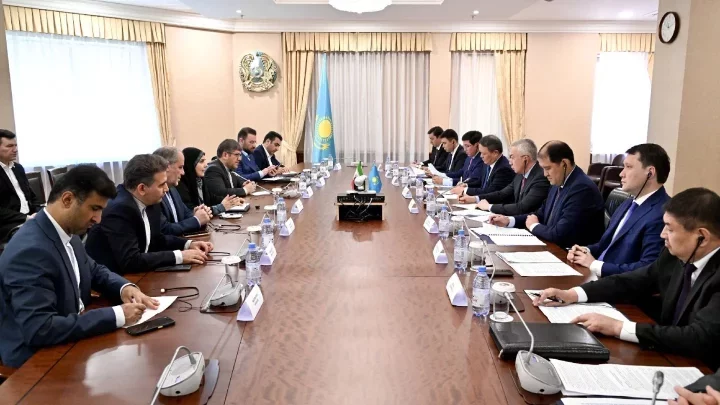 Photo: government\'s press-service
Kazakhstan and Iran have agreed to accelerate the development of transport corridors and port infrastructure, as well as expand investment cooperation, Orda.kz reports.
Kazakhstan’s Deputy Prime Minister and Minister of National Economy Serik Zhumangarin held talks with Iran’s Minister of Roads and Urban Development Farzaneh Sadegh. The parties discussed the implementation of agreements reached at the level of the heads of state, including the development of the North-South international transport corridor, increasing trade turnover, and strengthening logistics ties.
Zhumangarin noted that Iran remains one of Kazakhstan’s key trade and economic partners in the region. According to him, trade turnover between the two countries increased by 26.4% by the end of 2025, reaching $430.2 million. The parties reaffirmed their goal of bringing mutual trade to $3 billion, supported by the free trade agreement signed between Iran and the EAEU.
Special attention was given to the development of the North-South corridor. In 2025, traffic volume along the route increased by 12% and reached 3.5 million tons, while rail transportation rose by 69%.
To further expand transit potential, Kazakhstan proposed developing a joint roadmap for infrastructure modernization, which would increase the corridor’s capacity to 20 million tons per year.
The parties also discussed the development of port infrastructure. Iran announced that approval had been completed for the transfer of a land plot to Kazakhstan at the Shahid Rajaee port in Bandar Abbas. Iran also confirmed its readiness to provide Kazakhstan with opportunities to operate at the port of Chabahar, which would give access to markets in South and Southeast Asia.
In response, Kazakhstan is considering providing Iranian companies with port capacity in Aktau and Kuryk to expand logistics operations in the Caspian Sea.
Following the talks, the parties agreed to accelerate the implementation of previously reached agreements and intensify work on transport and logistics infrastructure, as well as investment cooperation.
Original author: Rustam Muratov
Read also:
Latest news
- Orda.kz Editorial Team to Cease Operations on September 1
- The Price of a Degree: How Students in Kazakhstan Pay for University
- Second Przewalski’s Horse Foal Born as Species Returns to Kazakhstan
- Kazakh Mining Companies Can Recalculate Purchases if Tenge Weakens
- Kazakhstan Names First Vice President in Three Decades
- What Almaty’s Bus Shelters Are Missing
- 400-Truck Queue Builds at Kazakh–Kyrgyz Border
- Kazakhstan Ready to Help Feed and Rebuild Gaza
- Tokayev Establishes New Presidential Security Body
- Almaty Takes Back Its Nearly Century-Old Hippodrome
- No More Guesswork on Savings: Kazakhstan Tightens Energy Audits for Businesses
- Public Money Could Be Used to Rescue Failing Kazakh Banks
- Third Kazakh Woman Reported Missing in Nepal-China Flood Zone
- Falconer Convicted Over 35 Protected Birds, Spared Punishment Under Amnesty
- Kazakh Citizen Detained in Yakutia in Phone Fraud Case
- Yuan Instead of Dollars? KazMunayGas Draws Record Demand in Asia
- China Gains Oil-Market Influence as OPEC+ Weakens
- Kazakhstan to Divide Smartphones Into White, Gray and Black Lists
- Kazakhstan’s Government Formally Resigns as First Kurultai Session Opens
- Rare Lynx Sighting Recorded in Northern Kazakhstan
