

Sculpture Symbolizing Freedom and the Fight Against Slavery Installed in Almaty
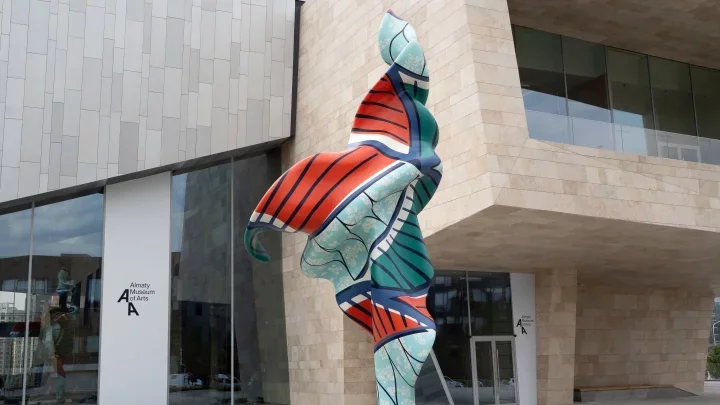 Yinka Shonibare, \"Wind Sculpture (TG) II\". Photo: Alexey Poptsov
A sculpture by British-Nigerian artist Yinka Shonibare has been unveiled in front of the main entrance to the Almaty Museum of Arts. The work was created specifically for the museum, the institution’s press service reported.
Titled Wind Sculpture, it serves as a symbol of freedom and cultural exchange. Its form resembles the sails of a ship, referencing the vessels that carried enslaved people across the Atlantic Ocean for centuries. According to Shonibare, he sought to create a sculpture, capturing the essence of the wind. In his studio, he experimented with fabric and a hair dryer to study the movement of air. The final piece — a light, flowing form made from heavy aluminum — appears as though it has been sculpted by the wind itself.
The surface is decorated with patterns resembling Ankara fabric, also known as batik or Dutch wax. While now strongly associated with Africa, its origins trace back to Indonesia and the Netherlands. In West Africa, Ankara has become a symbol of independence and cultural identity. Shonibare embodies this idea of cross-cultural dialogue in his work.
Yinka Shonibare is one of the most prominent contemporary artists exploring themes of colonialism and identity. His works are held in leading museums worldwide, including the Art Institute of Chicago, the British Museum in London, the Centre Pompidou in Paris, the Hirshhorn Museum in Washington, MoMA in New York, the San Francisco Museum of Modern Art, Tate in London, and Zeitz MOCAA in Cape Town, among others.
The Almaty Museum of Arts — a private contemporary art museum founded by collector, philanthropist, and entrepreneur Nurlan Smagulov — will officially open in September 2025.
Its collection, formed over the past three decades, includes more than 700 works from Kazakhstan and Central Asia, alongside pieces by major international artists.
The museum will focus on contemporary art from Kazakhstan, Central Asia, and neighboring regions. Open to diverse forms, genres, and ideas, it aims to become a major center for contemporary art in the region.
In early July, the museum acquired another notable piece — a 12-meter sculpture by Catalan artist Jaume Plensa. Shaped as a head with braids, the work is based on the likeness of a girl named Nades, who inspired the artist. Made of polyester resin, fiberglass, and stainless steel, Nades now stands as one of the museum’s highlights.
Original Author: Maria Kravtsova
Latest news
- Orda.kz Editorial Team to Cease Operations on September 1
- The Price of a Degree: How Students in Kazakhstan Pay for University
- Second Przewalski’s Horse Foal Born as Species Returns to Kazakhstan
- Kazakh Mining Companies Can Recalculate Purchases if Tenge Weakens
- Kazakhstan Names First Vice President in Three Decades
- What Almaty’s Bus Shelters Are Missing
- 400-Truck Queue Builds at Kazakh–Kyrgyz Border
- Kazakhstan Ready to Help Feed and Rebuild Gaza
- Tokayev Establishes New Presidential Security Body
- Almaty Takes Back Its Nearly Century-Old Hippodrome
- No More Guesswork on Savings: Kazakhstan Tightens Energy Audits for Businesses
- Public Money Could Be Used to Rescue Failing Kazakh Banks
- Third Kazakh Woman Reported Missing in Nepal-China Flood Zone
- Falconer Convicted Over 35 Protected Birds, Spared Punishment Under Amnesty
- Kazakh Citizen Detained in Yakutia in Phone Fraud Case
- Yuan Instead of Dollars? KazMunayGas Draws Record Demand in Asia
- China Gains Oil-Market Influence as OPEC+ Weakens
- Kazakhstan to Divide Smartphones Into White, Gray and Black Lists
- Kazakhstan’s Government Formally Resigns as First Kurultai Session Opens
- Rare Lynx Sighting Recorded in Northern Kazakhstan
