

Auru: A Stark Look at Society’s Deepest Problems

One of the most anticipated local films of the year, Auru, has been released in theaters. Director Aitore Zholdaskali previously gained attention with the series Sheker, and one of the producers, Kuanysh Beisek, formerly a music video director for ‘Irina Kairatovna’, created the popular hit Dästur.
The theme of Auru, fraud carried out under the guise of charity, feels closely connected to real events, especially after the recent scandal involving Perizat Kairat and the Biz Birgemiz foundation.
From the very premiere, Auru has been generating headlines: at the screening, the creators announced that a shortened version would be released in theaters. Aitore Zholdaskali later wrote on his Telegram channel that he had to sacrifice the ending.
However, after comparing the premiere cut with feedback from those who attended regular screenings, I realized the ending is the same in both versions. Most likely, the original final scene was removed earlier, before any public showings — and of course, it would be great to see the director’s cut.
The film’s first days in release were turbulent: instead of the announced “18+” rating, the film was hit with the strictest possible age limit — “21+,” which allows screenings only after 10 p.m.
Daytime and early-evening showtimes kept appearing and disappearing. On Friday, theaters opened ticket sales for all weekend showtimes, and tickets began selling quickly.
But on Saturday, most screenings were canceled, and the schedule was pushed back to late-night slots again.

Auru does indeed have violence and blood — the cult term “ultraviolence” from Stanley Kubrick’s A Clockwork Orange immediately comes to mind.
But not long ago, films like Saw X and Terrifier 3 screened here with simple “18+” ratings — both foreign franchises built entirely on creative brutality and far more hardcore than Auru.
So why such strictness toward local filmmakers?
The box office could have been protected just fine with an “18+” rating for one of the year’s most in-demand Kazakh films.
Turning to the film itself, Auru is imperfect — uneven in places, drawn-out in others — but also fiercely honest and uncompromising. In Britain’s 1950s–60s cinema, a group of directors became known as the “angry young men.”
The creators of Auru and Dästur could just as well be called “the outraged.” These young filmmakers, in their early thirties, look at our reality as if shouting: “How much more of this?” “When will this end?” “Why is this happening to us?” You may agree or disagree with their perspective, but the very fact that these questions are being asked matters.
The film’s protagonists, newlyweds Azamat and Tansholpan (excellent performances by Ayan Otepbergen and Dilnaz Kurmangali), are everymen of modern Kazakhstan. Aza works as a taxi driver, Tancho as a waitress.
They are drowning in debt: their wedding was financed by loans, and they spent the remaining money without considering how they would pay it back.
Why think about it — right now you can buy anything you want: gadgets, clothes, any food. Here, Aitore Zholdaskali and Kuanysh Beisek touch on one of the most painful sores of our society: we all know many stories about people unable to repay loans, their accounts blocked by banks.
And then there is the explosive rise of fraud in recent years: all of us have received countless calls from scammers, and, sadly, we often read stories of our citizens transferring their savings, selling apartments, or taking out loans for criminals. Aza and Tancho go even further — they decide to profit from something sacred, lying to the entire country about Stage IV cancer and opening a fundraising campaign for fake treatment.
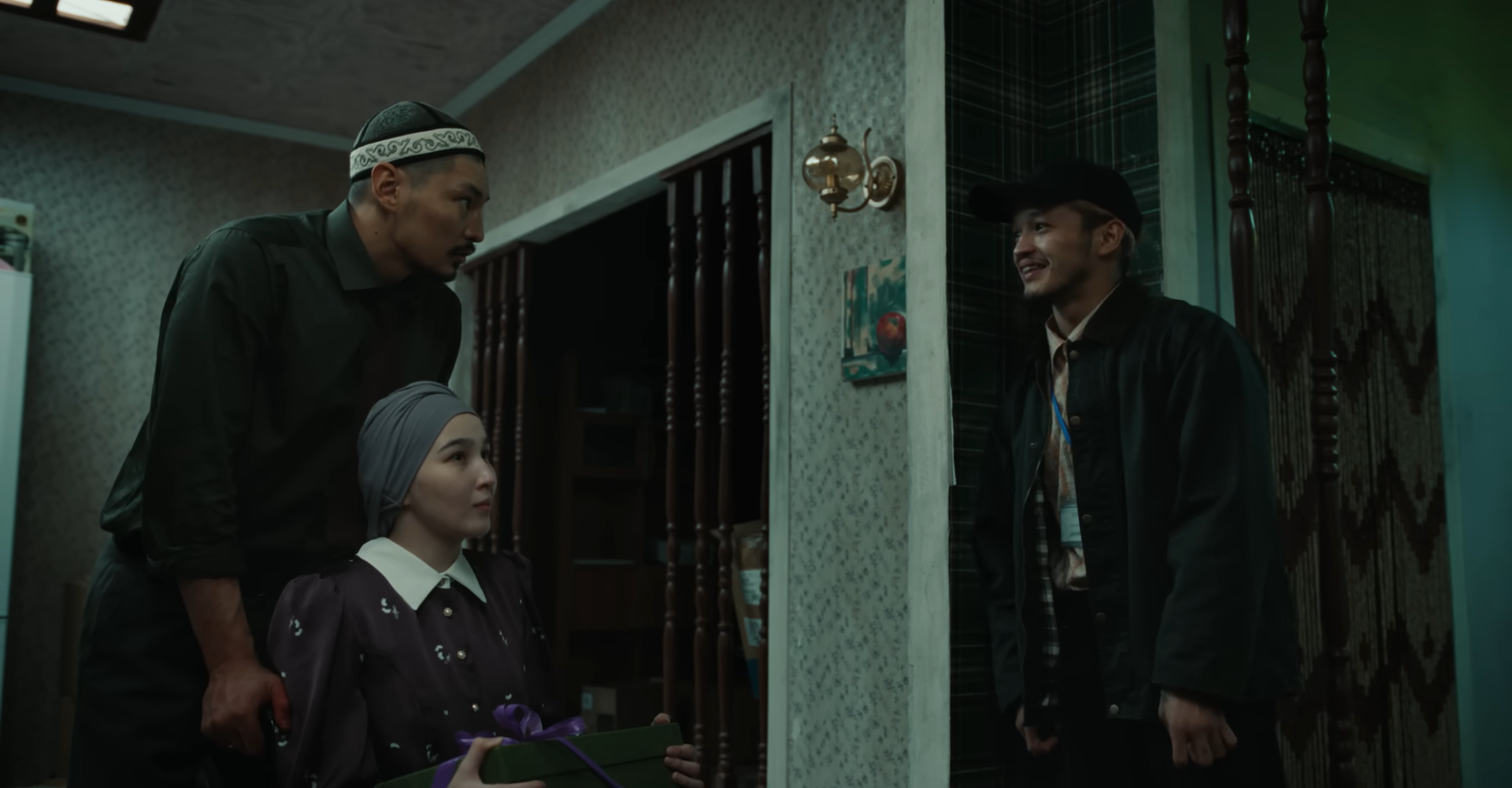
Both of these troubling trends seem to share the same roots — distorted values and alarming financial illiteracy. The ever-present jurt ne aitady (“what will people say?”), the absurd obsession with “appearing rather than being.”
A lack of quality education and critical thinking. And, of course, low incomes and limited social mobility. People want to live well, not someday, but now — and it’s hard to blame them; it’s a natural human desire.
Of course, this doesn’t justify irresponsible people, let alone fraudsters — but it raises questions about our social system as a whole.
What complicates things is that, narratively, Auru seems to fall apart into several separate threads. The social storyline about fraud suddenly gives way to the protagonist’s descent into overwhelming violence (somewhere between Joel Schumacher’s Falling Down and Breaking Bad), while another plotline about the agonizing collapse of a marriage suggests parallels — not direct, but noticeable — with Andrzej Żuławski’s Possession.
These storylines don’t fully merge; it feels as if the filmmakers wanted to say too much at once — and perhaps the material would have been stronger if divided into two or three separate films.

Stylistically, Aitore Zholdaskali relies on his signature techniques — and they remain his strengths. In Auru, you clearly see his cinephile background and love for film. As in Sheker, and partly in the weaker Shulamah, we see many references to genre classics.
The most noticeable references are homages to Fight Club. A scene at the beginning of Auru immediately brings to mind the moment when Edward Norton’s character chooses furniture from an IKEA catalog.
Meanwhile, the characters played by Azat Zhumadil and Aida Kurmangalieva work as waiters at an event before committing a crime, similar to Tyler Durden and his group. This sinister “volunteer” duo also evokes Joker and Harley Quinn — a mix of the funny and the disturbing.
And in the case of Azat Zhumadil’s character, the director even references himself — just like in Sheker, the character is named Aldik.
Auru may resonate with you, or it may shock you and even make you feel sick (as happened to some viewers), but it is unquestionably Kazakhstan’s film of the year.
Original Author: Gulazhar Mashrapova
Latest news
- Orda.kz Editorial Team to Cease Operations on September 1
- The Price of a Degree: How Students in Kazakhstan Pay for University
- Second Przewalski’s Horse Foal Born as Species Returns to Kazakhstan
- Kazakh Mining Companies Can Recalculate Purchases if Tenge Weakens
- Kazakhstan Names First Vice President in Three Decades
- What Almaty’s Bus Shelters Are Missing
- 400-Truck Queue Builds at Kazakh–Kyrgyz Border
- Kazakhstan Ready to Help Feed and Rebuild Gaza
- Tokayev Establishes New Presidential Security Body
- Almaty Takes Back Its Nearly Century-Old Hippodrome
- No More Guesswork on Savings: Kazakhstan Tightens Energy Audits for Businesses
- Public Money Could Be Used to Rescue Failing Kazakh Banks
- Third Kazakh Woman Reported Missing in Nepal-China Flood Zone
- Falconer Convicted Over 35 Protected Birds, Spared Punishment Under Amnesty
- Kazakh Citizen Detained in Yakutia in Phone Fraud Case
- Yuan Instead of Dollars? KazMunayGas Draws Record Demand in Asia
- China Gains Oil-Market Influence as OPEC+ Weakens
- Kazakhstan to Divide Smartphones Into White, Gray and Black Lists
- Kazakhstan’s Government Formally Resigns as First Kurultai Session Opens
- Rare Lynx Sighting Recorded in Northern Kazakhstan
