

From Party Lists to Presidential Succession: What the Kurultai Election Could Change
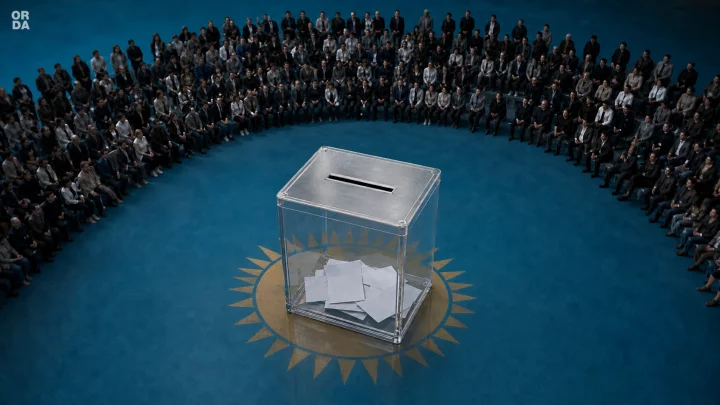 Illustration: Orda.kz
On August 23, Kazakhstan will elect members of its new unicameral Kurultai for the first time. Seven parties have fielded 545 candidates for 145 seats. Orda.kz spoke with political analyst Andrey Chebotarev about what makes this campaign different and the role the new legislature could play in a future transfer of power.
Campaigning is underway and will continue until midnight on August 22. Voting has yet to begin, but the outlines of Kazakhstan’s new political system are already visible.
“More Controlled and Predictable”
Kurultai members will be elected exclusively through party lists. Kazakhstan has used this system before, although the Kurultai members will be elected exclusively through party lists. Kazakhstan has used this system before, although the previous parliamentary election was held under a mixed system. Chebotarev points to two effects of the change.
The electoral system has shifted from mixed to proportional representation. On the one hand, this strengthens the role of political parties. On the other, elections held under such a system are more controlled and therefore more predictable.
Chebotarev links the transition to proportional representation to a broader restructuring of the political system. In his view, this is not another political “reset” like those of 2019 or 2022, but preparation for the country’s next political cycle.
An entirely new structure of the political system and relations within the political elite is now being built. In my view, these changes are intended, among other things, to make the system as stable as possible and prepare it for a future presidential transition. Stability should be provided by new institutions rather than by one individual. The coming election is therefore not simply another campaign, but a strategically important process.
Chebotarev also points to the international environment. In his assessment, the need to honor international commitments and preserve investment has increased demand among Kazakhstan’s major foreign partners for a stronger chain of command and continuity in government policy.
This restructuring is already visible in the new balance among the country’s political parties.
Adilet Takes Center Stage
Chebotarev sees the merger of Adilet and Amanat as more than a change of party branding. In his view, it has created a new center of political influence around which the future Kurultai will be organized.
One of the most important features of this election is the effective emergence of a new ruling party in the form of Adilet. This is further evidence that the country’s entire political power structure is changing.
If his forecast proves correct, the main question will be how firmly Adilet controls the new legislature and who takes its senior positions.
Adilet will hold the dominant position in the Kurultai. Its chairman, Aibek Dadebay, may become speaker, while representatives of other parties could take the deputy speaker positions,Chebotarev said.
The future of local council members elected under the Amanat banner also remains unclear. Chebotarev says they could be transferred to Adilet without new elections. Another possibility would be to dissolve the maslikhats and hold fresh elections next year. He also expects a government reshuffle and does not rule out changes among regional and local governors.
But the campaign is not only about who receives which position. After the election, parties will have to address voters’ everyday concerns.
Bold Slogans Are No Longer Enough
Chebotarev says voters are looking not for striking campaign messages but for concrete and achievable proposals on the country’s most pressing problems.
Parties will need to demonstrate more than bold slogans and campaign skills. Far more important are a strategic vision for Kazakhstan’s future and realistic proposals for raising incomes, providing housing and jobs, reducing prices, and improving health care and education.
According to the analyst, voters will assess the candidates’ professionalism, determination and ability to deliver on their programs. The quality of the Kurultai’s work will depend on which parties and candidates secure seats.
A great deal will depend on the party composition of the new legislature: whether all parties enter the Kurultai or only a limited number. The professional standards and experience of the candidates who ultimately win seats will be no less important.
Chebotarev added that the composition of the legislature will affect both the quality of new laws and the substance of parliamentary inquiries submitted to the government and other state bodies.
He sees the political significance of the August vote extending well beyond the current campaign — to 2029.
Who Could Become Kazakhstan’s Third President?
One of the first senior appointments involving the new Kurultai will be the selection of a vice president. Under the new Constitution, if the president leaves office early, presidential powers will pass to the vice president. Chebotarev links the creation of the post to preparations for a future transfer of power.
Even more important are the major changes that will follow once the Kurultai begins its work. First among them is the appointment of the vice president. I believe this person will become a potential successor to Kassym-Jomart Tokayev as head of state. In other words, we may be looking at Kazakhstan’s potential third president.
Under this system, the Kurultai will become one of the central institutions in the future transition. It will approve the president’s nominee for vice president and call the next presidential election.
The Kurultai will play a key role in these processes — from consenting to the president’s appointment of a vice president to calling the next presidential election. The system should rely less on a particular individual and more on new state institutions. The next presidential election will take place in 2029, and I believe everything will have been prepared and put in place by then,Chebotarev said.
Until the next presidential cycle, Chebotarev believes the Kurultai’s main task will be to provide the legislation needed to implement the goals set out in Tokayev’s 2022 election platform. The balance of power in the new legislature should allow the current political course to continue without delays through the end of the presidential term.
The August election will therefore determine not only the composition of the Kurultai, but also the political conditions in which Kazakhstan approaches 2029.
Read also:
Latest news
- Orda.kz Editorial Team to Cease Operations on September 1
- The Price of a Degree: How Students in Kazakhstan Pay for University
- Second Przewalski’s Horse Foal Born as Species Returns to Kazakhstan
- Kazakh Mining Companies Can Recalculate Purchases if Tenge Weakens
- Kazakhstan Names First Vice President in Three Decades
- What Almaty’s Bus Shelters Are Missing
- 400-Truck Queue Builds at Kazakh–Kyrgyz Border
- Kazakhstan Ready to Help Feed and Rebuild Gaza
- Tokayev Establishes New Presidential Security Body
- Almaty Takes Back Its Nearly Century-Old Hippodrome
- No More Guesswork on Savings: Kazakhstan Tightens Energy Audits for Businesses
- Public Money Could Be Used to Rescue Failing Kazakh Banks
- Third Kazakh Woman Reported Missing in Nepal-China Flood Zone
- Falconer Convicted Over 35 Protected Birds, Spared Punishment Under Amnesty
- Kazakh Citizen Detained in Yakutia in Phone Fraud Case
- Yuan Instead of Dollars? KazMunayGas Draws Record Demand in Asia
- China Gains Oil-Market Influence as OPEC+ Weakens
- Kazakhstan to Divide Smartphones Into White, Gray and Black Lists
- Kazakhstan’s Government Formally Resigns as First Kurultai Session Opens
- Rare Lynx Sighting Recorded in Northern Kazakhstan
