

Protesters Arrested in Tbilisi After Blocking Rustaveli Avenue
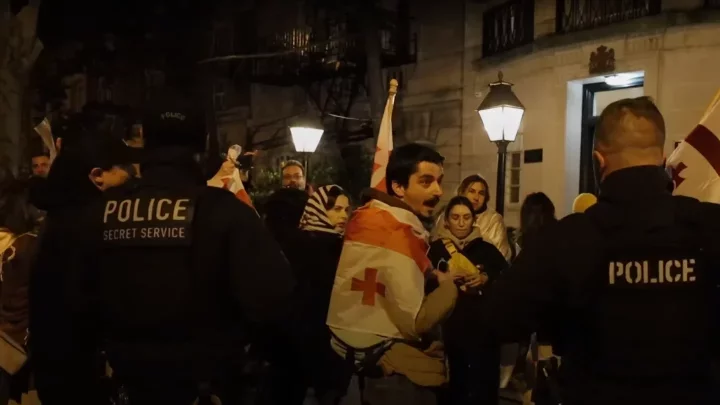 “Photo by Voice of America – Protesters in Tbilisi on March 7, 2023, during demonstrations against the proposed ‘foreign agents’ law. Public domain (Voice of America, U.S. federal government work).”
Participants in Georgia’s ongoing protests once again blocked traffic on Rustaveli Avenue in Tbilisi despite police warnings, Orda.kz reports, citing The Caucasian Knot.
The Interior Ministry stated that at least 14 people were detained for “artificially restricting traffic” and covering their faces. Among them was journalist Vakho Sanaya of the Formula TV channel, who received six days of administrative arrest. Artist Levan Margiani was sentenced to the same term, while activist Tornike Tkhilava was released with a verbal warning.
Artificial blocking of the road did not take place — it was an expression of protest against the regime. This is the most natural thing happening on Rustaveli today,
Sanaya said in court.
Judge Manuchar Tsatsua also sentenced Nino Svanidze to five days of arrest and Saba Khomeriki to eight days, while Gela Gamkrelidze was released with a verbal warning.
During his hearing, Gamkrelidze said he did not intend to violate the law and that the road had already been blocked by police vehicles. Another detainee, Vakhtang Machavariani, was released pending a medical certificate.
In a separate ruling, Judge Zviad Tsekvava sentenced Giorgi Kiasashvili to six days of administrative arrest for wearing a face covering during the rally, while Lasha Nachkebia received four days.
Administrative proceedings are ongoing against 13 other individuals.
Officials' Response
The Interior Ministry issued a statement following the protest:
The protesters violated Article 11 of Georgia’s Law on Assemblies and Demonstrations, which prohibits artificially blocking the roadway unless justified by the number of participants. Despite repeated warnings, participants did not comply with police instructions and continued their illegal actions. Some protesters also concealed their faces, which is a violation of the law. The Interior Ministry stated.
The ministry warned that repeated offenses could lead to criminal liability.
Background
Since November 28, 2024, protesters in Georgia have been gathering daily, demanding new parliamentary elections and the release of political prisoners. Police have repeatedly dispersed rallies using tear gas and water cannons; more than 1,000 people have faced administrative prosecution since the protests began.
On October 4, during municipal elections, thousands gathered in central Tbilisi. After opera singer Paata Burchuladze declared that “power in Georgia belongs to the people,” clashes broke out near the presidential palace.
Security forces used special equipment, while protesters threw firecrackers.
Six demonstrators and 21 officers were hospitalized, and around 30 others received medical aid on site. Police opened a criminal case over “calls to overthrow the government,” “attacks on officers,” and the “attempted storming of the palace.”
Surveillance and Street Detentions
During the October 18 protest, a Ministry of Internal Affairs drone hovered above Rustaveli Avenue, reportedly filming participants for identification purposes.
Police were also stopping individuals to verify identities.
At the Rustaveli metro station, plainclothes officers detained “Grandmother Aza,” a well-known protest participant displaced from Abkhazia, confiscating her medical mask, according to photographer Giorgi Mosiashvili (Mo Se).
Legal Context
Following the attempted storming of the presidential palace, the Georgian parliament swiftly adopted amendments toughening penalties for violations during public demonstrations.
Blocking roads or wearing masks at protests now carries up to 15 days of administrative arrest, or 20 days for organizers. Disobeying a police order to disperse may result in up to 60 days, while repeated offenses can lead to one year in prison, and subsequent ones — up to two years.
Latest news
- Orda.kz Editorial Team to Cease Operations on September 1
- The Price of a Degree: How Students in Kazakhstan Pay for University
- Second Przewalski’s Horse Foal Born as Species Returns to Kazakhstan
- Kazakh Mining Companies Can Recalculate Purchases if Tenge Weakens
- Kazakhstan Names First Vice President in Three Decades
- What Almaty’s Bus Shelters Are Missing
- 400-Truck Queue Builds at Kazakh–Kyrgyz Border
- Kazakhstan Ready to Help Feed and Rebuild Gaza
- Tokayev Establishes New Presidential Security Body
- Almaty Takes Back Its Nearly Century-Old Hippodrome
- No More Guesswork on Savings: Kazakhstan Tightens Energy Audits for Businesses
- Public Money Could Be Used to Rescue Failing Kazakh Banks
- Third Kazakh Woman Reported Missing in Nepal-China Flood Zone
- Falconer Convicted Over 35 Protected Birds, Spared Punishment Under Amnesty
- Kazakh Citizen Detained in Yakutia in Phone Fraud Case
- Yuan Instead of Dollars? KazMunayGas Draws Record Demand in Asia
- China Gains Oil-Market Influence as OPEC+ Weakens
- Kazakhstan to Divide Smartphones Into White, Gray and Black Lists
- Kazakhstan’s Government Formally Resigns as First Kurultai Session Opens
- Rare Lynx Sighting Recorded in Northern Kazakhstan
