

Political Scientist Abishev Discusses Russian Pressure, the NPP, and Toqayev’s Style of Dismissals
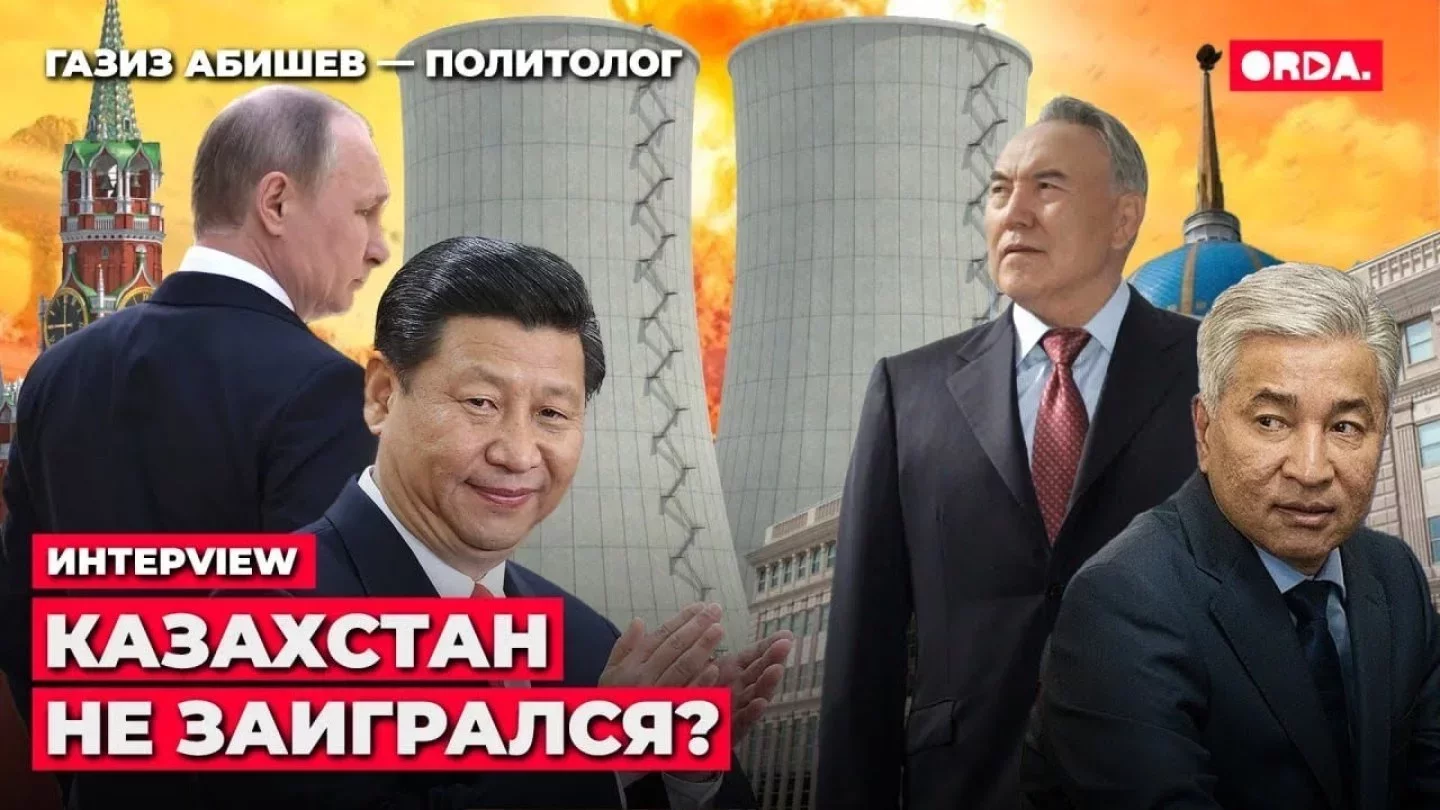 Photo: Orda.kz
Political scientist Gaziz Abishev spoke with Orda.kz editor-in-chief Gulnara Bazhkenova about why Russia’s influence over the choice of a nuclear power plant (NPP) contractor in Kazakhstan was predictable, why a “Kremlin candidate” could be risky in future elections, why public service has become unattractive for professionals, and what’s behind President Toqayev’s surprise ministerial dismissals.
This is a text version of their interview.
Russian Pressure on Kazakhstan Over the NPP?
Gaziz Abishev explained that Russia’s involvement in the selection of a contractor to build a nuclear power plant in Kazakhstan was foreseeable and in line with broader trends.
There are three sites in Kazakhstan, and three nuclear power plants will be built there. This was already clear a year ago… According to Kazakhstan’s traditional multi-vector political logic, you can’t give all the projects to the same contractor, so in principle, this was expected.
Abishev added that the technical rationale behind choosing Russian contractors is backed by both logical analysis and the independent views of international organizations. He pointed to the International Energy Agency (IEA), which recently confirmed Russia and China as global leaders in nuclear energy technology.
This isn’t an organization affiliated with Moscow or Beijing — it's headquartered in Paris, under Western influence. In one of their reports, they stated that the leading countries in nuclear power plant construction are Russia and China. Over the last eight years, 52 projects were launched globally — 25 by China, and 23 by Russia. So, even from a purely technical perspective, a rational, internationally monitored body has confirmed that Russia and China are the leaders in the development of nuclear technology.
He also noted that if Russia’s technology is rejected, Moscow could interpret it as a political snub.
Rosatom and the Russian government are very conservative hawks within Russia’s deep technological state, and they firmly believe they have the best technology. When two countries are allies, and Russia offers what it considers its best project — one developed over decades of cooperation with the Kazakh government — only to have it rejected, they interpret it as a politicized decision, a political demarche against a close ally in whom they've invested time, money, and political capital. To some extent, they see it as a hostile act.
Regarding speculation that former President Nursultan Nazarbayev’s recent visit to Russia might be tied to pressure over the NPP decision, Abishev said the evidence is inconclusive:
For me, there isn’t enough direct evidence yet to say that Nazarbayev’s visit was specifically tied to pressure from Russia regarding the nuclear power plant. There are many possible topics that could have been discussed: personal or family assets in Russia, their status, broader international issues, Kazakhstan’s stance on the war in Ukraine, or even political developments around the future transfer of power. The range of possibilities is quite broad. Of course, there’s also likely an element of political support for a close friend he’s known for over 25 years. So whether the visit was entirely focused on the nuclear plant issue — I can't say.
The “Kremlin Candidate” Scenario in Kazakhstan
Abishev believes that overt Russian interference in Kazakhstan’s future leadership transition is unlikely, even in the case of a candidate like Imangali Tasmagambetov.
He explained that Kazakhstan’s political system is structured around centralized coordination: election commissions, law enforcement, the media, and financial institutions all act in sync and are highly attuned to signals from the center. This coordination limits the impact of external pressure, especially while Russia is preoccupied with its confrontation with the West.
Moreover, Abishev believes that excessive support from Russia could backfire.
If the Russians support a candidate so actively with financial and organizational backing that rivals our own government’s efforts to protect political sovereignty, it will come off as so blatant and heavy-handed that Tasmagambetov himself will lose credibility in the eyes of the Kazakh electorate. It would be all too easy to say: 'Guys, this is a Russian candidate.'
According to Abishev, Kazakh society is now far less influenced by Russian media than it was a decade ago. The country’s independent information system has matured, and the electorate is more discerning. As a result, any scenario involving a “Kremlin-backed” candidate would likely hurt that candidate’s chances rather than help them.
According to Gaziz Abishev, Kazakhstani society is now far less dependent on Russian media and influence than it was a decade ago. The country’s sovereign information space has grown stronger, and voters have become more critical. As a result, the idea of a “Kremlin candidate” succeeding in Kazakhstan is increasingly unrealistic —at least not without political damage to the candidate himself.
Abishev also cautioned against focusing on individual figures too early, noting that it could backfire on potential candidates for high office:
I’ve received feedback from different people, reportedly close to various candidates on that list. All of them said the same thing: ‘You’re absolutely right — there’s no need to stir the pot prematurely. It can negatively affect various aspects, and no one wants their names dragged into the conversation unnecessarily. It looks like a hostile attack on them.
Toqayev’s Style and Why Fewer Want to Join the Civil Service
Political scientist Gaziz Abishev believes that Kazakhstan is currently experiencing a shortage of skilled professionals and that civil service is no longer an attractive path for qualified talent.
I agree with two points: that there’s been a broad deprofessionalization across sectors, and that public service simply doesn’t appeal to qualified people the way it used to. And not everyone is suited to the current political environment. I think the combination of these factors explains the current situation.
Many experts, he said, simply don’t want to enter government work. And those who do often struggle to meet the demands of the moment.
When commenting on President Toqayev’s ministerial dismissals, Abishev described the approach as pragmatic and low-profile, more businesslike than political.
It seems to me the president avoids theatrics. It’s just not his style to stage political drama in public. At some point, he simply holds a meeting, weighs the arguments, goes through the documents, and says: ‘Well, I see, they failed here—I won’t waste time on this, I’ll just fire them. Everyone will understand anyway. Go ahead and do it.’ This one needs to be fired, and that’s it. Then he steps back from the issue.
Because of this hands-off approach, Abishev noted, dismissals are often carried out with minimal explanation or transition. The bureaucratic system simply executes the order.
As for who might replace the recently dismissed Minister of Transport, Abishev said:
“Zhenis Kasymbek is doing good work in Astana, which is likely why he hasn’t been pulled away for this role yet. But he’d make a strong candidate.”
Original Author: Artyom Volkov
Latest news
- Kazakhstan Explains How Russians Who Fled Mobilization Can Be Deported
- Kazakhstan and Japan discuss hydrogen partnership with export potential
- Russia Thanks Tokayev for Initiative to Support Russian Language
- Almaty Could Restrict Cars Under Beijing-Style Anti-Smog Plan
- Tigers in Kazakhstan Are in No Rush to Breed
- What Changes Are Being Prepared Under the New Tax Code
- Alcohol and Tobacco Prices in Kazakhstan See Sharpest Monthly Rise in 15 Years — Analysts
- Middle East Conflict Will Not Lead to Higher Gasoline Prices in Kazakhstan — Minister
- Five Regions of Kazakhstan Face Higher Flood Risk This Spring
- Kazakhstan Ratifies Turkic States Civil Protection Deal
- Astana Enters Top 100 Safest Cities as Smart City Project Expands
- Almaty Cameras to Record New Driver Violations Starting March 12
- Kazakhstan Suspended 11 Polling Stations Abroad Due to Middle East Escalation
- Kazakhstan’s Foreign Ministry Comments on Disappearance of Citizen After South Korea Factory Fire
- ChatGPT Among AI Tools Recommended for School Lessons in Kazakhstan
- Missing Kazakh Woman Found in Vietnam Four Days Later
- Seven-Year-Old Kazakh Girl Returned From Georgia Following Six Months of Diplomatic Efforts
- Kazakhstan Plans to Rent 11 Helicopters for 22 Billion Tenge Ahead of the Fire Season
- Flights Delayed and Canceled at Astana Airport Due to Bad Weather
- More Than 8,500 Kazakhstanis Evacuated From the Middle East
