

Let’s Install a Thousand Towers! How Environmentalists Propose to Clean Almaty’s Air
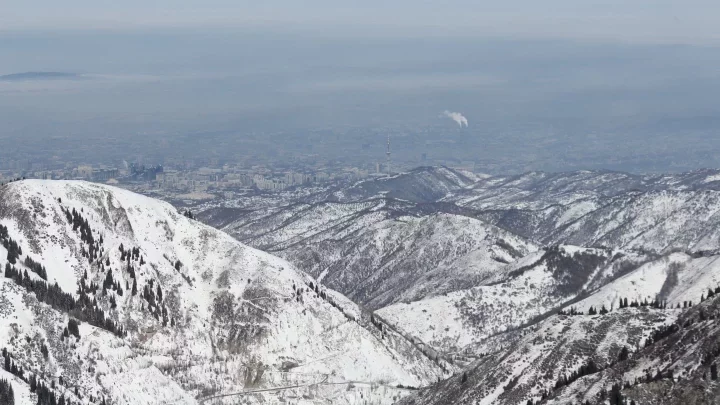 Photo: Orda.kz / Igor Ulitin
Almaty’s smog has been the subject of sad jokes for many years. But by the end of 2025, it no longer felt like something to laugh about. Almaty has repeatedly reached the top of the rankings of cities with the world’s dirtiest air.
Although new environmental regulations for the metropolis are currently being discussed, the Baytaq party has already presented its own proposal for cleaning Almaty’s air. Orda.kz explains what the environmentalists are suggesting.
The environmentalists presented their ideas for how to clean, or at least attempt to clean, the air in the southern capital at a reporting conference. This was the same event where they announced the nomination of Olzhas Suleimenov for the Nobel Peace Prize.
The party members offered several proposals for air purification, including some that were not particularly new. For example, converting CHP plants to gas (already in progress), switching to electric transport, and restricting access for old cars. But there was also something new: the idea of using air-cleaning towers. More precisely, using them on a large scale.
Air-cleaning towers, or smog towers, are not a new invention either. For example, in 2018, nearly all major global media covered the 100-meter smog tower in Xi’an, China. Another well-known structure is the 20-meter tower launched in 2020 in Delhi, India, though it was shut down a year later — the idea did not fully justify itself.
These towers exist in other countries as well, though often as more of an art installation.

But in Almaty, the environmentalists propose installing not one, not two, but between 1,000 and 1,500 smog towers. For a start, however, they suggest installing at least 10–20.
These would not be giants like the one in Xi’an, but much smaller structures. According to one of those proposing the idea, Vladimir Lykov from the Torus Design Bureau, they could visually resemble small architectural forms.
Unlike Xi’an and Delhi, where the towers essentially worked like giant vacuum cleaners, the principle in Almaty would be different. They propose using an electrostatic method that employs two electrodes, one positively charged and one negatively charged.
A similar approach has already been used, at least in Beijing, where such towers have also been installed.

The charge of the electrodes is enough to capture and trap PM 2.5, PM 10, and PM 1 particles. One air-cleaning tower can operate over an area of up to 300 square meters. The tower does not require an external power supply; it runs on solar panels, Lykov explained.
The particles he mentioned are fine suspended elements roughly between one micron and 2.5 micrometers in size.
Sensors will determine how effective each tower is, transmitting information in real time.
We are not proposing to cover the entire city with towers. We are saying they need to be installed in the most hazardous areas — where the concentration of pollutants is the highest, Lykov says.
The newly appointed head of Baytaq’s Almaty branch, Alma Karash, suggested using state-owned land for installation sites — hospitals, schools, and similar places — in order to avoid overpaying for rent.
And as for money: according to the environmentalists, each tower would cost around 100,000 dollars (about 52 million tenge at the current exchange rate). If 1,500 towers were installed, that would total 150 million dollars (more than 75 billion tenge).
But the party says they have already found an investor. According to Vladimir Lykov, the towers are a profitable project. He proposes using them to host advertising screens, navigation equipment, or interactive platforms.
However, the party did not reveal who the investor is at the conference, nor how soon this project could be implemented.
The environmentalists also called for restoring Almaty’s full irrigation ditch system and using it to water trees, which would also help clean the air. Their proposal echoes the idea of Kyrgyz researcher Antonina Spirova, who advocates reviving and expanding ditch networks across Central Asia, including for greening purposes.
Original Author: Igor Ulitin
Latest news
- Orda.kz Editorial Team to Cease Operations on September 1
- The Price of a Degree: How Students in Kazakhstan Pay for University
- Second Przewalski’s Horse Foal Born as Species Returns to Kazakhstan
- Kazakh Mining Companies Can Recalculate Purchases if Tenge Weakens
- Kazakhstan Names First Vice President in Three Decades
- What Almaty’s Bus Shelters Are Missing
- 400-Truck Queue Builds at Kazakh–Kyrgyz Border
- Kazakhstan Ready to Help Feed and Rebuild Gaza
- Tokayev Establishes New Presidential Security Body
- Almaty Takes Back Its Nearly Century-Old Hippodrome
- No More Guesswork on Savings: Kazakhstan Tightens Energy Audits for Businesses
- Public Money Could Be Used to Rescue Failing Kazakh Banks
- Third Kazakh Woman Reported Missing in Nepal-China Flood Zone
- Falconer Convicted Over 35 Protected Birds, Spared Punishment Under Amnesty
- Kazakh Citizen Detained in Yakutia in Phone Fraud Case
- Yuan Instead of Dollars? KazMunayGas Draws Record Demand in Asia
- China Gains Oil-Market Influence as OPEC+ Weakens
- Kazakhstan to Divide Smartphones Into White, Gray and Black Lists
- Kazakhstan’s Government Formally Resigns as First Kurultai Session Opens
- Rare Lynx Sighting Recorded in Northern Kazakhstan
