

Women's Position in Kazakh Society.
 Nazarbayev University in Astana
At Home, At work
Kazakhstan prides itself on being a country advocating equal rights, though women’s position in Kazakh society tends to take on a more conservative role. Their daily tasks revolve more around responsibilities regarding caregiving and house duties. Statistics seem to confirm this notion, as women contribute to household obligations more than men.
Contrary to logic based on such gender norms, 48.5% of the economically active population in Kazakhstan are women according to statistics released in March 2022. Every second working woman has a higher education. They also make up the majority of leadership positions with the exception of such positions in universities. Interestingly enough, there were two women candidates in the 2022 presidential election.
Women, however, make 21.7% less than men. Unemployment amongst women is also comparatively higher. In the fourth quarter of last year, the overall unemployment figure stood at 4.9%. The indicator reached 4.1% for men and 5.1% for women. There are programs that are aimed at improving women’s position in society, but Kazakhstan is 80th out of 156 in the global gender equality ranking. This is 8 positions worse than in 2021.
Behind Closed Doors
Vlast has reported that police did not look into the majority of the 100,000 reports on domestic violence this year. The total number may not even reflect the reality of the situation, as most victims are not inclined to even turn to the police due to societal pressure.
Societal pressure manifests itself in the Kazakh phrase “Uyat bolady (уят болады), which roughly translates as “It will be an embarrassment”. The phrase’s hidden meaning, however, is much more telling. The phrase essentially implies that it is better to not talk about domestic violence, as one could face "judgement". Many victims of violence, therefore, opt out of talking about crimes to avoid “embarrassing themselves or their family”.
Distrust in the police and judicial system is another factor. Regarding the police force, there have been situations where those involved tried to convince the victim “to make peace” with the abuser. By doing so, a woman can lose her status as a victim and ability to remain in a crisis centre. There have also been cases when the victim is blamed for the situation entirely.
The lack of women in the police force likely makes such situations even more complicated. According to official data, women make up only 15.4% of the police workforce in 2022. This is a 6 per cent increase compared to 2005 - 9.4%. This in tandem with only 57 crisis centres in the country makes for a gloomy predicament.
The Reality
The 2009 law on “Preventing Domestic Violence” has proven its own ineffectiveness, as the law “reacts” to domestic violence more than it prevents it according to one expert's opinion, Khalida Azhigulova, given to Vlast. Domestic violence had later been decriminalized in 2017.
Vlast also reports that the matter of re-qualifying it back into a criminal offence has been brought up before, though it met resistance from a conservative party in 2020. Law Enforcement have also expressed doubt about the “need” to criminalize it due to the potential of it lessening Law Enforcement’s ability to “detect” such offences.
Terms for those accused of domestic abuse are supposed to increase from 5 to 25 days according to Vlast. Vlast also reports that the warning for such an offence is also to be turned into community service along with court reconciliation being made easier for victims of domestic abuse.
97.3% of domestic abuse cases fall under administrative liability. According to Kazakhstan’s current Administrative Code, if an aggressor beats or causes “minor” harm to a victim’s health they can receive administrative arrests for 15 or 20 days. The administrative code has a requirement that states that victims must be in the hospital for no less than 21 days in order for harm to their health to be considered "moderately severe". However, a court will issue a written warning "not to do this anymore” for first-time offenders and instances where the harm to the victim is "light". If the violence is repeated within a year, the offender faces arrest.
Criminal punishment for domestic violence, on the other hand, can be pursued in accordance with the Criminal Code under article 110 “Torture”. The Article stipulates that the punishment is either a fine or 2 years in prison. Offences based on article 110 are also private-public ones. In layman’s terms, this means the police collect evidence proving the aggressor’s guilt for submission to court, not the victim.
Reproductive Rights
Contraception and abortion are available in Kazakhstan. According to article 79 in the Code of the Republic of Kazakhstan "On the health of the people and the healthcare system,” citizens of the Republic of Kazakhstan have the right to free reproductive choice, to receive reproductive health and family planning services, to prevent unwanted pregnancy, etc.
According to Vlast, the Order of the Minister of Health of the Republic of Kazakhstan dated 09.10.2020 "On approval of the Rules for artificial termination of pregnancy and the list of medical and social indications, as well as contraindications for artificial termination of pregnancy” states that a woman can terminate a 12 (or less) week pregnancy at will, a 22 (or less) week pregnancy for social reasons, and at any time for medical reasons.
However, societal pressure also plays a role here. The concept of family and gender policy until 2030, for instance, puts emphasis on the ability to reproduce. By 2030 there are goals for a reduction in artificial pregnancy terminations as well. Doctors are also required to conduct conversations aimed at explaining the moral, ethical, and psychological consequences and possible complications that abortions cause. It goes without saying that the above-mentioned gender roles are an additional factor in the decision on whether or not to go through with an abortion.
Anything But Quiet
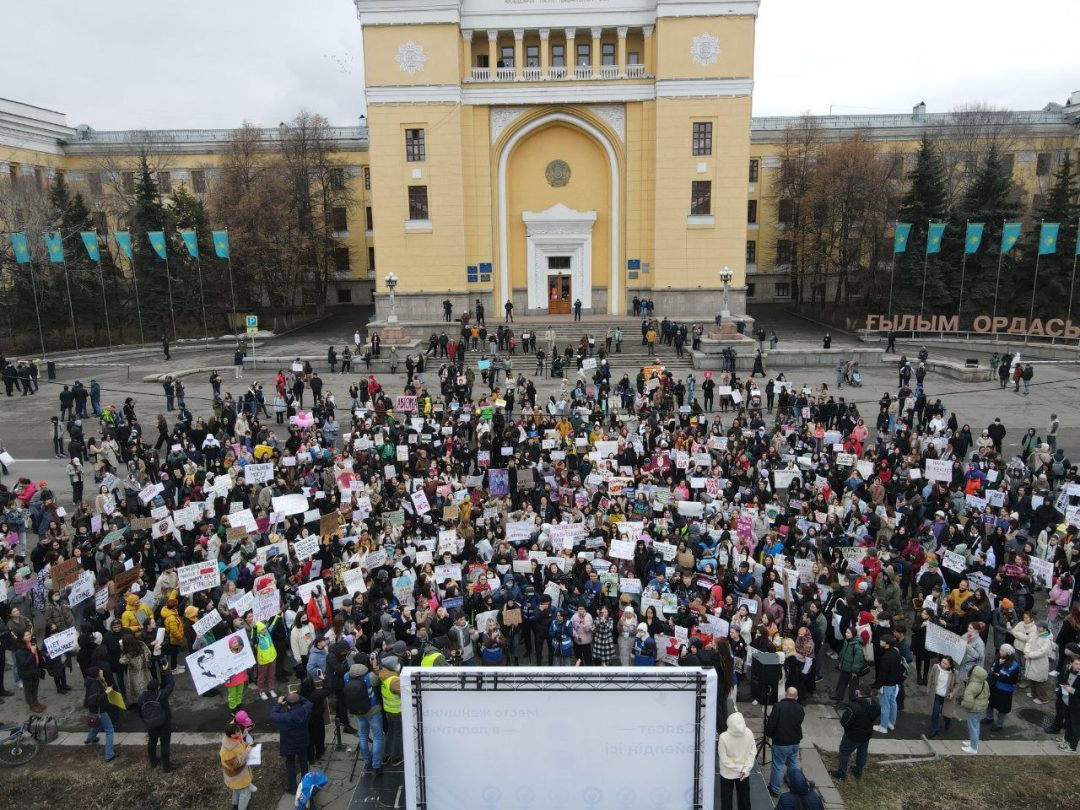
There have been efforts to bring attention to the problems that women face. On one occasion, the international Independent Women's Artists Foundation “Tan-Sholpan” held an exhibition at a museum in Almaty. The pieces that they presented intend for viewers to contemplate women’s position in modern society. Rallies in support of women’s rights have also become more noticeable in Kazakhstan despite prior obstacles.
Concerned people are voicing their opinions and society is likely taking note. Criminal liability for abusers is one step in the right direction for ensuring women's feeling of security in society, but it is only a legal one.
Latest news
- Orda.kz Editorial Team to Cease Operations on September 1
- The Price of a Degree: How Students in Kazakhstan Pay for University
- Second Przewalski’s Horse Foal Born as Species Returns to Kazakhstan
- Kazakh Mining Companies Can Recalculate Purchases if Tenge Weakens
- Kazakhstan Names First Vice President in Three Decades
- What Almaty’s Bus Shelters Are Missing
- 400-Truck Queue Builds at Kazakh–Kyrgyz Border
- Kazakhstan Ready to Help Feed and Rebuild Gaza
- Tokayev Establishes New Presidential Security Body
- Almaty Takes Back Its Nearly Century-Old Hippodrome
- No More Guesswork on Savings: Kazakhstan Tightens Energy Audits for Businesses
- Public Money Could Be Used to Rescue Failing Kazakh Banks
- Third Kazakh Woman Reported Missing in Nepal-China Flood Zone
- Falconer Convicted Over 35 Protected Birds, Spared Punishment Under Amnesty
- Kazakh Citizen Detained in Yakutia in Phone Fraud Case
- Yuan Instead of Dollars? KazMunayGas Draws Record Demand in Asia
- China Gains Oil-Market Influence as OPEC+ Weakens
- Kazakhstan to Divide Smartphones Into White, Gray and Black Lists
- Kazakhstan’s Government Formally Resigns as First Kurultai Session Opens
- Rare Lynx Sighting Recorded in Northern Kazakhstan
