

Why Did Kazakhstan’s President Not Attend the Azerbaijan Summit?
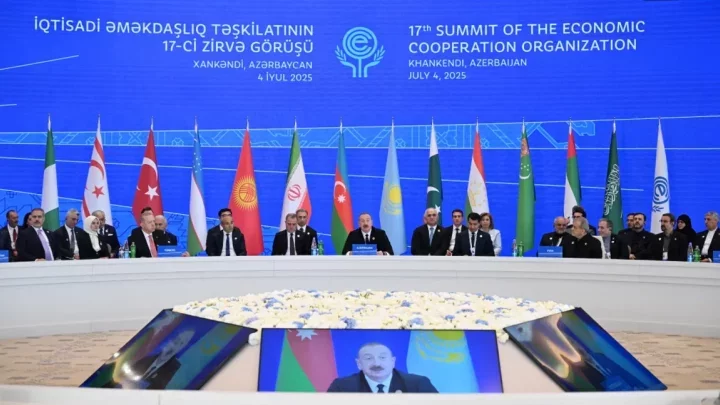 Photo: oxu.az
On July 5, the 17th Summit of the Economic Cooperation Organization (ECO) was held in Khankendi, Nagorno-Karabakh, Azerbaijan. The event brought together leaders from Azerbaijan, Türkiye, Iran, Uzbekistan, Kyrgyzstan, Tajikistan, as well as the Prime Minister of Pakistan, Afghanistan’s Deputy Prime Minister, and Turkmenistan’s Deputy Chairman of the Cabinet of Ministers.
Representatives from major international bodies such as the Organization of Turkic States (OTS), the Conference on Interaction and Confidence-Building Measures in Asia (CICA), TRACECA, the UN, and UNESCAP were also in attendance.
However, one notable absence stood out: President Qasym-Jomart Toqayev of Kazakhstan.
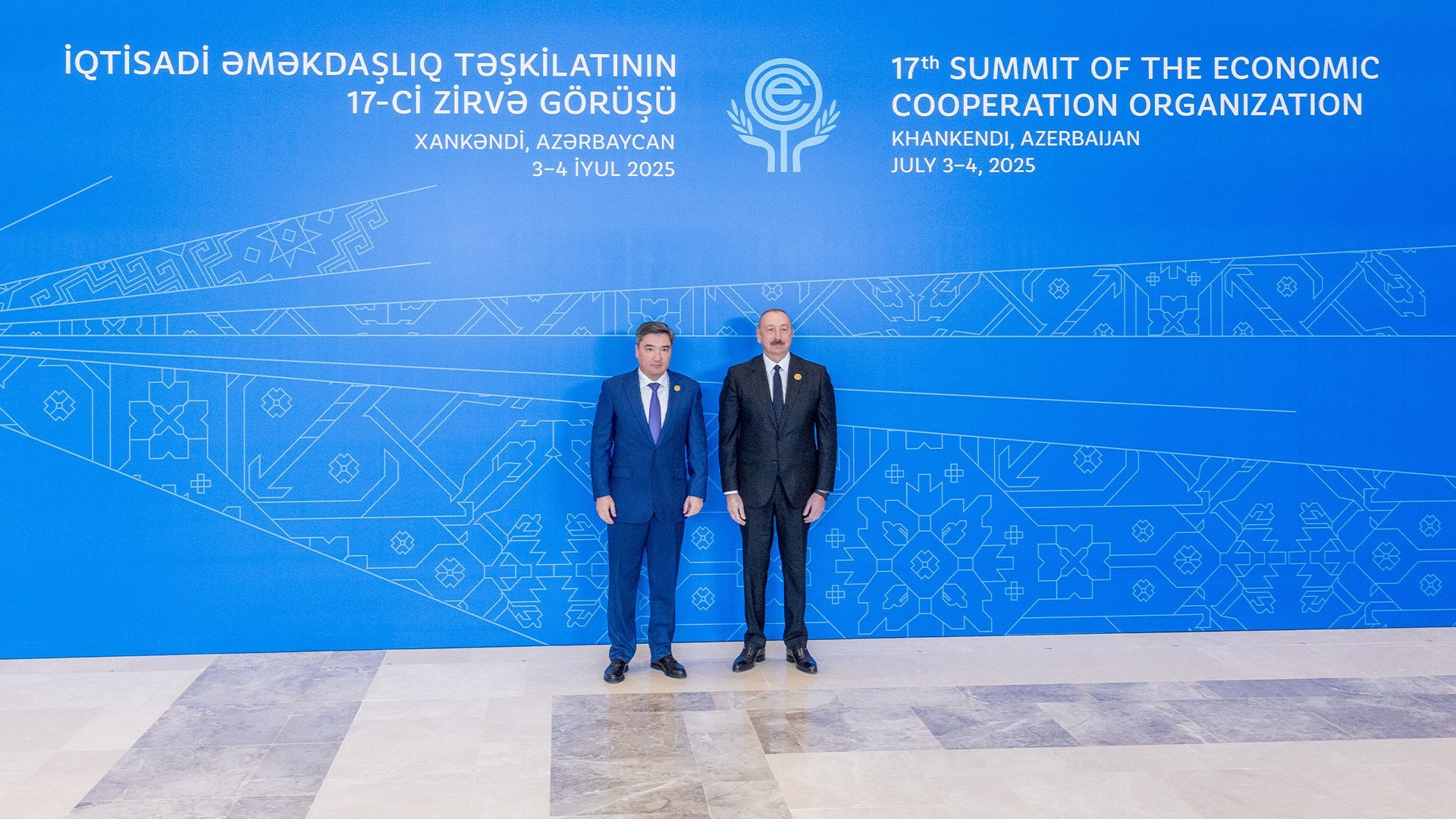
While other Central Asian leaders like Shavkat Mirziyoyev, Emomali Rahmon, and Sadyr Japarov attended in person, Kazakhstan was represented by Prime Minister Olzhas Bektenov. The decision sparked debate online, particularly amid growing tensions between Azerbaijan and Russia.
Orda.kz explores the possible implications.
A Strategic Absence?
Relations between Baku and Moscow have been deteriorating following Azerbaijan’s full reintegration of Nagorno-Karabakh, a region long contested with Armenia. Tensions escalated further after the December 2024 crash of an Azerbaijan Airlines plane near Aqtau, for which Baku blamed Russia.
Despite Moscow’s apology, no responsibility was formally accepted.
Matters worsened in June 2025, when Azerbaijanis, some purportedly holding Russian citizenship, were detained in Yekaterinburg on criminal charges.
Two died in custody, prompting allegations of torture. Azerbaijan responded strongly, summoning Russia’s chargé d'affaires, canceling Russian cultural events, and arresting employees of the pro-Kremlin Sputnik Azerbaijan.
In this context, some interpret Toqayev’s absence as a subtle gesture of goodwill toward the Kremlin. By not attending personally, the Kazakh president avoids appearing to endorse Azerbaijan’s increasingly assertive regional posture, particularly as it aligns itself more closely with Türkiye, Israel, and Ukraine — moves viewed in Moscow as steps away from Russian influence.
Sending the prime minister may represent a deliberate balancing act by Kazakhstan: maintaining participation in the summit while avoiding the political implications of a presidential-level appearance. Baku is clearly signaling a political shift away from Moscow, and a visit by Kazakhstan’s president could have been interpreted as either support or neutrality.
Instead, Aqorda opted to keep its distance, avoiding any explicit positioning amid a fraught regional climate.
Multi-Vector Diplomacy?
Blogger Kuat Dombai voiced his confusion:
To be honest, I don’t understand why President Toqayev didn’t attend the summit in Azerbaijan, especially at such a critical time for our country. Leaders like Mirziyoyev, Japarov, and Erdogan were there. I don’t get it... Any suggestions? Azerbaijan is strategically important to us, and Aliyev came to our C5 summits even when he wasn’t expected. Any thoughts?
Others point out that the ECO summit is fundamentally an intergovernmental platform, where the presence of prime ministers is more customary than that of presidents.
Kazakhstan, Pakistan, and Turkmenistan all followed this practice.
This is actually an intergovernmental organization, so the presence of prime ministers is more fitting than that of heads of state. Both Toqayev and Aliyev are seasoned diplomats and likely maintain close daily communication,media expert Askar Japarov explains.
Nevertheless, some observers argue that Toqayev’s decision not to attend may have been a strategic miscalculation.
In high-stakes diplomacy, the absence of a head of state can carry more weight and ambiguity than a direct appearance.
Knight’s Move
Renowned political analyst Arkady Dubnov weighed in on the situation. He believes the key to understanding President Toqayev’s decision lies in the geography of the summit. The event took place in Khankendi—a city recently brought back under Azerbaijani control.
Just a few years ago, it was known as Stepanakert, the capital of Armenian-controlled Nagorno-Karabakh.
Of course, one could get away with a joke on this account, explaining that Toqayev sent Prime Minister Bektenov in his place because he had to prepare for the 85th anniversary of Kazakhstan’s First President, Nursultan Nazarbayev. But I’ll leave that bit of sarcasm as a reflection of my own recent misanthropy. On a more serious note, having closely followed the foreign policy approach of Toqayev — an experienced diplomat — I’d like to offer a few personal thoughts in response to Orda.kz’s question. First, let me recall Toqayev’s well-known stance: he strongly opposes any attempts by states to support separatist movements in other countries, even under the pretext of shared ethnic, linguistic, or religious ties. As you may remember, Qasym-Jomart Toqayev demonstrated a similar approach several years ago by refusing to recognize quasi-state entities in the Ukrainian Donbas.
In addition, Dubnov notes that Ersin Tatar, President of the Turkish Republic of Northern Cyprus (TRNC) — a state not recognized by the international community — was invited to the summit in Khankendi.
The primary beneficiary of Tatar's participation, he argues, was Turkish President Recep Tayyip Erdoğan. One of the cornerstones of his foreign policy is the effort to legitimize the statehood of Turkish Cypriots, and any international platform where TRNC participation appears appropriate is leveraged to that end.
The TRNC holds observer status in the ECO, which enabled Ersin Tatar to attend. Upon his return to Cyprus, he proudly announced at a press conference: “Being part of this family, we took our place in a hall with such a high level of representation and the flag of the TRNC for the first time.”
According to Dubnov, this clearly demonstrates efforts to secure recognition for the TRNC. Tatar also noted that President Erdoğan had used his speech at the summit to openly urge ECO members to deepen their economic and political ties with the TRNC:
“I would like to express my sincere gratitude to the President of the Republic of Türkiye, Mr. Recep Tayyip Erdoğan.”
Dubnov adds:
President Toqayev, who understands the dynamics of such summits very well, could not have failed to recognize that the issue of TRNC recognition would be one of the key themes in Khankendi. Had he attended and not publicly reiterated his well-known position on the matter, it could have been interpreted as silent approval. And he deemed it unnecessary to restate that position once again. That’s why he did not go to Khankendi.
There may have been another factor. Even ahead of the summit, it was clear that holding it in Khankendi was symbolic — an unmistakable signal from Ilham Aliyev, inviting his guests to join him in celebrating Azerbaijan’s victory in the Second Karabakh War, which led to the region’s reintegration into Azerbaijan.
Dubnov continued:
Aliyev’s rhetoric in Khankendi was pompous in its accusations against 'Armenia and its patrons, who did not take our warnings seriously that if Armenia does not voluntarily leave our occupied territories, we will restore the territorial integrity of our country by military means.' 'Armenia and its patrons did not take our warning seriously, and as a result, they came to regret it,' the Azerbaijani president declared. Was it possible that President Toqayev anticipated this kind of victory-lap performance from his Azerbaijani counterpart — and simply didn’t feel inclined to be part of it? I don’t know...
As for the version of Toqayev's non-participation in the summit, where the host was the President of Azerbaijan, according to which it looked like a sign of solidarity with Russia, which is currently in a state of acute conflict with Baku, it seems more than doubtful to me. Astana and Moscow are currently dealing with their own bilateral issues, particularly concerning the treatment of Kazakh citizens entering Russia.
Toqayev’s decision was a well-calculated expression of Kazakhstan’s multi-vector foreign policy.
On one hand, the country remains engaged in Asian regional diplomacy by participating in forums like the ECO.
On the other hand, it avoids entanglement in the growing rift between Moscow and Baku, preserving balance and sidestepping political pressure. Such a move is consistent with Kazakhstan’s longstanding diplomatic tradition.
Original Author: Ilya Astakhov
Latest news
- Orda.kz Editorial Team to Cease Operations on September 1
- The Price of a Degree: How Students in Kazakhstan Pay for University
- Second Przewalski’s Horse Foal Born as Species Returns to Kazakhstan
- Kazakh Mining Companies Can Recalculate Purchases if Tenge Weakens
- Kazakhstan Names First Vice President in Three Decades
- What Almaty’s Bus Shelters Are Missing
- 400-Truck Queue Builds at Kazakh–Kyrgyz Border
- Kazakhstan Ready to Help Feed and Rebuild Gaza
- Tokayev Establishes New Presidential Security Body
- Almaty Takes Back Its Nearly Century-Old Hippodrome
- No More Guesswork on Savings: Kazakhstan Tightens Energy Audits for Businesses
- Public Money Could Be Used to Rescue Failing Kazakh Banks
- Third Kazakh Woman Reported Missing in Nepal-China Flood Zone
- Falconer Convicted Over 35 Protected Birds, Spared Punishment Under Amnesty
- Kazakh Citizen Detained in Yakutia in Phone Fraud Case
- Yuan Instead of Dollars? KazMunayGas Draws Record Demand in Asia
- China Gains Oil-Market Influence as OPEC+ Weakens
- Kazakhstan to Divide Smartphones Into White, Gray and Black Lists
- Kazakhstan’s Government Formally Resigns as First Kurultai Session Opens
- Rare Lynx Sighting Recorded in Northern Kazakhstan
