

Who’s Really Behind Kazakhstan’s "Unified Accounting System"?
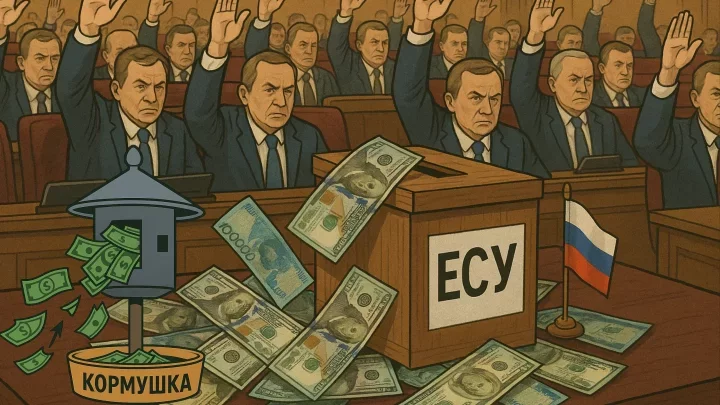 Photo: Dall-E, illustrative purposes
A little-known LLP, newly formed and unknown in the local market, has quietly approached Kazakhstani banks, offering to act as a "backup" service provider. That’s how leaders in Kazakhstan’s financial sector learned that betting transaction fees are ending up with Russia’s TSUPIS system, despite being dressed in a Kazakh wrapper.
What’s more, the very deputies who once rejected this kind of arrangement as a relic of "Old Kazakhstan" have now quietly voted it back in, under a new name: the Unified Accounting System (UAS), Orda.kz reports.
While this move may have been expected from the Ministry of Tourism and Sports, what’s surprising is that lawmakers are now writing legislation tailored to accommodate Russian officials and banks, under the banner of New Kazakhstan.
Operation UAS: A Backdoor Revival
On paper, the project sounds reasonable: create a national accounting system to curb gambling addiction, eliminate shadow revenues from betting, and redirect some of that money toward sports development. In reality, this is Kazakhstan’s second attempt to insert a private intermediary between bookmakers and the state — and it’s just as opaque as the first.
The first attempt was in 2020, when a private company called the Betting Accounting Center (BAC) was introduced through the Ministry of Sports. The plan was for this private operator to take 4% of the total turnover from bookmakers and betting operators — tens of billions of tenge annually — without offering any services, just acting as a "technical middleman."
That scheme collapsed after a scandal involving an expensive gift: the head of the Betting Accounting Center gave a luxury handbag worth millions of tenge to the Deputy Minister of Sports. Both were fined and publicly disgraced, and the project was quietly shut down.
Then Qantar happened, and the Betting Accounting Center was forgotten.
A Familiar Scheme?
Roughly a year later, the idea was revived, with new faces, but the same core logic. On the surface, things looked different: the operator was now a state-linked company, and the cut was reduced to 1% instead of 4%. Corruption risks looked smaller too, though we're still talking about billions, around 13 to 15 billion a year.
But the key point remains: it's all about total control
In the spring and summer of last year, specific messages seemed to come from the Majilis. Deputy Yelnur Beisenbayev, leader of the Amanat faction, spoke out strongly against the return of the scheme. He described the BAC as a "relapse of the past" and a "parasitic layer."
Beisenbayev publicly and confidently criticized efforts to bring back the BAC under a new guise. He called it a "gasket of Old Kazakhstan," emphasized the importance of protecting national interests, and urged for transparency and integrity in the legislative process. His stance appeared firm — almost uncompromising.
But by fall 2024, everything had changed.
Beisenbayev quietly voted in favor of a new bill — this time featuring the exact same scheme, now branded as the Unified Accounting System (UAS). No statements, no explanations.
In early 2025, the Ministry of Tourism and Sports formalized the new system. Minister Yerbol Myrzabosynov signed an order detailing how the UAS would operate. According to the rules, by the end of this year, all sports betting transactions in Kazakhstan will fall under control.
What this effectively creates is a powerful, centralized gatekeeper — one capable of steering money and traffic between operators. The UAS will be able to pressure certain bookmakers while favoring others. But who will decide which bookmakers get the green light and which ones won't?
A Change of Tune
Not long ago, Yelnur Beisenbayev was the loudest voice warning against exactly this kind of structure. He positioned himself as a defender of “New Kazakhstan,” standing firmly against old schemes and hidden interests. He was either unaware or perfectly aware of where everything was heading. But when the same mechanics returned under a new name, he gave his approval.
Whether it was political convenience, party pressure, or a calculated pivot — it no longer matters. What matters is that politicians like Beisenbayev are now enabling the quiet reintroduction of systems the country once rejected.
Adding to the concern: some information suggests that Russian consultants — the same ones who built Russia’s ETSUPIS system — are actively involved in designing Kazakhstan’s UAS. In Russia, ETSUPIS has already proven its power to block some companies while allowing others to operate freely. A tested model of control.
Legal Oversight — Or A Loophole?
Today, the UAS is presented as a win for everyone: low commission rates, centralized accounting, protection for children, and increased transparency. But behind this polished façade lies a powerful tool — one that can be used to quietly reshape the market, redirect customers, and consolidate control. And crucially, there's no legal safeguard in place to prevent that from happening.
Regulatory bodies already exist and have long been overseeing the betting sector effectively. So why duplicate their role? The answer seems clear: to create a new lever of influence. To control money. Data. Market players. And to decide who stays — and who’s pushed out.
Just like in 2020, businesses are again facing the threat of quiet takeover. The difference now is in the method: less noise, more polish. It's being done under the banner of national interest — with glossy presentations, patriotic rhetoric, and the language of reform.
But UAS isn't just about regulating bets. It's about controlling the market, and with it, access to financial flows, data, and power. It also threatens to wipe out an entire segment of independent payment service providers. And while some still trust in the promise of a clean, modern system, others are already rewriting the rules — behind closed doors, for their own benefit.
Previously, Orda.kz reported how efforts to combat gambling addiction have been used as a cover to monopolize not just the betting industry, but multiple sectors at once.
Latest news
- Orda.kz Editorial Team to Cease Operations on September 1
- The Price of a Degree: How Students in Kazakhstan Pay for University
- Second Przewalski’s Horse Foal Born as Species Returns to Kazakhstan
- Kazakh Mining Companies Can Recalculate Purchases if Tenge Weakens
- Kazakhstan Names First Vice President in Three Decades
- What Almaty’s Bus Shelters Are Missing
- 400-Truck Queue Builds at Kazakh–Kyrgyz Border
- Kazakhstan Ready to Help Feed and Rebuild Gaza
- Tokayev Establishes New Presidential Security Body
- Almaty Takes Back Its Nearly Century-Old Hippodrome
- No More Guesswork on Savings: Kazakhstan Tightens Energy Audits for Businesses
- Public Money Could Be Used to Rescue Failing Kazakh Banks
- Third Kazakh Woman Reported Missing in Nepal-China Flood Zone
- Falconer Convicted Over 35 Protected Birds, Spared Punishment Under Amnesty
- Kazakh Citizen Detained in Yakutia in Phone Fraud Case
- Yuan Instead of Dollars? KazMunayGas Draws Record Demand in Asia
- China Gains Oil-Market Influence as OPEC+ Weakens
- Kazakhstan to Divide Smartphones Into White, Gray and Black Lists
- Kazakhstan’s Government Formally Resigns as First Kurultai Session Opens
- Rare Lynx Sighting Recorded in Northern Kazakhstan
