

Toqayev Outlines Presidential Role, Global Vision, and Tech Ambitions at Astana International Forum
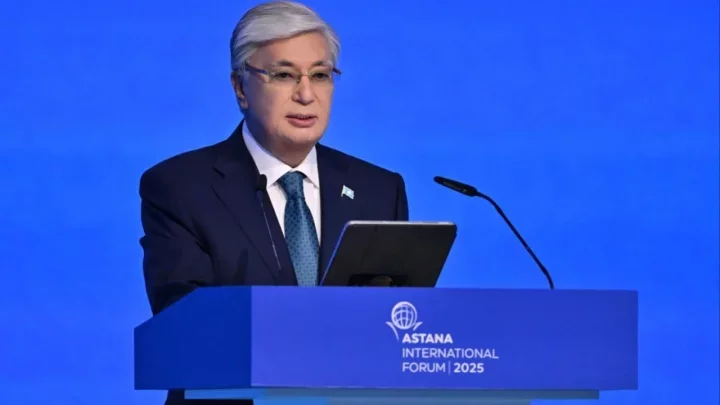 Photo: Aqorda
Speaking at the Astana International Forum, President Qasym-Jomart Toqayev offered a comprehensive assessment of the presidency, international cooperation, and Kazakhstan’s technological aspirations, Orda.kz reports.
Hired by The People
According to Toqayev, Kazakhstan has implemented extensive reforms aimed at strengthening statehood, developing institutions, and building a just society.
He recalled the nationwide referendum that amended the Constitution, curbing presidential powers and moving away from a “super-presidential” model.
“I am convinced that the president is a state manager hired by the people for a certain period, in our case for seven years.”
He emphasized that the new governance system rests on a balance of powers:
“A strong president – an influential parliament – an accountable government.”
Our country has made efforts to modernize and strengthen statehood in order to build a truly just society in Kazakhstan. We have moved to a presidential republic with a system of checks and balances based on the principle of responsibility to the people.
Toqayev described the single seven-year presidential term as a deliberate and unprecedented move to strengthen the political system.
Political scientist Gaziz Abishev highlighted the significance of Toqayev’s remarks:
President Toqayev, speaking at the AEF, once again articulates the most important point about the ownership of supreme power: 'The President is a state manager hired by the people for a certain period.' In other words, he refutes speculation about a possible 'zeroing out' and describes the political horizon until the next election campaign, which will begin within the next four years.
He noted that Toqayev continues to demonstrate consistency in reform and commitment to institutional frameworks.
Global Cooperation
The President also addressed global threats, noting that while they are transnational, the world’s responses remain fragmented.
"The threats we face are undoubtedly transnational. Yet our responses are increasingly fragmented. Institutions for global cooperation must adapt to a more fragile, unstable and contradictory world."
He called on “middle powers” to play a more active role in shaping an equitable world order.
Kazakhstan firmly believes that middle powers must be committed to a fair and inclusive global order, which requires a reassessment of approaches. Accordingly, middle powers may need to assume greater responsibility.
Toqayev referred to the upcoming 80th anniversary of the United Nations in 2025, emphasizing the organization's founding vision.
Founded in 1945 by 51 nations after a devastating world war, the UN offered a bold vision for a more peaceful and secure world. Today, the Organization's 193 Member States represent a more diverse, complex and interconnected global community.
However, he criticized the outdated structure of the UN Security Council.
This gap between the institutional structure that was created 80 years ago and modern realities undermines the credibility and effectiveness of the UN. Critical decisions affecting billions of people should not be taken by just a few countries.
He advocated for broader regional representation and reforms to maintain the UN’s legitimacy.
Structural reform of the Security Council is necessary to ensure that the UN remains relevant and truly reflects the real world. Major powers must reaffirm their commitment to maintaining peace and security, as well as the core principle of respect for the territorial integrity of all countries.
He concluded with a call to return to the foundational principles of the UN Charter.
"We must all adhere firmly to the UN Charter, avoiding biased and selective approaches to its basic principles. Only in this way can we restore confidence in the authority of the United Nations."
IT Hub in Eurasia
Regarding domestic priorities, Toqayev outlined Kazakhstan’s strategy for technological leadership in Eurasia.
“We have made significant progress in digital transformation, reflecting our ambition to become a Eurasian IT hub.”
He stressed the importance of academic and research infrastructure.
We are paying special attention to artificial intelligence. Our goal is to become an academic and innovation hub, where a number of branches of foreign universities will operate and partnerships in the field of research and development will be established.
Kazakhstan has received a powerful supercomputer to support AI, data analysis, and scientific research.
“In addition, we plan to create an innovative pilot zone CryptoCity, where cryptocurrencies can be used to purchase goods, services and for other purposes.”
He added that digital growth must align with social development, highlighting education and professional inclusion.
The country aims to lead in high-value sectors from clean energy to precision manufacturing.
Nuclear Disarmament And Peace.
Toqayev also reaffirmed Kazakhstan’s commitment to nuclear disarmament and peace.
Today, nine states possess more than 13,000 nuclear warheads. The risk of the use of nuclear weapons is growing. We are aware of the potential consequences. Kazakhstan has consciously renounced its nuclear arsenal in the name of peace.
He pointed to emerging risks such as artificial intelligence, which challenge traditional methods of resolving disputes.
"The world is facing a choice. We must decide what values to uphold. The future depends on our decisions today."
In 2023, 52 countries were engaged in armed conflict, with the cost of violence reaching $19 trillion.
We know what this means. Kazakhstan still faces the consequences of 450 nuclear tests. We consciously gave up the inherited arsenal in the name of peace. Today, we continue to advocate for the non-proliferation of nuclear and biological weapons. Wars justified by historical arguments or hostility seem outdated and even strange. Instead, we must engage people - especially young people - in the formation of an enlightened society.
He concluded by reaffirming Kazakhstan’s foreign policy principles of dialogue, sovereignty, and cultural diversity as foundations for global stability.
Original Author: Artyom Volkov, Article 2, Article 3, Article 4
Latest news
- Orda.kz Editorial Team to Cease Operations on September 1
- The Price of a Degree: How Students in Kazakhstan Pay for University
- Second Przewalski’s Horse Foal Born as Species Returns to Kazakhstan
- Kazakh Mining Companies Can Recalculate Purchases if Tenge Weakens
- Kazakhstan Names First Vice President in Three Decades
- What Almaty’s Bus Shelters Are Missing
- 400-Truck Queue Builds at Kazakh–Kyrgyz Border
- Kazakhstan Ready to Help Feed and Rebuild Gaza
- Tokayev Establishes New Presidential Security Body
- Almaty Takes Back Its Nearly Century-Old Hippodrome
- No More Guesswork on Savings: Kazakhstan Tightens Energy Audits for Businesses
- Public Money Could Be Used to Rescue Failing Kazakh Banks
- Third Kazakh Woman Reported Missing in Nepal-China Flood Zone
- Falconer Convicted Over 35 Protected Birds, Spared Punishment Under Amnesty
- Kazakh Citizen Detained in Yakutia in Phone Fraud Case
- Yuan Instead of Dollars? KazMunayGas Draws Record Demand in Asia
- China Gains Oil-Market Influence as OPEC+ Weakens
- Kazakhstan to Divide Smartphones Into White, Gray and Black Lists
- Kazakhstan’s Government Formally Resigns as First Kurultai Session Opens
- Rare Lynx Sighting Recorded in Northern Kazakhstan
