

"The Oil Era's End Is Already in Sight" - Almas Chukin on Falling Oil Prices
 Photo: Elements.envato.com
Global oil prices have recently hit a four-year low, raising serious concerns for oil-dependent economies like Kazakhstan. Renowned Kazakh economist Almas Chukin explains how this trend could spell trouble for the country, Orda.kz reports.
OPEC’s policy partly drove the decline, as the oil exporters’ cartel agreed to increase production by another 411,000 barrels per day in June. Saudi Arabia, OPEC’s de facto leader, deliberately flooded the market with cheap oil, signaling its readiness to maintain these low prices for the long haul.
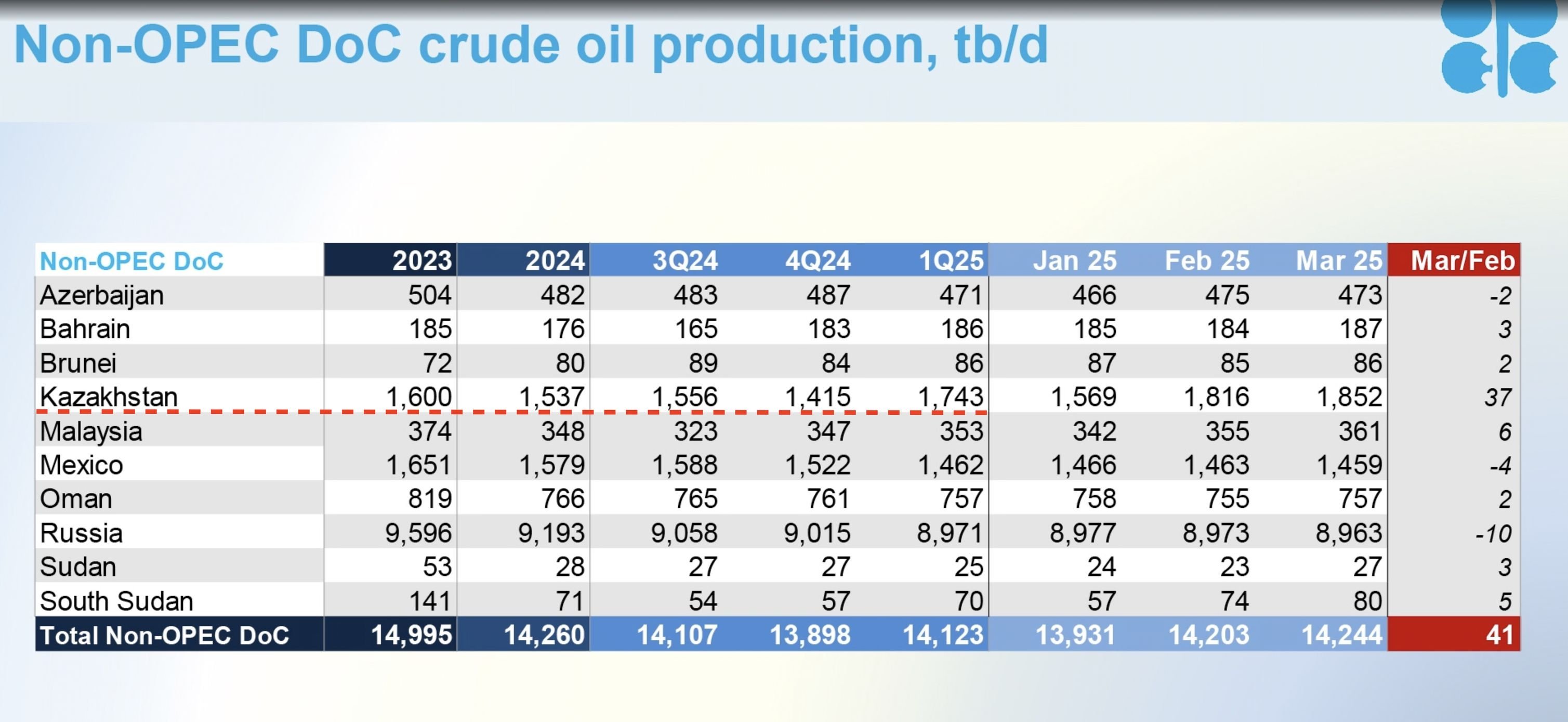
At the same time, the failure of several countries, especially Kazakhstan and Iraq, to meet their production quotas prompted a reaction from Saudi Arabia.
I read that Kazakhstan has influenced OPEC+ the other day and caused a global collapse in oil prices. It seemed strange to me. Our volumes aren’t that large, and it's not the first time prices have fluctuated, rising and falling. I was just finishing modeling how price changes affect our budget, and suddenly the picture took on a completely different tone.Chukin said.
Chukin points out that only eight of the 11 OPEC+ countries currently adhere to agreed production cuts.
It’s important to understand that this is specifically about production. Oil isn’t something you can just store at the wellhead, so it is impossible to reduce 'export.' Once it’s extracted, it has to be sold. The real challenge is limiting production itself. An oil well is like a living organism — it needs to keep flowing. You can’t just shut it off like a bathroom tap; at best, you can slightly reduce the flow. If you stop production entirely, paraffins and other organic materials can solidify, potentially killing the well.the economist notes.
Production and export are not the same thing. Some countries, like the U.S. and Russia, produce large oil volumes but consume a significant share domestically. Others use much of their output for petrochemical production, which doesn’t factor into export figures. Then there are countries like Kazakhstan, which export nearly everything they produce.
To illustrate, the expert points to Tengizchevroil’s record output in April — two million barrels per day, nearly 2% of global output. Given that OPEC accounts for just over 40% of total global output, Kazakhstan’s contribution represents almost 5% of that share.
Our quota, which we committed to follow, is 1,468,000 barrels per day. So right now, we’re exceeding it by about half a million barrels. When the decision to cut production was made, Saudi Arabia, as the world’s top exporter, took on additional voluntary cuts, reducing output by two million barrels. In that context, our excess of half a million barrels is already a quarter of their 'gift.'Chukin believes.
He recalled that OPEC+ recently announced a gradual quota increase for all participants by 130,000 barrels.
But Saudi Arabia's patience eventually wore thin. Whether to pressure violators or because they foresaw Trump’s tariffs leading to lower demand and falling prices anyway, they pushed for a threefold increase in the quota. If favorable prices weren’t possible, then the only option was to seize market share and try to make up for it with volume. We keep saying we're committed to the agreement, but in reality, there's not much we can do— we don't control the foreign companies operating here. And honestly, how are we supposed to make cuts? You can't just tell TCO or NCOC to shut down their projects. Cutting our own is painful. It’s a zugzwang situation,say Chukin.
According to Chukin, the current trajectory points to a breakdown of the agreement. On the surface, it might seem like little will change for Kazakhstan — oil prices are down by 15–20%, but production is up by 15–17%, so overall revenue may end up roughly the same as before.
To illustrate the fragility of the situation, Chukin compares the oil industry’s income structure to a piece of meat: the fat represents profit, the muscle stands for development and depreciation, and the bones are operating costs.
When prices drop, expenses stay the same, but profits vanish. And it’s from profit that taxes, investment loans, and dividends are paid. Once profits dry up, development halts, fixed assets deteriorate, and eventually, painful cuts to jobs and production begin. When it comes to the state budget, it’s important to understand that the relationship here isn’t linear.
Not everyone knows that in Kazakhstan, among all oil and gas-related payments, only the export customs duty on crude oil goes directly into the republican budget. All other major revenues from oil production (non-rent payments, corporate taxes, special taxes, etc.) are first collected in the National Fund and then reinvested or partially transferred to the budget through annual allocations.
The expert's table, which details how much revenue per barrel flowed into the National Fund at various oil prices in past years, clearly shows a notable decline.
If we finish the year with oil averaging around $60 per barrel, a serious rethink of our financial and economic policy is just around the corner. The 2025–27 budget was built on a Brent price of $75 per barrel. We’re projected to sell nearly 700 million barrels annually, so even a $15 shortfall per barrel means $10.5 billion in lost revenue. And that’s precisely the ‘fat’ from which most corporate income tax is paid. Production Sharing Agreements (PSAs) might cushion the blow slightly, as they’re less dependent on profit levels. It’s hard to predict exactly, but we could fall short by two to three trillion tenge. That would mean increasing transfers from the National Fund, and GDP figures could also take a hit—from both reduced sector sales and fewer contracts for related industries, the economist warned
According to him, the end of the oil era is already in sight, and Kazakhstan’s economy will need to transform more rapidly.
Original Author: Raushan Korzhumbekova
Source: Almas Chukin's Facebook.
Latest news
- Orda.kz Editorial Team to Cease Operations on September 1
- The Price of a Degree: How Students in Kazakhstan Pay for University
- Second Przewalski’s Horse Foal Born as Species Returns to Kazakhstan
- Kazakh Mining Companies Can Recalculate Purchases if Tenge Weakens
- Kazakhstan Names First Vice President in Three Decades
- What Almaty’s Bus Shelters Are Missing
- 400-Truck Queue Builds at Kazakh–Kyrgyz Border
- Kazakhstan Ready to Help Feed and Rebuild Gaza
- Tokayev Establishes New Presidential Security Body
- Almaty Takes Back Its Nearly Century-Old Hippodrome
- No More Guesswork on Savings: Kazakhstan Tightens Energy Audits for Businesses
- Public Money Could Be Used to Rescue Failing Kazakh Banks
- Third Kazakh Woman Reported Missing in Nepal-China Flood Zone
- Falconer Convicted Over 35 Protected Birds, Spared Punishment Under Amnesty
- Kazakh Citizen Detained in Yakutia in Phone Fraud Case
- Yuan Instead of Dollars? KazMunayGas Draws Record Demand in Asia
- China Gains Oil-Market Influence as OPEC+ Weakens
- Kazakhstan to Divide Smartphones Into White, Gray and Black Lists
- Kazakhstan’s Government Formally Resigns as First Kurultai Session Opens
- Rare Lynx Sighting Recorded in Northern Kazakhstan
