

Old Yandex in New Hands: How Will The Change of the Yandex’s Shareholders Affect Kazakhstan
 Kazakhstanphoto: yandex.ru
News recently emerged that the Russian "Yandex" may soon fall into new hands. Russian billionaires closely associated with the Kremlin elite have made offers to buy 51% of the shares. International representative offices of some Yandex services will part ways with the Russian legal entity. Orda.kz decided to figure out what these services are, how it will affect Kazakhstan and local users
There Can Only Be One
Yandex is the largest Russian company in the information technology industry. The company calls itself a multinational, i.e., it owns production units in several countries. The company's main legal entity, Yandex N. V., was registered in the Netherlands in 2004. The founders of the firm, Arkady Volozh and Ilya Segalovich, decided to take such a step in order to be able to sell shares on the Nasdaq exchange and attract investors. But trading was suspended on February 28, 2022, after the onset of Russia’s invasion of Ukraine.
On May 25, information was published on the company's official website that Yandex received applications from potential investors to purchase various packages of economic shares in the company. Bloomberg reports that Russian billionaires Vladimir Potanin and Vagit Alekperov are among them. They are vying over 51% of the shares. Incidentally, Potanin is a former First Deputy Prime Minister of the Russian Federation. Alekperov is the former head of the Russian oil and gas company Lukoil. Potanin is also under UK and US sanctions.
According to the company’s official statements, all applications will be checked for compliance with the sanctions restrictions.
The IT giant was estimated at 500-600 billion rubles, or 7-7.5 billion dollars.
Despite having the majority stake, potential investors will only be able to buy an economic stake in the company. The company’s management will maintain voting control.
"New economic investors will not have control over the company. As with the current corporate structure, Yandex management will retain control,”
Yandex’s official website
Not That Long Ago.
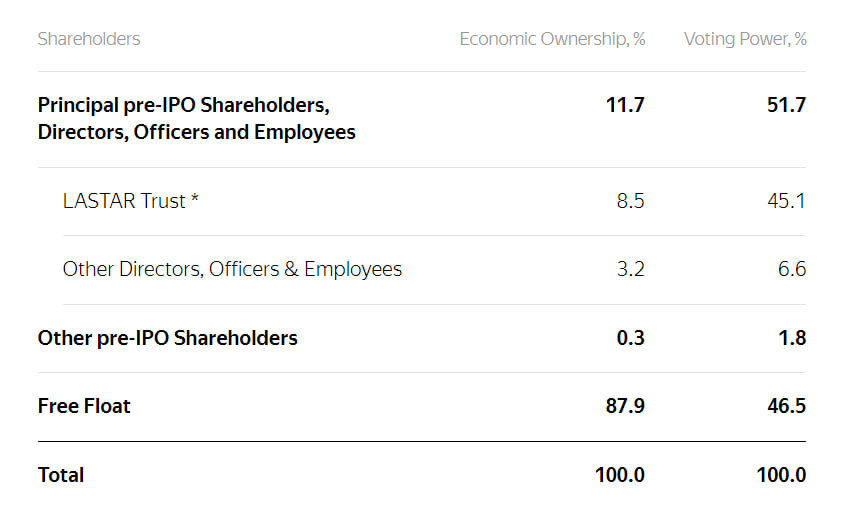
Current data on Yandex’s shareholders indicates LASTAR Trust as the main shareholder of the company. This is the family trust of Yandex’s founder - Arkady Volozha. The Family Trust no longer has voting rights in the company: in 2022, it transferred them to independent members of the company's board of directors. 46.5% of the voting shares and 87.9% of the share capital are in free circulation.
How the situation will change remains unclear.
"The final decision on the potential composition of economic investors has not yet been made. Yandex will disclose all the details, including the list of economic investors, when it is possible,"
the company stated
Independent Yandex Services
Other important information for the international divisions of Yandex has also been released.
The businesses of autonomous cars, cloud technologies, educational services and data markup platforms will remain on the Russian market and continue their operations. But their international entities will be passed onto independent companies that will be controlled by Yandex N.V. i.e. Yandex’s main legal entity.
This will mean that international entities will be separate from the Russian entity and may skirt secondary sanctions. However, it is too early for Kazakhstan to rejoice. Indeed, the list of businesses only includes drones, which are used most often in Russia, Israel and the USA, a cloud system and educational services.


Their online platforms have a much smaller number of users than other Yandex services. For example, in 2022, the number of Yandex Cloud cloud storage worldwide customers was only 24 thousand. While the number of active users on"Yandex. Taxi" exceeded 40 million by the end of 2022.
There is no exact statistical data on Kazakhstani users’ proportion in this figure. But it is a no-brainer that "Yandex. Taxi" is used more often in Kazakhstan.
Russian Piggy Bank Gets Billions of Tenge
According to analysts, Kazakhstan reportedly pays Russia 1 billion tenge on a daily basis via Yandex Taxi fees.
The figure seems astronomical, but if you dig a little deeper, then everything falls into place.
In 2022, the Minister of Digital Development Bagdat Musin said that about 150 thousand citizens of Kazakhstan work on the Yandex platform. Taxi". According to the official website of the company, every day every driver carries out 20-30 orders. The average amount of each trip around Almaty is 1,500-2,000 tenge.
Yandex. Taxi’s fees are also the highest on the market and range from 17-21% including VAT. The Agency for the Protection and Development of Competition (APDC) announced this in 2022.
Simple mathematical calculations can produce the conclusion that "Yandex. Taxi" in Kazakhstan pays Russia upwards of 1 billion tenge per day
Kazakhstan had attempted to create a more competitive environment in the field of passenger transportation. China’s DiDi, another Russian company Indriver and America’s Uber all made the scene.
Changing market conditions, however, led to DiDi’s unfortunate departure. And among the remaining companies, it would seem that only Uber was not from Russia. But in July 2017, Yandex and Uber announced a decision to merge their taxi services in Russia, Belarus, Kazakhstan, Georgia, Azerbaijan and Armenia.

Yandex has thereby remained the monopolist on Kazakhstan’s passenger transportation market, thus providing reasoning for taxi prices’ upward trend. The APDC had launched an investigation into Yandex Taxi at the end of 2022. Yet it proved to be for not due to the lack of analysis. Although the antimonopoly authority presses on in its investigation, prices remain high. Fees are 36% higher than the market maximum.
In May 2023, Yandex drivers from the regions near Almaty held a protest because of this. According to them, Yandex Pro has halted guaranteed bonuses.
"<...> the fee of 21% for each trip is not compatible with profit,"
the taxi drivers noted.
Meanwhile, the press service of Yandex Go assured that the service is working as usual. In other words, with the same monopolistic pricing.
The question remains whether Kazakhstan is able to create its own tax service without supporting the Russian economy with billions every day. Or will foreign powerhouses’ unsuccessful ventures scared away a domestic developer?
Orda.kz will continue to follow the situation.
Original Author: Silam Akbota
Disclaimer: This is a translated piece. The text has been modified, the content is the same. Please refer to the original piece in Russian for accuracy.
Latest news
- Orda.kz Editorial Team to Cease Operations on September 1
- The Price of a Degree: How Students in Kazakhstan Pay for University
- Second Przewalski’s Horse Foal Born as Species Returns to Kazakhstan
- Kazakh Mining Companies Can Recalculate Purchases if Tenge Weakens
- Kazakhstan Names First Vice President in Three Decades
- What Almaty’s Bus Shelters Are Missing
- 400-Truck Queue Builds at Kazakh–Kyrgyz Border
- Kazakhstan Ready to Help Feed and Rebuild Gaza
- Tokayev Establishes New Presidential Security Body
- Almaty Takes Back Its Nearly Century-Old Hippodrome
- No More Guesswork on Savings: Kazakhstan Tightens Energy Audits for Businesses
- Public Money Could Be Used to Rescue Failing Kazakh Banks
- Third Kazakh Woman Reported Missing in Nepal-China Flood Zone
- Falconer Convicted Over 35 Protected Birds, Spared Punishment Under Amnesty
- Kazakh Citizen Detained in Yakutia in Phone Fraud Case
- Yuan Instead of Dollars? KazMunayGas Draws Record Demand in Asia
- China Gains Oil-Market Influence as OPEC+ Weakens
- Kazakhstan to Divide Smartphones Into White, Gray and Black Lists
- Kazakhstan’s Government Formally Resigns as First Kurultai Session Opens
- Rare Lynx Sighting Recorded in Northern Kazakhstan
