

Kazakhstan to Audit USAID Programs and Funding
 Photo: U.S. Department of Agriculture / Wikimedia Commons (Public Domain)
The Kazakh government is set to audit all programs implemented by the United States Agency for International Development (USAID) in the country. This was revealed in a response from Minister of National Economy Serik Zhumangarin to a parliamentary inquiry, which Orda.kz has reviewed.
According to Zhumangarin, a special working group was established within the Ministry of Foreign Affairs in 2024 to conduct a detailed assessment of USAID’s activities.
The audit will focus on evaluating the effectiveness of funded projects, comparing their stated objectives with actual outcomes, and examining USAID’s connections with governmental and non-governmental organizations.
A detailed analysis of funded projects and programs will be conducted, including an assessment of their alignment with stated goals and actual results. This includes studying USAID’s country strategies, its relationships with other organizations, including governmental and non-governmental, and financial flow analysis to uncover possible cover-up schemes, inconsistencies in spending, and conflicts of interest, Zhumangarin stated.
According to the Kazakh Foreign Ministry, USAID implemented 28 long-term programs in 2024 under bilateral agreements. The total funding allocated for Kazakhstan in 2023–2024 amounted to $26.5 million, supporting projects in the economy, energy, healthcare, civil society, and media sectors. Some of these programs extended beyond Kazakhstan to the broader Central Asian region.
Among the NGOs implementing USAID-funded projects in 2024–2025 are:
- Desenta Foundation
- Kadyr-Kasiyet NGO
- Eurasia Foundation Representative Office
- Winrock International Representative Office
- Internews Network Representative Office
- American Bar Association Representative Office
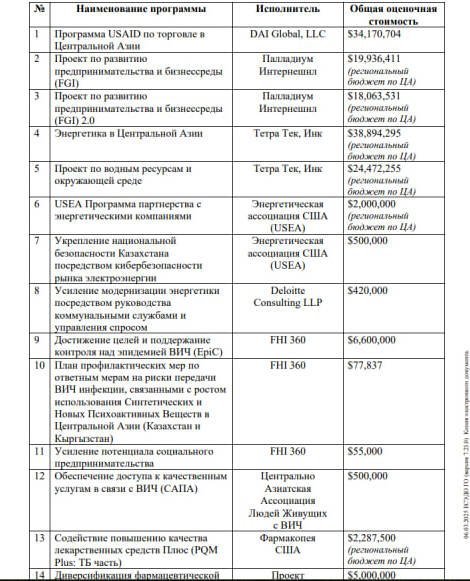
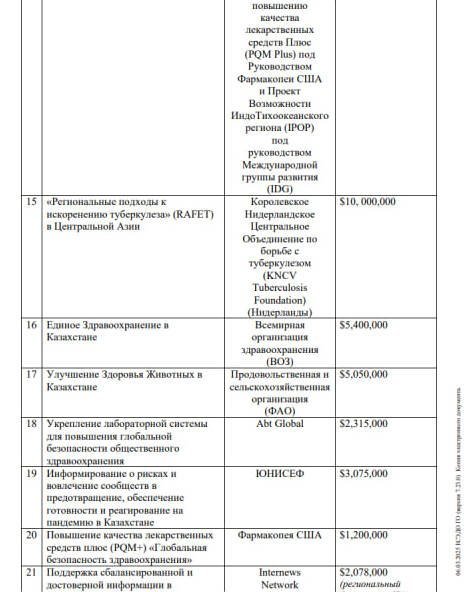
Additionally, the State Revenue Committee of the Ministry of Finance collaborated with USAID under a memorandum on digitalization and modernization of customs infrastructure. As part of this initiative, the U.S. agency provided the committee server equipment worth approximately 400 million tenge.
One of the components of the USAID program is simplifying customs and border control procedures. Through this partnership, USAID provided not only technical assistance but also support for working meetings, sessions, and foreign visits, Zhumangarin noted.
NGO Financial Reporting Requirements
Under Kazakhstan’s Law on Charity, local organizations receiving foreign funding must publish annual reports detailing their financial activities. Foreign and international charitable organizations operating in Kazakhstan are also required to disclose their funding sources, founders, and areas of expenditure.
Zhumangarin emphasized the obligations under Kazakhstan’s Tax Code, stating:
Individuals and structural divisions of legal entities must report to tax authorities on the receipt and expenditure of foreign funds. Noncompliance results in fines: individuals – 50 MCI, small NGOs – 100 MCI, medium-sized NGOs – 200 MCI, large organizations – 300 MCI.
The State Revenue Committee monitors compliance and maintains a register of entities receiving foreign funds. Between 2018 and 2024, eight NGOs reported receiving funding from USAID, though the exact amounts remain classified as tax secrets.
Kazakhstan’s Ministry of Justice has proposed to state bodies drafting legislation to protect children from potential risks associated with foreign-funded projects. This proposal is still in its early development stages.the minister noted.
Meanwhile, the audit of USAID activities will continue, with further scrutiny of its financial flows, partnerships, and influence, Zhumangarin concluded.
The suspension of USAID funding has raised concerns about the future of human rights organizations in Kazakhstan. This situation is further complicated by Majilis deputy Irina Smirnova’s proposal to introduce a "foreign agents" law.
Orda.kz recently investigated whether NGOs that previously received USAID support could seek alternative funding from the state.
Original Author: Aliya Askarova
Latest news
- Orda.kz Editorial Team to Cease Operations on September 1
- The Price of a Degree: How Students in Kazakhstan Pay for University
- Second Przewalski’s Horse Foal Born as Species Returns to Kazakhstan
- Kazakh Mining Companies Can Recalculate Purchases if Tenge Weakens
- Kazakhstan Names First Vice President in Three Decades
- What Almaty’s Bus Shelters Are Missing
- 400-Truck Queue Builds at Kazakh–Kyrgyz Border
- Kazakhstan Ready to Help Feed and Rebuild Gaza
- Tokayev Establishes New Presidential Security Body
- Almaty Takes Back Its Nearly Century-Old Hippodrome
- No More Guesswork on Savings: Kazakhstan Tightens Energy Audits for Businesses
- Public Money Could Be Used to Rescue Failing Kazakh Banks
- Third Kazakh Woman Reported Missing in Nepal-China Flood Zone
- Falconer Convicted Over 35 Protected Birds, Spared Punishment Under Amnesty
- Kazakh Citizen Detained in Yakutia in Phone Fraud Case
- Yuan Instead of Dollars? KazMunayGas Draws Record Demand in Asia
- China Gains Oil-Market Influence as OPEC+ Weakens
- Kazakhstan to Divide Smartphones Into White, Gray and Black Lists
- Kazakhstan’s Government Formally Resigns as First Kurultai Session Opens
- Rare Lynx Sighting Recorded in Northern Kazakhstan
