

Kazakhstan Approves Comprehensive Plan To Preserve Cultural Heritage
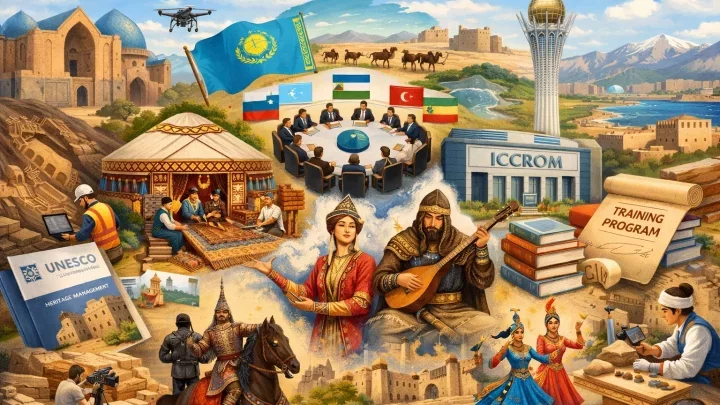 AI-generated illustration
The Kazakh government has approved a comprehensive plan for the preservation and promotion of cultural heritage under the auspices of UNESCO and ISESCO for 2026–2028. The corresponding decree was signed by prime minister Olzhas Bektenov, Orda.kz reports.
The comprehensive plan covers three key areas, the press service of the Cabinet of Ministers noted:
- preservation and promotion of tangible cultural heritage;
- development and support of the intangible cultural heritage of the Kazakh people;
- promotion of the UNESCO Memory of the World program.
Among the main tasks are improving the protection of World Heritage sites, advancing Kazakhstan's cultural values on the international agenda, developing an expert and educational base, and engaging society more actively in heritage preservation.
In terms of monument protection, the plan provides for monitoring the condition of internationally significant sites, preparing a methodological manual on the management of UNESCO World Heritage sites in Kazakhstan, and expanding the tentative list of cultural heritage sites for further international promotion.
A separate section concerns international cooperation. In particular, it plans interdepartmental and expert consultations on the preparation of a possible nomination, "Silk Road: Caspian‑Volga Corridor."
Work will also continue on the multinational nomination of "Alpamys batyr" together with Azerbaijan, Turkey, Uzbekistan and Turkmenistan for inclusion in the UNESCO Intangible Cultural Heritage List, the government noted.
Another direction is preparing for Kazakhstan’s accession to ICCROM — the International Centre for the Study of the Preservation and Restoration of Cultural Property. This will expand professional cooperation and enable the use of modern approaches to heritage preservation and restoration.
A significant part of the plan concerns training. Every year, at least 30 experts will be trained as part of the implementation of the UNESCO Convention for the Safeguarding of the Intangible Cultural Heritage. The International Educational Corporation also provides for the development of conceptual and draft projects for monument preservation within bachelor’s and master’s programsthe statement said.
Special attention is planned for endangered elements of intangible cultural heritage, including the production and decoration of the Kazakh yurt, Kazakh carpet weaving and the epic genre of termein several regions of the country.
According to the plan’s authors, its implementation will strengthen heritage preservation efforts, reduce the shortage of specialized educational programs and specialists, and expand the participation of local communities and the use of modern technologies in this field.
Original author: Alexander Smolin
Read also:
Latest news
- Orda.kz Editorial Team to Cease Operations on September 1
- The Price of a Degree: How Students in Kazakhstan Pay for University
- Second Przewalski’s Horse Foal Born as Species Returns to Kazakhstan
- Kazakh Mining Companies Can Recalculate Purchases if Tenge Weakens
- Kazakhstan Names First Vice President in Three Decades
- What Almaty’s Bus Shelters Are Missing
- 400-Truck Queue Builds at Kazakh–Kyrgyz Border
- Kazakhstan Ready to Help Feed and Rebuild Gaza
- Tokayev Establishes New Presidential Security Body
- Almaty Takes Back Its Nearly Century-Old Hippodrome
- No More Guesswork on Savings: Kazakhstan Tightens Energy Audits for Businesses
- Public Money Could Be Used to Rescue Failing Kazakh Banks
- Third Kazakh Woman Reported Missing in Nepal-China Flood Zone
- Falconer Convicted Over 35 Protected Birds, Spared Punishment Under Amnesty
- Kazakh Citizen Detained in Yakutia in Phone Fraud Case
- Yuan Instead of Dollars? KazMunayGas Draws Record Demand in Asia
- China Gains Oil-Market Influence as OPEC+ Weakens
- Kazakhstan to Divide Smartphones Into White, Gray and Black Lists
- Kazakhstan’s Government Formally Resigns as First Kurultai Session Opens
- Rare Lynx Sighting Recorded in Northern Kazakhstan
