

Kazakh Experts Explain Why AI Is Becoming the Main Weapon of Modern Warfare
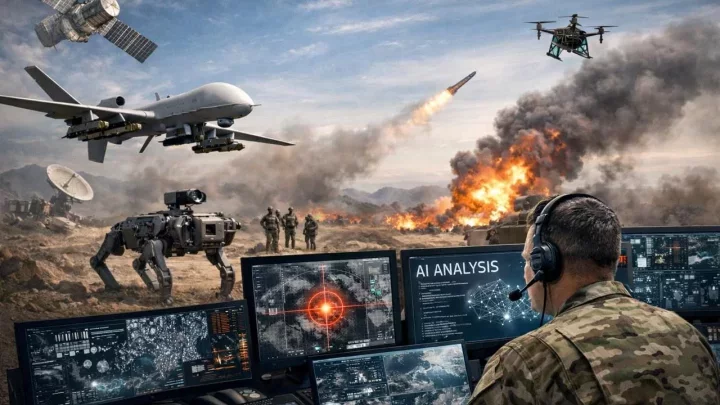 AI-generated illustration
Artificial intelligence is no longer just a scientific breakthrough — it has become a real instrument of war. Against the backdrop of ongoing military conflicts around the world, Kazakh experts say the ability to integrate AI is now seen as a decisive strategic advantage, Orda.kz reports.
Today, AI is used not only for highly specialized technological tasks, but also in key elements of military strategy. Recent conflicts make that clear.
According to Andrey Andreev, an expert at the Qazaq Expert Club who studies relations between society and the state, the world is entering a new era — the era of algorithmic warfare.
Data analysis systems such as Israel’s Lavender and the American Project Maven can process vast amounts of images and signals from drones and satellites. What once took a group of officers a full day, modern systems can do in minutes. This makes it possible to carry out massive strikes at an unprecedented pace, as recent operations in the Middle East have shown, where nearly 900 strikes were launched in the first 12 hours.he said.
Autonomous systems also play an important role in this new military architecture, the expert added. Drones with AI elements can patrol territory, track targets, and transmit data to operators. At the same time, AI has become one of the main areas of global military competition. The United States and China are investing billions of dollars in this field.
According to defense budget analysts, the Pentagon allocates about $800 million to $1.3 billion annually to AI projects. China is also rapidly increasing investment: its total defense spending is estimated at about $314 billion a year, and a significant share of research and development is aimed at artificial intelligence. Andreev said.
At the same time, Andreev noted that the current level of technological development still has serious limitations. War remains an unpredictable environment in which the human factor plays a decisive role. In addition, the military use of AI raises major ethical and legal questions. Errors in algorithms or the misinterpretation of data can lead to tragic consequences.
In future conflicts, he said, the advantage will depend not only on the amount of equipment or the size of an army. It will also depend on how effectively states integrate AI into intelligence, command, and decision-making systems.
Venture investment in AI projects in Kazakhstan increased more than fivefold between 2023 and 2025, from about $14 million to $73 million. In his address to the nation, President Kassym-Jomart Tokayev also set the goal of moving public administration fully into a digital format within three years. Kazakhstan has already adopted a separate law on artificial intelligence, created a dedicated ministry, and launched a supercomputer. But the question of AI’s military use remains largely outside public discussion.
Original author: Alexander Smolin
Read also:
Latest news
- Orda.kz Editorial Team to Cease Operations on September 1
- The Price of a Degree: How Students in Kazakhstan Pay for University
- Second Przewalski’s Horse Foal Born as Species Returns to Kazakhstan
- Kazakh Mining Companies Can Recalculate Purchases if Tenge Weakens
- Kazakhstan Names First Vice President in Three Decades
- What Almaty’s Bus Shelters Are Missing
- 400-Truck Queue Builds at Kazakh–Kyrgyz Border
- Kazakhstan Ready to Help Feed and Rebuild Gaza
- Tokayev Establishes New Presidential Security Body
- Almaty Takes Back Its Nearly Century-Old Hippodrome
- No More Guesswork on Savings: Kazakhstan Tightens Energy Audits for Businesses
- Public Money Could Be Used to Rescue Failing Kazakh Banks
- Third Kazakh Woman Reported Missing in Nepal-China Flood Zone
- Falconer Convicted Over 35 Protected Birds, Spared Punishment Under Amnesty
- Kazakh Citizen Detained in Yakutia in Phone Fraud Case
- Yuan Instead of Dollars? KazMunayGas Draws Record Demand in Asia
- China Gains Oil-Market Influence as OPEC+ Weakens
- Kazakhstan to Divide Smartphones Into White, Gray and Black Lists
- Kazakhstan’s Government Formally Resigns as First Kurultai Session Opens
- Rare Lynx Sighting Recorded in Northern Kazakhstan
