

Georgia Fast-Tracks New Restrictions on Protests Amid Year-Long Demonstrations
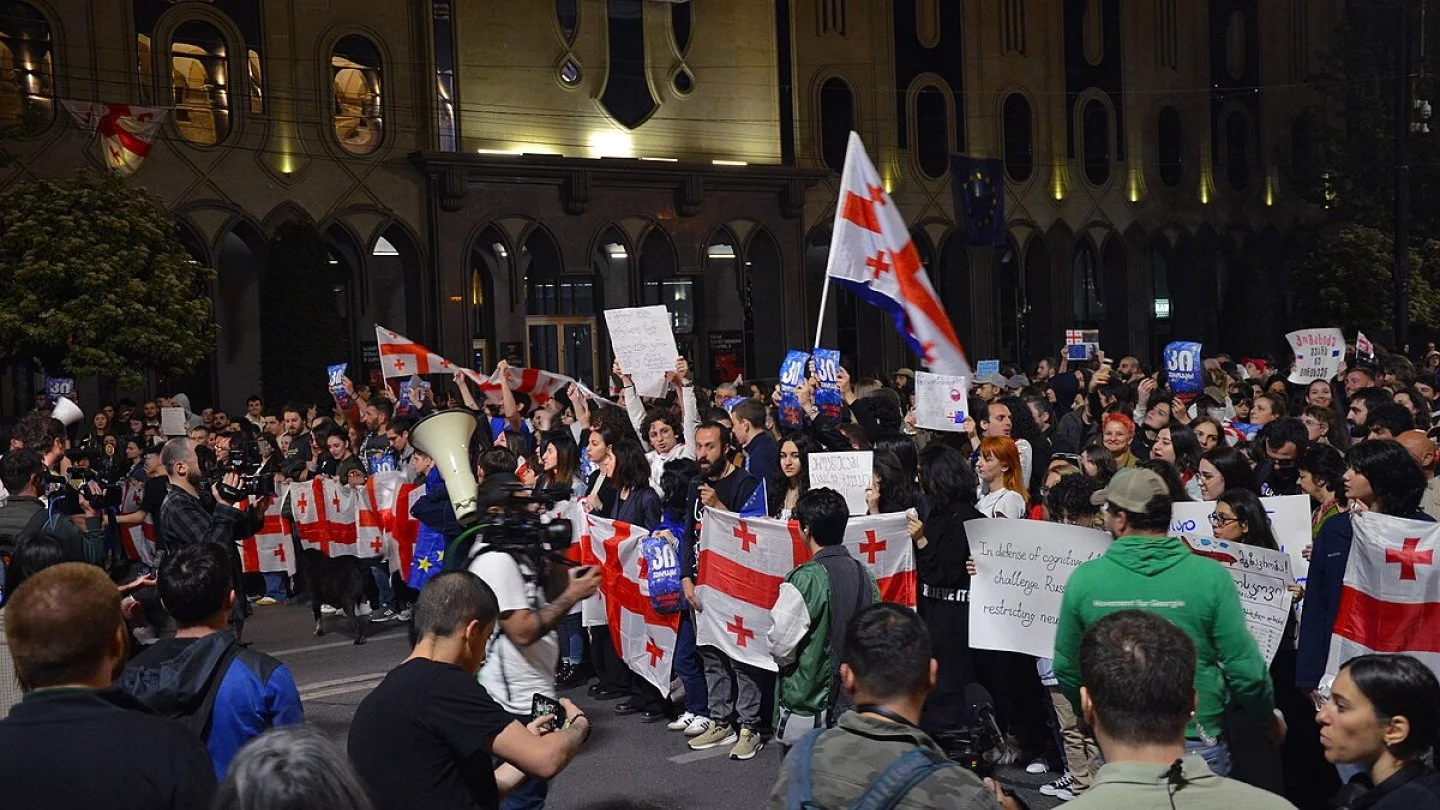 Photo: Ill. Purposes, Protest Tbilisi 21 April 2024 Author Jelger Groeneveld, Creative Commons Attribution 2.0 Generic license.
Parliament in Georgia has pushed through yet another tightening of protest rules, adopting amendments in a fast-tracked final reading, Orda.kz reports, citing NewsGeorgia.
The bill, prepared by the ruling Georgian Dream party, revises the Law on Assemblies and Manifestations as well as the Administrative Offenses Code.
Under the new rules, organizers must notify the Interior Ministry five days in advance if they plan to hold a rally in any “place of public concentration or traffic movement” — a definition broad enough to include sidewalks.
Demonstrations in public areas without prior notification are now banned.
In response to such notices, the Interior Ministry may issue a “warning” or suggest a different time or location. If a protest is spontaneous, organizers are required to inform the police “immediately.”
Should police decide that an assembly violates the law, participants will have 15 minutes to disperse. After that, the gathering is deemed illegal, and authorities are empowered to shut it down using measures permitted under Georgian law and international norms.
Penalties include administrative detention of up to 15 days for participants and up to 20 days for organizers. Repeat violations can trigger criminal cases. In practice, detainees at protests often end up facing an additional charge of disobeying police orders.
Current legislation does not require organizers to obtain police approval for rallies — only to notify municipal authorities for large-scale events. The new amendments dramatically narrow the space for protest marches, a format that gained popularity in Tbilisi after authorities banned road blockades. In effect, they could make pickets outside parliament, ministries, courts, and other state buildings nearly impossible.
Background
Protests, which began after Georgian Dream announced it was freezing negotiations on EU accession, have been ongoing for over a year.
During mass protests in late 2024 over the halted EU bid, authorities banned laser pointers, face coverings, pyrotechnics, and road blockades for smaller rallies. Initially, violators were fined 5,000 lari, but the fines proved ineffective.
Since October 2025, penalties have escalated to administrative arrests of up to 60 days and, for repeat offenses, criminal charges carrying sentences of up to two years.
The new law will take effect once signed by President Mikheil Kavelashvili, who traditionally does not delay such approvals.
Latest news
- The War in Iran Opens a Window of Opportunity for Kazakhstan’s Oil Sector, Analysts Say
- Iran Conflict Escalates Beyond the Gulf: What Kazakh Experts Say About Risks for Central Asia and Kazakhstan
- Kazakhstan Prepares Possible Evacuation of Its Citizens From Iran
- LRT in Astana Is Reaching the Finish Line: The Launch Is Expected in the Coming Months
- Kazakhstan Ready to Help the UAE Amid Escalation in the Region
- Tokayev Discusses Middle East Escalation With Qatar’s Emir
- Airlines Ready to Bring Kazakhstanis Home From the Middle East
- Tokayev Sends Support Messages to Gulf Leaders Amid Regional Escalation
- Kazakhstan Bans Its Airlines From Flying Over Several Middle East Countries
- Astana Strengthens Security Measures Amid Escalation Around Iran
- Tokayev Meets U.S. Ambassador Stufft, Discusses Board of Peace Cooperation
- Mangystau Launches AI-Assisted School Monitoring to Prevent Teen Suicidal Behavior
- Kazakhstan to Supply UK With Critical Minerals
- AI Faculties for Educators to Open in Kazakhstan: What Other Changes Are Coming to the Education Sector
- There Are Medals — But Not Enough Ice: What’s Happening to Figure Skating in Kazakhstan
- Is Kazakhstan’s Nuclear Power Plant Project at Risk After New UK Sanctions? Rosatom Responds
- Prosecutor General’s Office Suspends Extradition of Navalny Ex-Staffer Detained in Almaty
- Former EBRD Executive Jürgen Rigterink Elected as New Independent Director on Bank RBK’s Board of Directors
- Kazakhstan Near Bottom of Retirement Comfort Ranking
- Kazakhstan to Open New International Flights Across Asia, the Middle East and Europe
