

State Funding VS USAID: What Funding Options Are There in Kazakhstan?
 tock.adobe.com
The suspension of USAID funding has raised concerns about the future of human rights organizations in Kazakhstan.
MP Irina Smirnova’s proposal to introduce a law on foreign agents further complicates the situation.
Can NGOs that previously relied on USAID now turn to state funding? Is the government ready to replace foreign grants, and which organizations can access state financing? Orda.kz explores these questions.
State Money and Human Rights: A Conflict of Interest?
According to Adilzhan Nurmakov, head of Urban Forum Kazakhstan, few NGOs in Kazakhstan received direct funding from USAID due to complex accreditation procedures. Most USAID support came from large American foundations, which funded civil society, independent media, and educational programs.
But can these same organizations now expect state funding? "You can answer this question yourself," says Nurmakov:
Will Kazakhstan finance independent journalism? The state has always aimed to control the NGO sector. As for human rights — no comment.
Currently, many NGOs receive government funding. However, half of this support goes to "pro-government" NGOs, while the rest funds social services, such as support for vulnerable groups and people with disabilities.
The issue isn’t whether NGOs can receive state funding — it’s whether they want it. And even if they do, does the state want to fund the work that these NGOs do? The state is not interested in funding programs, topics, and specific NGOs that were supported and are still supported by other non-American foundations. Nurmakov adds.
Gulmira Birzhanova, co-founder of the Legal Media Center (an organization focused on protecting journalists), believes there is nothing wrong with NGOs receiving state funding — if it is for social projects.
Regarding human rights or freedom of speech, state financing creates a conflict of interest.
Despite this, state grants for NGOs have long existed in Kazakhstan.
Some allocations exceed those from international organizations. The state provides substantial funding to the non-governmental sector, she notes.
The USAID situation remains uncertain, but Birzhanova expects clarity in the coming months.
Our organization wasn’t directly recipient of USAID funding — we work with the US Embassy in Kazakhstan. We’re currently facing a three-month suspension of one of our projects related to legal training and journalist safety. But I hope the situation will stabilize, as freedom of speech remains a priority, she adds.
How Much Money Is the State Offering?
Kazakhstan’s Civil Initiatives Support Center (CISC) distributes state grants to NGOs, acting as an intermediary between the government and civil society. The funding is substantial; for example, the Ministry of Culture and Information allocated 1.2 billion tenge in 2023, 1.1 billion tenge in 2024, and 735 million tenge planned for 2025.
While detailed funding information for 2024 and 2025 is not yet available, the 2023 priorities included essential topics such as support for vulnerable populations, rural civil society development, and youth entrepreneurship. However, some funding allocations raise questions.
For instance:
- 33 million tenge annually (2023–2024) for “increasing youth trust in law enforcement agencies”
- 12 million tenge annually(2023–2024) for promoting “successful representatives of the youth who have achieved success during the years of independence”
- 54 million tenge annually (2023–2025) for strengthening family values among young people
- 32 million tenge annually for improving NGO-government interaction through the Assembly of the People of Kazakhstan
Some of these initiatives seem to replace fundamental family education. For example, 34 million tenge was allocated to “prevent any forms of humiliation based on linguistic and ethnic characteristics.”
How can the effectiveness of such funding be measured?
In 2023, the CISC distributed 2.1 billion tenge across 145 grant projects, 500 million of which came from Akimats.
Although the 2024 reports aren’t available on the website yet, there is already a section listing grants for the year.
Most listed grants are under 10 million tenge, but some stand out with much more significant sums. For instance, the corporate fund Bilim Foundation received 45 million tenge for a project aimed at "developing a culture of seeking psychological help among younger generations."
The goal is to reduce young people’s anxiety about their future compared to 2022 levels.
The student association Bolashaq Kazakhstan secured 50 million tenge for “developing modern intellectual team games in the state language.” Meanwhile, the public foundation Pravo won a 45 million tenge for organizing family resource support centers under the Bakytty Otbasy program in family courts.
Additionally, a 36 million tenge was allocated to expand the ZHAS PROJECT youth corps initiative across various regions. The goal is to create opportunities for vulnerable youth groups and support youth-led initiatives.
The state isn’t holding back when it comes to youth funding.
Religious projects also received substantial grants.
The public foundation Amant Expert was awarded 69 million tenge to operate Kazislam.kz, a special Islamic web portal that describes itself as "the only online resource in the country promoting state policies on religion."
Another 38.8 million tenge was set aside to train religious specialists, while 34.4 million tenge was allocated to create informational materials against religious extremism and terrorism.
Effectiveness in Question
Makhabbat Yespenova, director of the Kameda Public Foundation, highlights issues with the state grant system. She notes a lack of transparency, unfair competition, and weak effectiveness monitoring.
Yespenova argues that state grants have effectively become a tool for government social procurement, with authorities controlling project content and administration.
The competitive selection process for distributing grants has caused a lot of complaints from NGOs participating in the competitions. There have been cases of lawsuits against the CISC from NGOs. Weak oversight of expert evaluations and selection process has led to the emergence of unprofessional experts who have no connection to the civil sector and social projects, or who openly lobby the interests of certain organizations, she explains.
When forming grant topics, neither the analysis of grant implementation from previous years, research, the needs of Kazakhstanis and NGOs, nor the recommendations of civil forums are taken into account.
The system of monitoring and evaluating the effectiveness of projects within the framework of state grants is also very weak. The procedures for checking reports and receiving feedback also require changes. Reports are checked for months (although according to the contract they should be checked for 10 days). Already accepted reports can be checked by new managers, department directors, deputy chairs of the CISC three or four times. Requirements and comments are not based on any regulatory documents, they often contradict each other, shared by Makhabbat Yespenova.
All this increases the administrative burden on NGOs and takes a lot of time away from implementing projects:
For example, our foundation and NAO CISC had difficulties in receiving the entire grant amount for last year, which we hope to receive in the near future.
Makhabbat Yespenova believes that an NGO can fully count on government support if it has several funding sources.
There is still a high probability that individual civil servants interpret the funding criteria at their own discretion,she noted.
Yespenova believes securing state funding will be much harder for human rights organizations dealing with sensitive issues like LGBTQ+ rights or freedom of speech.
The Kameda Foundation receives funding from both international donors and the state. USAID was also among the organization's grantors. Yespenova believes that an NGO can exist entirely at the state's expense.
Yespenova warns that if a foreign agents law is introduced, the NGO landscape in Kazakhstan could change significantly.
The most optimistic scenario is if an NGO, within the framework of existing legislation, can restructure fundraising to achieve its goals and objectives. Another likely scenario is the introduction of a law on foreign agents with certain requirements and restrictions. Well, the worst scenario for NGOs that have received or are receiving international funding is the deprivation of administrative resources, funding, and constant inspections, she cautions.
One potential solution, she suggests, is for Kazakhstani citizens themselves to become donors to NGOs.
Citizen donations in Europe and the Americas account for 40–70% of NGO funding. Our laws allow for this model. Crowdfunding and business partnerships should also be explored, she emphasizes.
State Contracts and Tenders
State financing for NGOs isn’t limited to grants; government contracts exist.
For example, Astana Akimat decided to allocate almost 134 million tenge for centers for non-governmental organizations.
The corresponding lot appeared on the state procurement website: "Organization and provision of functioning of civil (resource) centers for non-governmental organizations."
The funds are earmarked for three years, from 2025 to 2027. 44.6 million tenge per year.
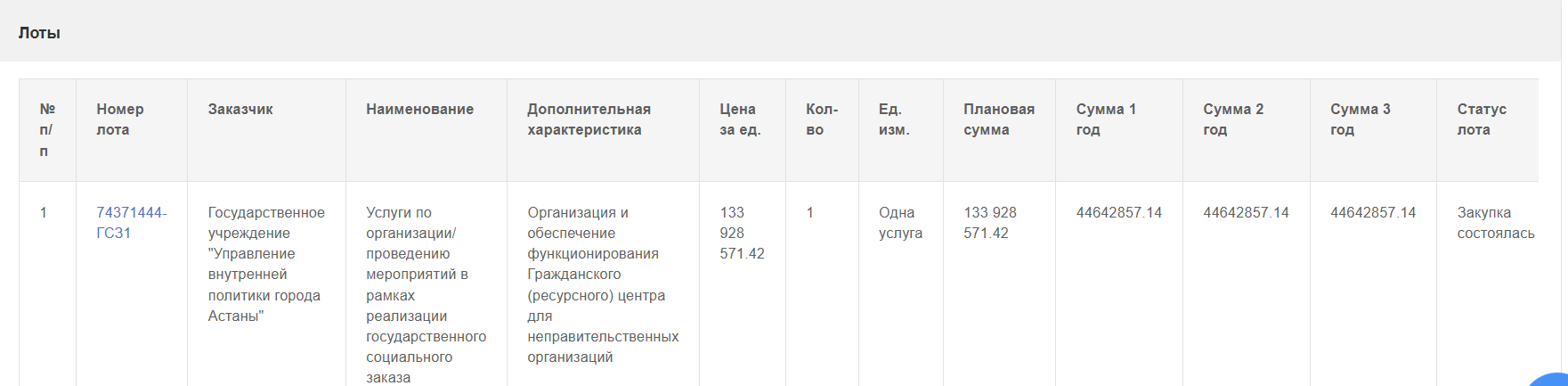
For the entire service, the Astana Akimat is ready to pay 133 million 928 thousand tenge.
They will be used for:
- Office rental and center design
- Involvement of specialists
- Organizing events, including NGO days at universities, a civil forum and meetings at the Akimat
- Printing of materials (programs, notepads, pens, shoppers, thermoses)
- Video competition for NGOs (20 winners, 10 grants of 200,000 tenge)
- Creation of a database of NGOs, website modernization and networking events
- Consultations, trainings, and workshops for the non-governmental sector
The efficiency of 200-thousand-tenge grants is an eye-catcher, considering the small amount.
We addressed all questions directly to the client — the internal policy department of the Astana Akimat.
They explained that the project is designed to help local NGOs and increase their effectiveness.
As part of the project, the Center for Civil Initiatives had already rented a building in Astana. When the project ended, the building was vacated.
This year, the supplier is obliged to select premises that meet the requirements. Proposals for the implementation of the project are currently being considered. The center is planning to organize a common room with computers for organizing the targeted work of non-governmental organizations, the administration reported.
Mini-grants, as noted by the Akimat, "are intended to support new initiatives and small NGO projects, allowing them to implement the idea at the initial stage."
In their official response, the administration mentioned grants not of 200,000 but 500,000
The organization that won the tender is the Kazakhstan Association Damu ULE.
According to the kompra.kz website, the association paid three million tenge in taxes in 2024. In 2023 — 1.8 million tenge, and in 2022 and 2021 — 1.2 million tenge.
Anara Bitebayeva is listed as its head. It also has two branches: Almaty, Almaty region, Aqtau, and the Mangystau region.
Kompra.kz indicates that the organization won at least 29 tenders in Astana, East Kazakhstan, and Mangystau regions from 2.5 to 13 million tenge in 2024.
In 2024, the amount of the state social contract won by Damu was smaller - only 13 million tenge for a project called: “Organization of work to implement sustainable development goals.”
In 2023, the organization also won several tenders; the amounts were more modest than the current 133 million tenge:
- 4.4 million tenge for “ implementing a set of measures to form a gender culture”
- 8.9 million tenge for “ organizing a set of events dedicated to the state holidays of the Republic of Kazakhstan”
- 13.3 million tenge for “ holding a series of events with leaders of the civil sector and the media space”
Anara Bitebayeva hails from Pavlodar. She was born in 1978 and created the organization in 2019.
Today, the ALE "Kazakhstan Association Damu" is actively working in the fight against corruption. It conducts trainings and seminars together with the Research Institute for the Study of Anti-Corruption Issues of the Academy of Public Administration under the President of the Republic of Kazakhstan.
Anara Bitebayeva also owns the advertising agency Arkar Finance. In 2024, the company paid only 156,000 tenge in taxes. In 2023 - 229 thousand. And in 2022 - a million tenge.
Arkar Finance also participated in government procurement and government contracts but with much more modest amounts.
In 2018, the company had a court case with the RGU "Sports Committee - Central Sports Club of the Army of the Ministry of Defense of the Republic of Kazakhstan."
It concerned Arkar Finance's recognition as an unscrupulous participant in public procurement and recovery of a penalty.
The essence of the dispute was that the agency failed to fulfill a state order for 94 million tenge on time.
The court ordered Arkar Finance to pay a penalty but did not recognize the company as an unscrupulous supplier.
"Golden" Tenders for Youth Initiatives
In Almaty, the Akimat hasn’t held a similar tender, but other projects fall under state social procurement.
The largest tender for 2025 comes from the Youth Policy Department of Almaty, which allocated 241.9 million tenge for the Jasyl El project, which provides temporary seasonal employment. In second place is the Active Longevity Center in the Medeu district, which received 123.7 million tenge.
Another 108.4 million tenge has been allocated for “ensuring the community center's activities” in Jetisu District-2.
Meanwhile, in Shymkent, another major city in Kazakhstan, the situation in 2025 looks much more modest.
So far, only tender announcements have been made.
The largest proposed tender is 11.2 million tenge for a project aimed at "developing dialogue with young people and supporting youth initiatives to increase their engagement in public life."
Kazakhstan is indeed making youth a financial priority.
State funding for NGOs amounts to tens, if not hundreds of millions of tenge, but the real question is — what exactly is the state willing to spend it on?
Can these funds replace foreign grants while preserving the independence of human rights organizations, or will they serve as another instrument of control?
It’s not just about the numbers; it’s about the actual impact on society.
Original Author: Zhadra Zhulmukhametova
Latest news
- Kazakhstan Prosecutor Opposes Deportation of 16-Year-Old Russian Teen
- Russian TV Channels Taken Off Air in Kazakhstan
- Mistaken Claim? Kazakhstan Denies $1B Contribution to the Board of Peace
- How many Kazakhstanis remain in the Middle East — MFA
- Kazhydromet Warns of High Flood Risk in Five Regions in 2026
- MP Calls for Prosecutor Review of Kazakhstanis’ Dubai Property
- Kazakhstan Moves to Legalize Private Detective Work
- Kazakhstan to Extend Gas Export Ban for Six More Months
- Majilis MP Calls to Soften Liability for Kazakhstanis Drawn into Foreign Wars for Pay
- The Delivery of 51 Stadler Passenger Coaches Has Been Delayed
- Kazakhstan Returns Nearly 1,000 Citizens From the Middle East
- Damaged Baikonur Launch Pad Facility Restored After 2025 Collapse
- A Rare Black Melanist Wolf Was Shot in Eastern Kazakhstan
- Kazakhstan Maintains Neutral Stance on Middle East Escalation
- Kazakh MFA: Citizens Evacuated from the Middle East via Oman and Saudi Arabia
- Kazakhstan to Spend 4.6 Trillion Tenge on Road Projects Through 2029
- Central Asia Competes for the Skies: Why Kazakhstan Risks Falling Behind Uzbekistan on Jet Fuel
- The War in Iran Opens a Window of Opportunity for Kazakhstan’s Oil Sector, Analysts Say
- Iran Conflict Escalates Beyond the Gulf: What Kazakh Experts Say About Risks for Central Asia and Kazakhstan
- Kazakhstan Prepares Possible Evacuation of Its Citizens From Iran
