

Qosshy Replaces Domestic Traffic Software with Russian Alternative Amid Contractor Dispute
 Photo: Midjorney, ill. purposes
Qosshy has become the second city in Kazakhstan to forgo Kazakh traffic management software in favor of the Russian product “Megapolis.” Deputy Akim of the city, Nurlan Sadyrov, explained the decision as an effort to avoid dependence on domestic software developers, describing the Russian product as “publicly available,” Orda.kz reports.
According to the National Accreditation Center, the “Megapolis” automated traffic management system is not certified in Kazakhstan. This means there is no information about its quality, reliability, or compliance with national standards.
Additionally, the Russian software has a local representative in Kazakhstan—City Traffic LLP. This company claims to have the “exclusive right to use and maintain the Megapolis system.”
Yet, the Akimat's contractor is an entirely different company — KOKZHAL LLP.
Reason #1
We were forced to change the system (Kazakhstani — Ed.) because it was proprietary, and we became dependent on the developers. They could regulate traffic even though they were no longer our contractors. So we changed the software to something more universal,said Deputy Akim of Qosshy Nurlan Sadyrov.
Notably, Qosshy’s traffic lights were previously connected to the capital’s road management system. This system enabled real-time traffic and passenger flow management, coordination of green waves, and more. The control panel was housed in the Qosshy Akimat building, and only the client had the right and ability to operate it.
The previous contractor’s role was limited to monitoring equipment status to promptly address malfunctions.
The development of Qosshy’s modern traffic system took two years and involved a significant investment. With the arrival of the new Akim, the decision was made to replace it.
Reason #2
Another reason for the software change, according to the Deputy Akim, was the new contractor’s lack of expertise. The Akimat had awarded the tender for “installation, assembly, repair, and operation of traffic lights and road signs” to a company that offered a 52% discount, ultimately securing the contract for 25.5 million tenge.
After winning the tender, it became clear that the company did not meet the necessary qualifications and could not maintain the city’s expensive equipment. This seems to have prompted the software switch, even though the existing equipment was still under warranty.
We’re currently facing issues with traffic lights because there is proprietary software there. That added some complications. Before, the old contractor would come and handle adjustments themselves. But since this is government procurement, we can’t work with the same contractor every year. It’s a competitive environment,the official stated.
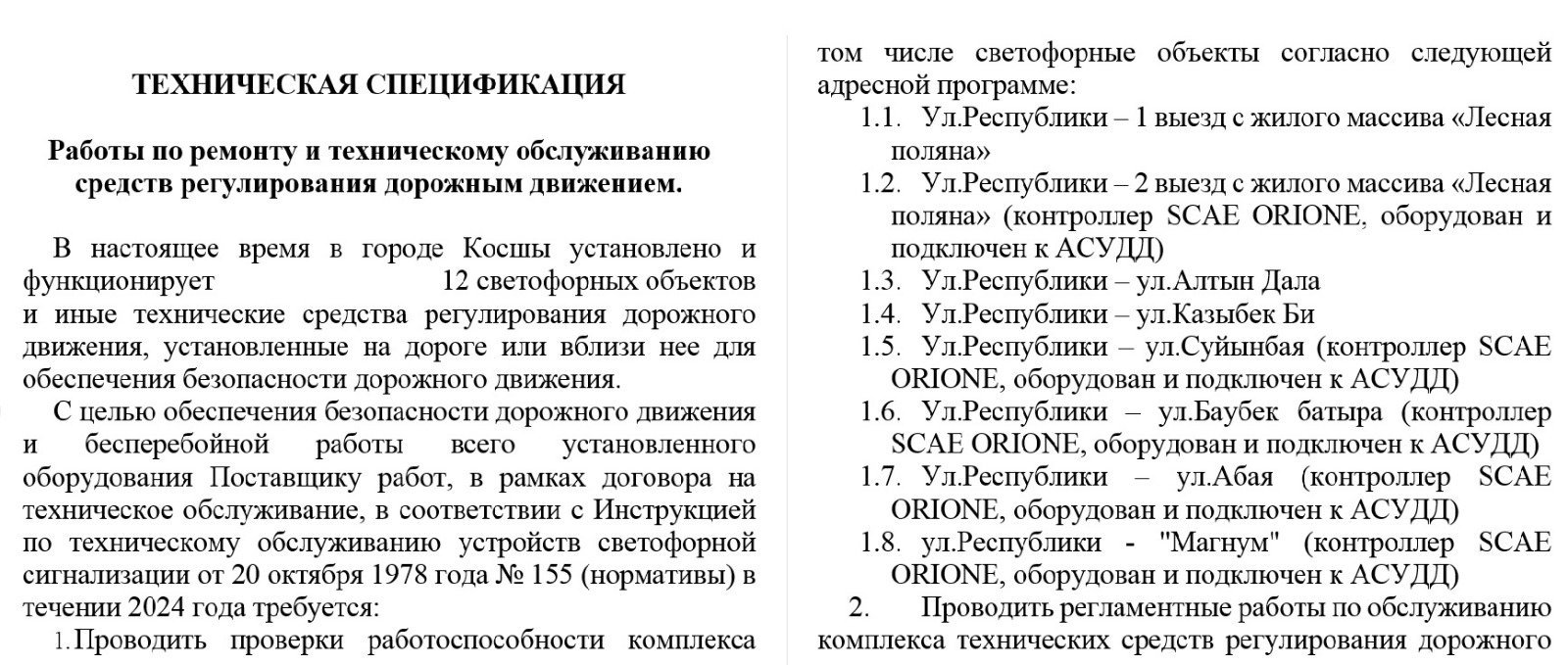
This might have explained the situation — if not for one key detail. The technical specifications required the contractor to be able to work with SCAE controllers, which are integrated with Kazakh software.
So if the company lacked the necessary qualifications, why did the Akimat proceed with the contract?
The Akimat now claims that the tender did not include traffic light servicing.
We held a tender based on price offers because, firstly, there were time constraints, and secondly, most of the work involved road markings and signs. There was no traffic light work planned — they’re just being serviced, said the Deputy Akim, even though the official documents suggest otherwise.
What’s Next?
The Akimat appears to have tried to correct past mistakes. When announcing a new tender for traffic light servicing, they included a new requirement: the contractor must have experience working with the Megapolis software.
The technical specifications mention that only some traffic lights operate on the Russian software, with no reference at all to the Kazakhstani one.
Even before the new tender was announced, the Akimat and the contractor removed Kazakh developers’ equipment from Qosshy’s traffic lights and replaced it with hardware compatible with the Russian system. This was done without any government procurement process to upgrade or replace the equipment, meaning there were no formal grounds or allocated funds for such a change.
It also remains unclear why the Akimat is announcing a new tender when a similar one, based on price offers, was already held at the end of 2024 and is valid until the end of 2025.
Another questionable move is the new tender for installing traffic lights, which states that contractors must be able to work with the Russian software and integrate new lights into the Megapolis automated traffic control system.
But when and how did this system become operational? The city never officially purchased it.
A key question arises: why did the Akimat of Qosshy replace free, locally developed Kazakh software with Russian software that the city never officially purchased — and who ultimately benefits from this decision?
At the same time, the city has still not paid the Kazakhstan-based developers for part of the work and the equipment they installed — a total of 79.4 million tenge. Officials claim the work was not completed under the terms of the contract and have refused to pay.
Certificates of completion were signed, and the former head of Qosshy’s transport department signed a letter acknowledging that the city owed money to the company.
The new contractor, apparently with the Akimat’s approval, dismantled equipment that hadn’t even been paid for. It was never returned to the original owner.
The Document That Disappeared
The Kazakhstan-based company attempted to recover the debt from the Akimat outside of court. They contacted a notary and submitted documentation proving the existence of the debt. The notary issued a notarial writ of execution — a legal document that allows for debt collection without going to court.
According to the law, the debtor had 10 working days to contest the document. No one did. The notarial writ of execution went into effect, and the accounts of the transport department were frozen. When this occurred in February 2025, officials attempted to challenge the notary’s decision, but the deadline had already passed.
To regain the right to file a claim, officials argued that they were unaware of the law. They submitted several applications to the court — each one flawed in some way: either it was filed in the wrong court, lacked an address, had a faulty digital signature, was improperly drafted, or did not confirm the plaintiff’s authority.
Ultimately, the Qosshy City Court accepted the seventh attempt.
The court, however, unexpectedly ruled that the deadline had been missed not due to the department’s fault, but allegedly because the former department head had concealed the existence of the notarial writ of execution. No evidence was presented to support this; the former manager was not summoned, and neither side insisted on hearing from him.
Despite these irregularities, the court annulled the notarial writ of execution and unfroze the accounts.
The contractor was dissatisfied and filed an appeal. The company is demanding payment for the completed work.
Original Author: Ilya Astakhov
Latest news
- Kazakhstan Prosecutor Opposes Deportation of 16-Year-Old Russian Teen
- Russian TV Channels Taken Off Air in Kazakhstan
- Mistaken Claim? Kazakhstan Denies $1B Contribution to the Board of Peace
- How many Kazakhstanis remain in the Middle East — MFA
- Kazhydromet Warns of High Flood Risk in Five Regions in 2026
- MP Calls for Prosecutor Review of Kazakhstanis’ Dubai Property
- Kazakhstan Moves to Legalize Private Detective Work
- Kazakhstan to Extend Gas Export Ban for Six More Months
- Majilis MP Calls to Soften Liability for Kazakhstanis Drawn into Foreign Wars for Pay
- The Delivery of 51 Stadler Passenger Coaches Has Been Delayed
- Kazakhstan Returns Nearly 1,000 Citizens From the Middle East
- Damaged Baikonur Launch Pad Facility Restored After 2025 Collapse
- A Rare Black Melanist Wolf Was Shot in Eastern Kazakhstan
- Kazakhstan Maintains Neutral Stance on Middle East Escalation
- Kazakh MFA: Citizens Evacuated from the Middle East via Oman and Saudi Arabia
- Kazakhstan to Spend 4.6 Trillion Tenge on Road Projects Through 2029
- Central Asia Competes for the Skies: Why Kazakhstan Risks Falling Behind Uzbekistan on Jet Fuel
- The War in Iran Opens a Window of Opportunity for Kazakhstan’s Oil Sector, Analysts Say
- Iran Conflict Escalates Beyond the Gulf: What Kazakh Experts Say About Risks for Central Asia and Kazakhstan
- Kazakhstan Prepares Possible Evacuation of Its Citizens From Iran
