

Kazakhstan Exporters Sound Alarm as KTZ Imposes Over 20 Rail Transport Bans
 Photo: Midjorney Generated, ill. purposes
Kazakhstan is facing mounting logistics issues as the national railway operator KTZ has introduced more than 20 transport restrictions over the past two months, severely complicating grain exports to Central Asia and shipments to China. The bans have left hundreds of loaded railcars stranded on sidings, with freight carriers reporting mounting financial losses, Orda.kz reports.
The most problematic restriction is the ban on exporting cargo through Saryagash — Kazakhstan’s main rail gateway for grain shipments to Uzbekistan, Tajikistan, Kyrgyzstan, Turkmenistan, and Afghanistan.
According to KTZ, the ban aims to “stabilize train traffic and prevent disruptions in supplying socially important goods.”
Orda.kz has requested clarification from the company.
Despite the bottlenecks, transit cargo has continued to move smoothly. Transit freight from Russia and China carries significantly higher tariffs, and exporters say KTZ prioritizes those more profitable shipments at the expense of domestic producers.
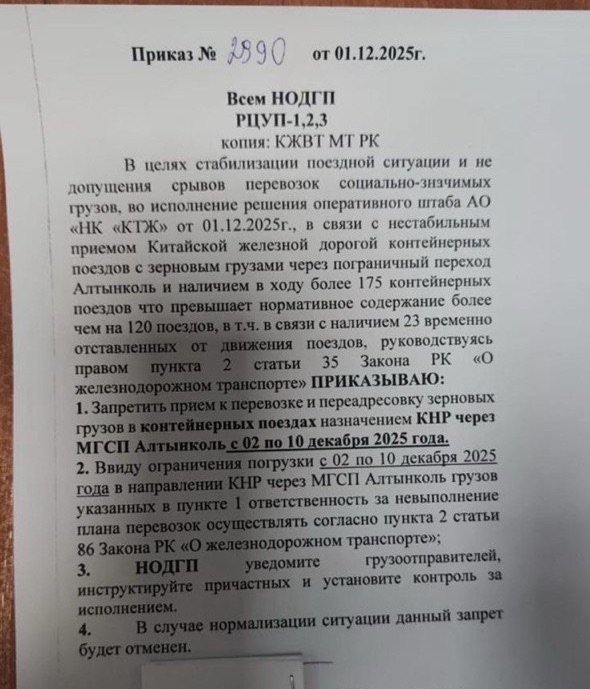
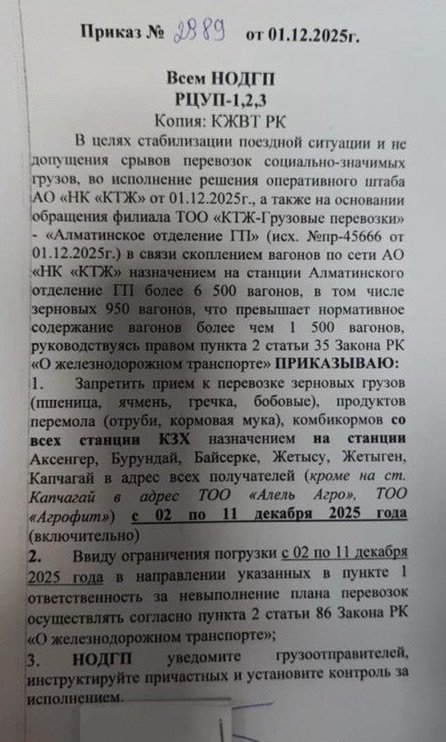
Export cargo, by contrast, is low-margin and takes up considerable infrastructure capacity.
Exporters argue this prioritization is deliberate.
Due to restrictions, logistics costs are rising unpredictably. We can't keep up, and the prices for contracts signed several months ago are no longer valid. But they can't be changed, and that's why we're losing money, plus the dollar has fallen. Almost all flour mills are export-oriented. We're one of the few that supply products within Kazakhstan. We load an average of 50 railcars within Kazakhstan. We have branches and warehouses in various cities. Therefore, many manufacturers rely on our flour; the technology is well-established, including semi-finished products and bakeries. And for several months now, because of this situation, we've been loading our products in Kazakhstan at a very unprofitable rate, at a loss, for three months now. But we can't let down the factories that depend on us; we can't lose our reputation. We hope the situation will resolve itself, and we continue to supply Kazakhstan,
said Viktor Gavrilenko, logistician at Aruna LLC.
Exporters warn that the rate imbalance now gives priority to Russian and Uzbek cargo registered as transit, pushing Kazakhstani companies out of regional markets.
As a result:
- Kazakh exporters are losing customers in Uzbekistan — their largest market in the south
- Factories are being underutilized
- Wagons sit idle for hundreds of hours, generating fines
- Russian and Uzbek suppliers are displacing Kazakh grain producers
- Conditions inside Kazakhstan have also deteriorated
Since we don't have railcars, we're looking for alternative delivery routes. We use trucks, but they're much more expensive. This is why shipping in Kazakhstan is unprofitable. Besides, we work in tenge, and prices for everything except flour are rising. Flour, a strategic raw material, isn't rising in price. I'll explain why this situation has arisen within the republic. We have a fleet called Kaztemirtrans, formerly state-owned, then converted into an LLC. There's no alternative to this fleet in Kazakhstan. It's the most affordable and has plenty of railcars. It's convenient to work with, but now there aren't any. They've also gone to China and abroad, and it's unprofitable. Kaztemirtrans also needs to make money during the season. All the railcars are exported. And all the other railcars are very expensive, plus there are restrictions,
added Gavrilenko.
The Scale
At Saryagash alone, over 12,000 grain railcars have been unable to depart. In October and November, additional bans were imposed at Dostyk and Altynkol — disrupting more than 200 trains.
Two months of restrictions have effectively turned KTZ into a regulator, exporters say, with bans functioning as a tool to push traffic toward lucrative transit.
Low export rates lead to carriers losing money. This forces them to prioritize expensive transit, which requires bans. But then exports suffer, and the economy loses revenue:
KTZ's policy is focused solely on personal profit. The interests of Kazakhstan citizens and local businesses are irrelevant, as transit generates the lion's share of revenue. That's why transit is prioritized. Consequently, stations are clogged with cars sitting idle both on sidings and at stations, greatly impeding car turnover,
said Yulia Velmitskaya, logistician at Kostanay station.
According to her, only customers bear the losses:
- Broken contractual obligations
- Wagon downtime charges on private tracks and KTZ lines
- Reduced or suspended production at export-dependent factories
At the same time, KTZ bears no responsibility to its customers — no fines, penalties, discounts, or repayments for cars not delivered or removed from sidings or station tracks on time, for late freight deliveries, or for loading disruptions due to constant, sudden bans. Businesses are suffering colossal losses. We're not even talking about lost profits; we'd be able to cover the wages of our employees. So what can we do? Organize a boycott? Businessmen can't afford that. We're responsible not only for our obligations to banks/landlords and clients/partners, but also for hundreds of employees whose wages we have no right to withhold,
Velmitskaya added.
KTZ's Explanation
KTZ previously said the bans were caused by slower train acceptance on the Chinese side. They cited a reduction in trains entering via Altynkol — from 14 to 10 per day, and on some days to six.
Chinese authorities, KTZ claims, now conduct multi-day laboratory inspections of grain, causing a backlog of 3,000 railcars.
As a result, KTZ introduced temporary limits: no more than three grain container trains per day.
According to the company, the restrictions are “temporary and forced.”
Exporters say the explanations don’t match reality
Forwarders report that only Kazakhstani railcars are stuck at the border — while transit wagons move through the “green corridor.”
We were given this information (about intensified inspections by China – Ed.). But the Chinese side says they have enough space, everything is fine. But then again, we don't have reliable information. We haven't been there ourselves, we haven't traveled there. But they say only Kazakhstani railcars are parked at the border. Transit railcars go beyond the green corridor. And our railcars are parked. We can't send them because of the ban. And the railcars are on credit, and the credits need to be repaid. And the employees, of course, need to be paid. Representatives of KTZ from Astana visited us, saying they're doing everything possible and impossible, and that everything will soon be fine, but the situation is only getting worse, Olesya Sharavina, a logistician at TEK GLOBUS TRANS LLC, told us.
Orda.kz previously reported that thousands of Kazakhstan’s export railcars remain stuck at the borders with China and Uzbekistan due to KTZ’s prohibitions.
Last year saw similar delays at the Chinese border, where inspection times reportedly stretched from five days to nearly two weeks.
Original Author: Ilya Astakhov
Latest news
- Ministry of Health Reveals Leading Causes of Death Among Kazakhstanis
- Smell of Feces and Flooded Offices: The Conditions KTZ Employees Work In
- “We Are Less Prone to Corruption”: NSDP Members Discuss Women in Power and “Men’s Clubs”
- Auditors Reveal How Officials Diverted Tens of Billions of Tenge in Kostanay Region
- Kazakhstanis Cool on Dollar Despite Favorable Exchange Rate
- EAEU Looks to Speed Up Transportation Using AI
- Astana Resident Who Posted Story About Harassment in Army on Social Media Detained
- National Bank Allows Use of Old 10,000‑Tenge Bills Until 2027
- Parliament Adopts Law on Special Status of City of Alatau
- From Electric to Hybrid: Kazakhstan’s Changing Auto Market
- Kazakhstan Proposes Changes to Structure of Pension Contributions
- Three New Hydroelectric Power Plants to Be Built in Kazakhstan
- Life Up to 77 Years: New Healthcare Strategy Presented in Kazakhstan
- Kinopark Demanded "Entry Fees" for Film Distribution in Kazakhstan
- Could Kazpost Be Closed in Kazakhstan's Villages? Prime Minister Responds to Deputies' Concerns
- Kazakhstan Seeks to Introduce Compulsory Employment for IDPs and Kandas
- Residents of Almaty Demand Return of Baum Grove to Specially Protected Natural Area Status
- A Drone Again? Object Similar to UAV Found in Western Kazakhstan
- Problems of the Caspian Sea and Projects Worth Billions of Dollars – What Bektenov and Mishustin Discussed in Astana
- Senate Ratifies Protocol to Simplify Alimony Collection Abroad
