

An Artist from Almaty Deciphers the Sacred Meanings of Kazakh Ornaments
 Photo: Orda.kz
Ornaments are a part of the visual language familiar to every Kazakhstani. We see it from childhood, but often don’t reflect on the deeper meanings behind each element. Orda.kz set out to uncover what lies beneath these familiar symbols.
Azhar Altynsaka is a textile artist currently researching traditional Kazakh embroidery and gathering a variety of techniques. So far, she has identified and described more than 50 different stitches, exploring their regional distribution and aesthetic significance. She is affiliated with the "Steppe Magic" art space and the "Turk Tengri" foundation.
Ornaments are the ethnocode of the people. They are not just decorative visuals, but reflections of the ancestral worldview.
Most people today look only for the meanings behind the ornaments. But an ornament is more than a wish, a prayer, or protection. First of all, the ornament reflected the ideas of being; it was an interpretation of the divine chaos (the surrounding world), how the world was perceived by our ancestors, what they believed in, and sacralized. That’s why understanding the meaning of an ornament must go hand in hand with understanding the worldview of our ancestors,says Azhar.
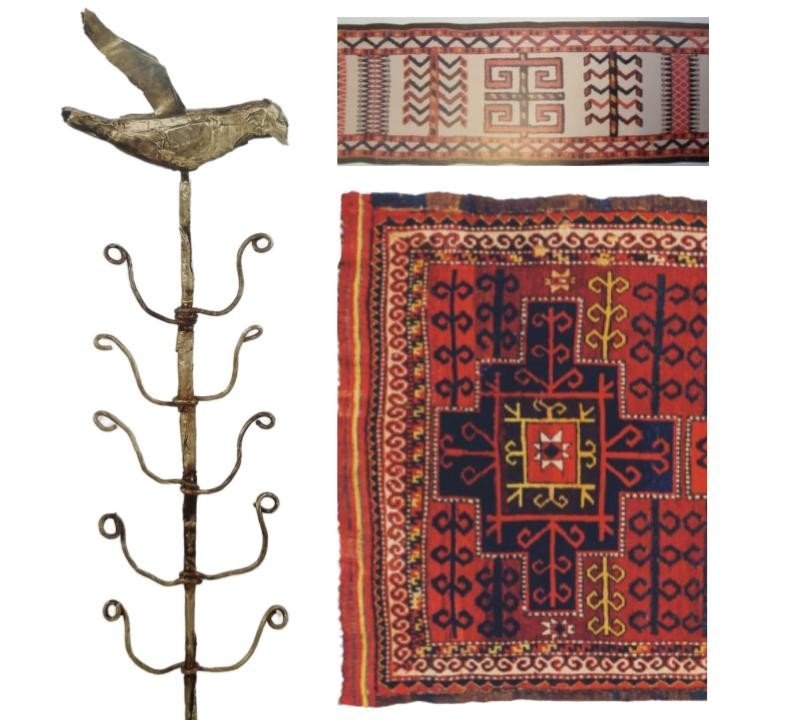
In ancient times, Kazakhs had a completely different way of describing the universe. The ideas of heaven and hell were unfamiliar. Instead, the world was divided into three layers: the Upper, Middle, and Lower Worlds. Just as a person travels through the steppe, their soul also journeys through these realms. One theory suggests that ornaments can be classified according to their relation to these layers.
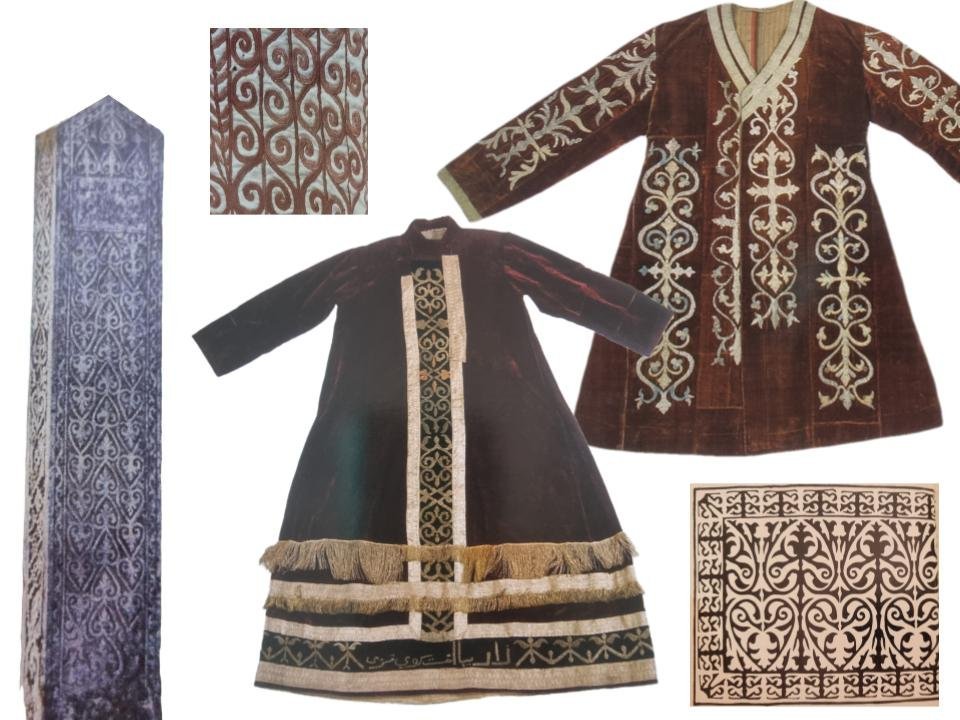
For example, in this drawing, you can see a stylized camel’s paw fused with plant elements on a kulpytas (gravestone), a bride’s wedding dress, a saukele (ceremonial headdress), and a felt carpet.
These objects represent different planes: the gravestone signifies the Lower World, clothing represents the Middle World, and the headdress symbolizes the Upper World.
One hypothesis says all plant motifs are manifestations of the World Tree, Baiterek. It belongs to the realm of magical ornaments and is considered to represent the Upper World. The camel’s paw is another common motif, which is also very often used on small architectural forms, especially in western Kazakhstan. But the same ornament appears on a bride’s dress, on the saukele, and elsewhere, making it difficult to definitively assign patterns to specific realms, Azhar explains
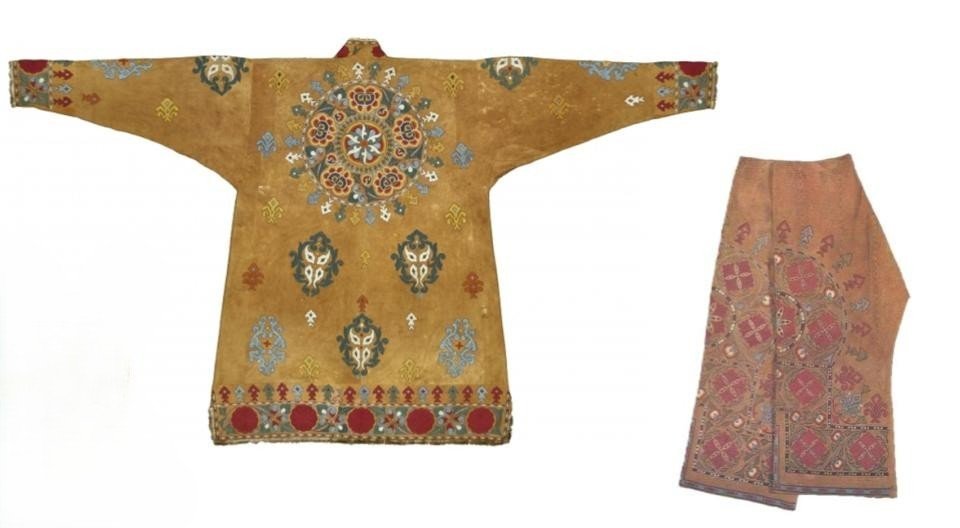
According to one theory, plant-based motifs symbolize the various forms (hypostases) of the World Tree, cosmogonic patterns, and sun-related ornamentation—all traditionally associated with the Upper World. Yet, they also appear on garments linked to the Middle World.


The classification of ornaments many learn in school — dividing them into plant, zoomorphic, astral, and geometric types — became outdated 800 years ago. Most ornaments we see today are hybrids, combining multiple types. Nonetheless, certain defining properties remain.
They were first documented by Samuil Dudin about 100 years ago during his expeditions. At that time, he identified four characteristics of Kazakh pattern-making; now there are more than 10 of them.
Some of the main features include:
- The pattern and background are equally important
- Ornaments retain aesthetic value across surfaces
- No fixed top or bottom
- A simultaneous perspective from above and in profile
Today, there are many opinions and hypotheses about the meaning of Kazakh ornaments, but most lack a scientific foundation, making research complicated. For many reasons, we’ve lost our mythological consciousness and archaic worldview (which is a natural part of societal development), while the ornaments have gone through a complex evolutionary process. Now, only scientific study can help us recover their true meanings. The study of ornaments is a fascinating interdisciplinary journey through history, ethnography, anthropology, archaeology, philosophy, mythology, and art history, Azhar notes.
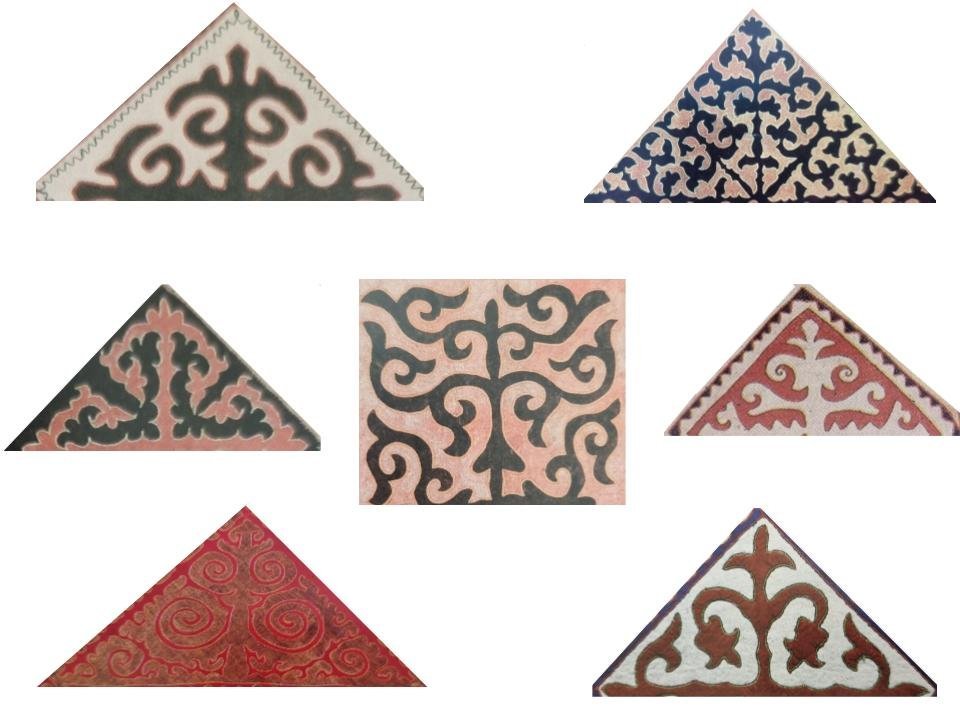
For example, while many assume that any spiral motif represents a ram’s horn, Azhar points out that these designs often combine cosmogonic, anthropomorphic, and bimorphic (plant and animal) elements. Alongside the ram’s horn, you may find synthesized symbols of the universe, birds, human figures, and the World Tree.
Throughout history, the Kazakh people have, at times against their will, lost up to 70% of their traditional art. Along with it, the mythological mindset faded, and the generational link to this symbolic language weakened, making interpretation more difficult.
Many believe the key to decoding the full meaning of Kazakh ornamentation has been lost. As pattern-making continues to evolve, ornaments are simplified and merged, but the search for their sacred roots continues.
This didn’t happen only to the Kazakhs — it’s a universal phenomenon among all peoples of the world, and it’s completely natural. Ornaments evolve over time. For example, more than a thousand years ago, people used to depict an entire ram. Rams or all horned animals in general were considered sacred. The ram’s horns symbolized the sun, while a deer’s antlers represented the World Tree. And at some point, our ancestors stop depicting a ram as a whole, and took only the most important element,explains the researcher.
Today, Kazakh ornaments are widely used by the public. And although their application may sometimes appear simplistic or superficial, it reflects a growing interest and a positive cultural impulse. Experts can classify, describe, and create typologies — but ornaments must live among people, not just in academic archives.
The evolution of ornamentation cannot be stopped. While science continues to study these patterns, we are simultaneously witnessing the loss of original meanings, the merging of different ornamental motifs, the emergence of new interpretations, and the creation of entirely new forms. Whether scientific research can keep pace with these modern transformations — both in form and meaning — is an open question, says Azhar.
Original Author: Daria Sidorova
Latest news
- Kazakhstan Prosecutor Opposes Deportation of 16-Year-Old Russian Teen
- Russian TV Channels Taken Off Air in Kazakhstan
- Mistaken Claim? Kazakhstan Denies $1B Contribution to the Board of Peace
- How many Kazakhstanis remain in the Middle East — MFA
- Kazhydromet Warns of High Flood Risk in Five Regions in 2026
- MP Calls for Prosecutor Review of Kazakhstanis’ Dubai Property
- Kazakhstan Moves to Legalize Private Detective Work
- Kazakhstan to Extend Gas Export Ban for Six More Months
- Majilis MP Calls to Soften Liability for Kazakhstanis Drawn into Foreign Wars for Pay
- The Delivery of 51 Stadler Passenger Coaches Has Been Delayed
- Kazakhstan Returns Nearly 1,000 Citizens From the Middle East
- Damaged Baikonur Launch Pad Facility Restored After 2025 Collapse
- A Rare Black Melanist Wolf Was Shot in Eastern Kazakhstan
- Kazakhstan Maintains Neutral Stance on Middle East Escalation
- Kazakh MFA: Citizens Evacuated from the Middle East via Oman and Saudi Arabia
- Kazakhstan to Spend 4.6 Trillion Tenge on Road Projects Through 2029
- Central Asia Competes for the Skies: Why Kazakhstan Risks Falling Behind Uzbekistan on Jet Fuel
- The War in Iran Opens a Window of Opportunity for Kazakhstan’s Oil Sector, Analysts Say
- Iran Conflict Escalates Beyond the Gulf: What Kazakh Experts Say About Risks for Central Asia and Kazakhstan
- Kazakhstan Prepares Possible Evacuation of Its Citizens From Iran
