

Digital Nomad Residency: Authorities Respond to Technical Complaints
 Photo: Orda.kz
In late June, Orda.kz reported on the story of a foreigner trying to get a residence permit in Kazakhstan through the widely publicized Digital Nomad Residency program, but has not been able to do so so far, mainly due to technical errors.
After speaking with him, we reached out to the relevant state agencies.
Here's what they told us.
Our interviewee, a Russian IT specialist who asked to go by Nikolai, has been living in Kazakhstan for several years. When the Ministry of Digital Development launched its Digital Nomad Residency program in January, Nikolai saw it as an opportunity to formalize his status.
Applications officially opened in mid-February, but he still hasn’t received a residence permit.
According to Nikolai, the main issues were bugs on the eGov website and a shortage of migration police officers dealing with Digital Nomad Residency.
No Technical Failures Recorded
We reached out to the four entities responsible for the Digital Nomad Residency program: the Ministry of Internal Affairs (MIA), the Ministry of Digital Development, Innovation and Aerospace Industry (MDDIAI), Government for Citizens, and National Information Technologies JSC (NIT).
Nikolai told us that when he visited the Bostandyq District migration office in person, the staff had never heard of the Digital Nomad Residency program and said they couldn’t accept documents for it.
In response, the Ministry of Internal Affairs confirmed that they are aware of the program, and added:
Foreigners and stateless persons, provided they meet the legal requirements, have the right to apply to the migration service departments for a permanent residence permit, regardless of the implementation of the Digital Nomad Residency pilot program.
As for staffing shortages, the MIA stated that the number of officers is adjusted based on workload.
Nikolai also mentioned failures on the eGov platform. So we contacted NIT and Government for Citizens, which oversee its technical performance.
Government for Citizens referred us to NIT, so we got two identical answers:
We inform you that no technical failures on the eGov.kz platform affecting the processing of migration-related documents, including Digital Nomad Residency, have been recorded.
As we reported earlier, complaints about the eGov platform haven’t come just from digital nomad applicants — foreigners applying for temporary residence permits online have also faced issues.
Nevertheless, NIT insists the platform is functioning properly.
Between January 1 and June 25, 2025, no official complaints were submitted to NIT JSC regarding any platform issues affecting migration document processing. No technical problems have been detected on the eGov.kz side.
According to NIT, the delay may lie with the applicants themselves:
The reasons may be incorrect data provided by applicants, an incomplete package of documents, or the need for additional checks. These situations are not related to the technical operation of the eGov.kz platform, and are regulated by current migration laws.
They also noted that:
In some cases, the registration process may be delayed due to the need to clarify submitted data, request additional documents, or conduct additional checks. These are standard procedures stipulated by the legislation of the Republic of Kazakhstan, and they are not related to technical failures of the eGov.kz platform. It is important to understand that submitting an application on eGov.kz portal is just one step in a multi-stage process — it only sends your request for preliminary approval.
Still Waiting
More than two weeks have passed since our last conversation with Nikolai. At that time — in late June — his legal stay in Kazakhstan was about to expire. We checked in to see what happened.
He told us he had received a temporary residence permit, which now allows him to remain in the country legally. But the process wasn’t smooth:
It turned out that if you work for an individual entrepreneur, the owner of the residence where you live must receive an SMS with a code from eGov, which then needs to be passed to the Public Service Center. When I applied for a temporary residence permit, the SMS service didn’t work for an hour and a half.
The process of obtaining a residence permit has made some progress:
At the end of June and the beginning of July, applications moved beyond the migration police. Now, my application and those of several others are at the approval stage with the National Security Committee. If all goes well, the first approvals or rejections might come by mid-August.
We reached out to the Ministry of Digital Development to find out how many foreigners have applied for a residence permit through the Digital Nomad Residency program — and how many have actually received one.
So far, 156 applications have been submitted via the Astana Hub website. Of those, 29 people have progressed to submitting their applications through eGov.kz. Some are currently under review by the authorized government agency, five have been sent back for revision, 13 are awaiting processing, and one has been rejected. So far, no applications have been fully approved through the complete registration process, the Ministry replied.
According to the Ministry of Digital Development, another six people were rejected at the application stage by Astana Hub. The reasons for these refusals were not disclosed — the Ministry said that it falls under the jurisdiction of the Ministry of Internal Affairs and the National Security Committee.
The Ministry of Digital Development also did not respond to our question about why temporary residence permits weren’t offered to Digital Nomad Residency applicants during the permit registration process. Again, the Ministry said this was the responsibility of the Ministry of Internal Affairs.
We asked one more question: how can applicants living in other countries apply for the Digital Nomad Residency program, given that Kazakhstan’s IIN (Individual Identification Number) and an electronic digital signature (EDS) are required to register on the eGov website?
The Ministry replied that foreigners can obtain an IIN from abroad if Kazakhstan has a diplomatic mission in their country.
IINs can be issued at the consulates or embassies of Kazakhstan. Applicants must visit a diplomatic mission in person and provide the required documents. After obtaining an IIN, they can then apply for an EDS (electronic digital signatrue - Ed.).
However, the Ministry did not explain how a foreigner is expected to obtain an EDS.
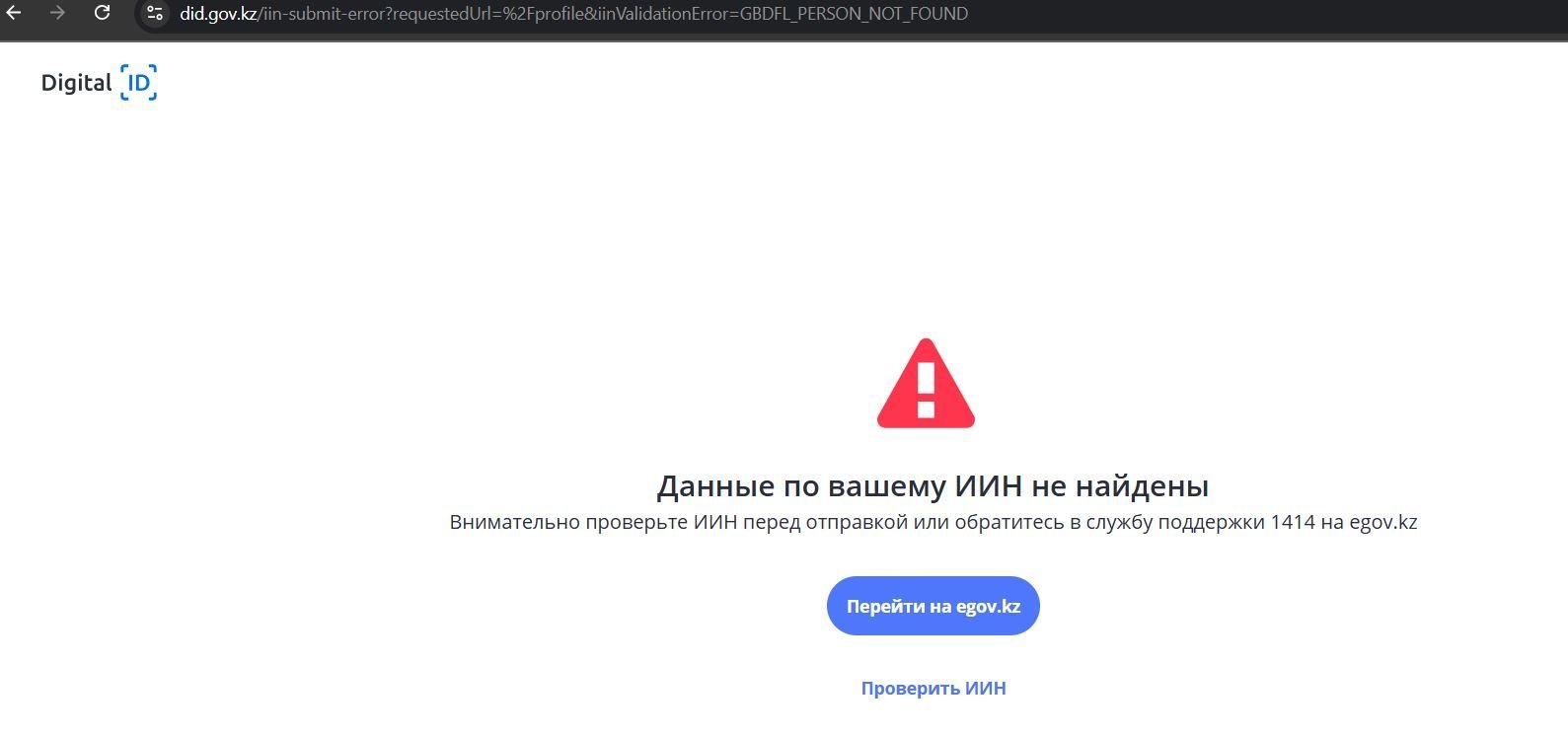
The e.gov.kz website does not accept applications using a foreigner’s IIN. Instead, it displays an error message.
In theory, as the Ministry stated back in 2021, EDSs can be issued at some Kazakh Embassies and Consulates — but only in 11 cities: Washington, Seoul, Bishkek, Moscow, Prague, Dubai, New York, St. Petersburg, Frankfurt am Main, Istanbul, and Beijing.
Orda.kz could not find any updated list or expansion of these locations on the Ministry of Digital Development’s website.
That means if someone in countries like Australia, Brazil, or Morocco wants to apply for the Digital Nomad Residency, they may need to travel thousands of kilometers to one of these 11 cities.
Original Author: Igor Ulitin
Latest news
- MP Calls for Prosecutor Review of Kazakhstanis’ Dubai Property
- Kazakhstan Moves to Legalize Private Detective Work
- Kazakhstan to Extend Gas Export Ban for Six More Months
- Majilis MP Calls to Soften Liability for Kazakhstanis Drawn into Foreign Wars for Pay
- The Delivery of 51 Stadler Passenger Coaches Has Been Delayed
- Kazakhstan Returns Nearly 1,000 Citizens From the Middle East
- Damaged Baikonur Launch Pad Facility Restored After 2025 Collapse
- A Rare Black Melanist Wolf Was Shot in Eastern Kazakhstan
- Kazakhstan Maintains Neutral Stance on Middle East Escalation
- Kazakh MFA: Citizens Evacuated from the Middle East via Oman and Saudi Arabia
- Kazakhstan to Spend 4.6 Trillion Tenge on Road Projects Through 2029
- Central Asia Competes for the Skies: Why Kazakhstan Risks Falling Behind Uzbekistan on Jet Fuel
- The War in Iran Opens a Window of Opportunity for Kazakhstan’s Oil Sector, Analysts Say
- Iran Conflict Escalates Beyond the Gulf: What Kazakh Experts Say About Risks for Central Asia and Kazakhstan
- Kazakhstan Prepares Possible Evacuation of Its Citizens From Iran
- LRT in Astana Is Reaching the Finish Line: The Launch Is Expected in the Coming Months
- Kazakhstan Ready to Help the UAE Amid Escalation in the Region
- Tokayev Discusses Middle East Escalation With Qatar’s Emir
- Airlines Ready to Bring Kazakhstanis Home From the Middle East
- Tokayev Sends Support Messages to Gulf Leaders Amid Regional Escalation
