

Toqayev’s Annual Address: Senate Reform, AI Ministry, And Sweeping National Priorities
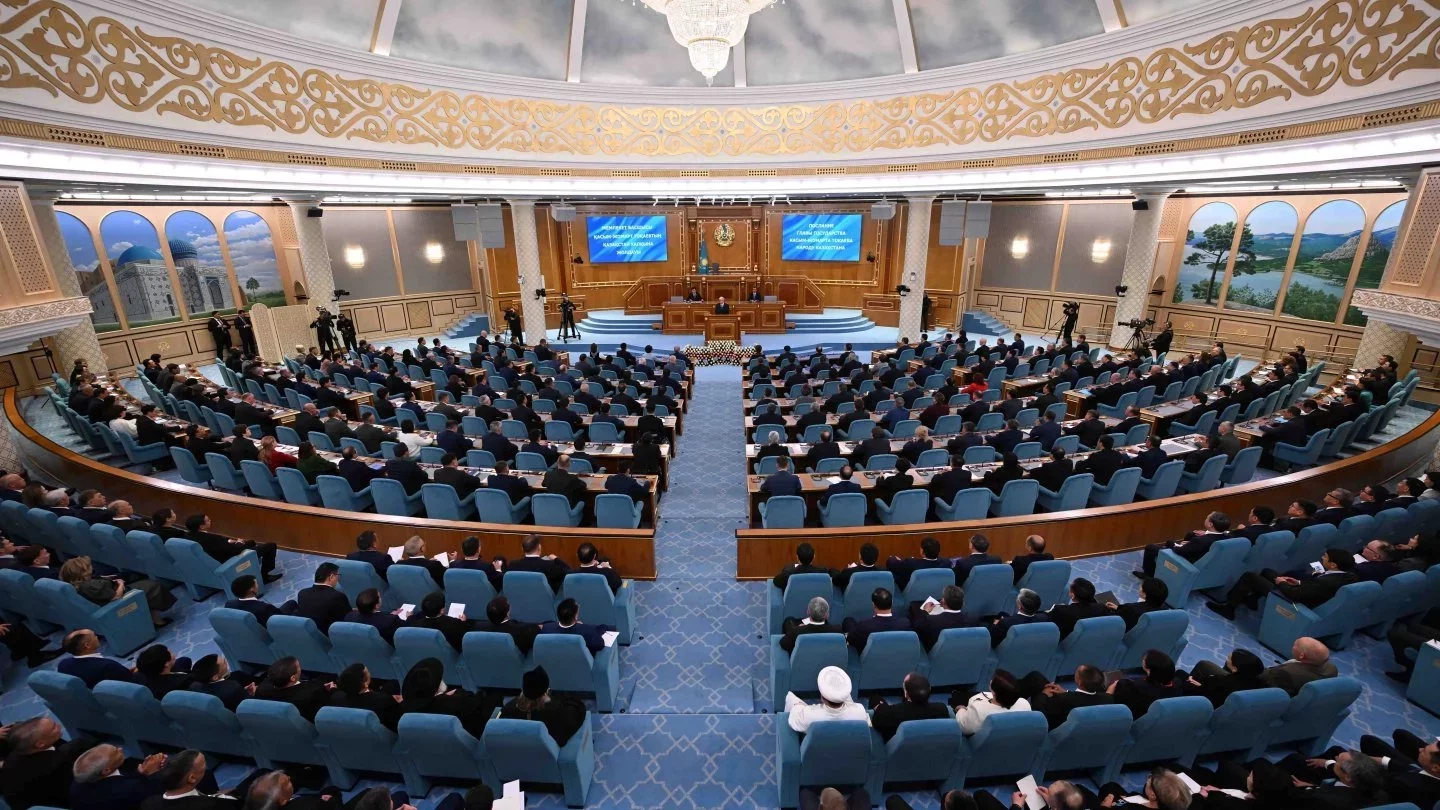 Photo: Aqorda
Today, President Qasym-Jomart Toqayev delivered his annual address to the people of Kazakhstan at a joint session of the chambers of parliament, Orda.kz reports.
In a wide-ranging speech, he outlined major reforms and priorities for the country — from artificial intelligence and the future of the Senate to energy policy, social benefits, and infrastructure.
Below we have summarized the key points from his address.
Creation of AI Ministry
Toqayev announced the establishment of a Ministry of Artificial Intelligence.
On the basis of the current specialized ministry, it is necessary to create the Ministry of Artificial Intelligence and Digital Development. It should be headed by a specialist at the level of Deputy Prime Minister, Toqayev said.
He stressed the need to modernize the economy through digitalization and the active use of AI. As a first step, he called for accelerating the adoption of the Digital Code, which will define key areas of digitalization, including AI, the platform economy, and the use of big data.
The president said the entire system of public administration must be restructured with greater transparency and efficiency.
Toqayev also instructed that Kazakhstan be transformed into a fully-fledged digital country within three years.
Renaming of The Asset Recovery Committee
The committee will now be engaged in protecting the rights of investors.
Toqayev said the country has developed a cumbersome and fragmented system of interaction with investors, which inevitably leads to bureaucracy and duplication of functions.
The work is being done unsatisfactorily. In the current difficult situation, attracting investment is our primary task, which requires new approaches. I would like to especially note that in any case, all organizational work to attract investment is entirely assigned to the Prime Minister. There is no need to establish a new ministry. However, it is striking that the name of none of the government agencies contains the word ‘investments’. This issue is under the jurisdiction of three or four institutions and has not been resolved, Toqayev said.
He gave Prime Minister Olzhas Bektenov 10 days to develop specific proposals and instructed the government to prepare a plan for the radical renewal of the investment attraction system as soon as possible.
I propose renaming the Asset Recovery Committee of the General Prosecutor’s Office of the Republic of Kazakhstan to the Investor Rights Protection Committee. It must be said that the Prosecutor General’s Office has worked well with the owners of illegal assets. About 850 billion tenge have been returned to the treasury. These funds are used to build 10 schools and four sports facilities, construct and modernize 235 healthcare facilities and 177 water infrastructure facilities. Additional funds are expected to be received by the national budget. We will be confident that investors will receive a greater degree of support, Toqayev said.
The Senate
Toqayev proposed a parliamentary reform that could lead to the abolition of the Senate. He noted that this reform would be a logical continuation of earlier changes, including the reform of presidential powers.
I myself had the opportunity to head the Senate for ten years, and I always perceived this work as a great honor and responsibility. Therefore, it is not easy for me to speak about parliamentary reform from this rostrum. Despite this, I will nevertheless make a proposal today to create a unicameral parliament in our country in the foreseeable future, Toqayev said.
At the same time, he stressed that this is a very serious issue that cannot be rushed.
The proposal must undergo thorough discussion among civil society, experts, and the current parliament.
I believe that the discussion, given the extraordinary nature of the reform, will take at least a year, after which a national referendum could be held in 2027, and then the necessary changes could be made to the Constitution. I have said more than once that all issues of crucial importance for the state will be resolved only with the consent of the people. If we all come to a common decision regarding the need to create a unicameral parliament, then such a parliament, in my opinion, should be elected only by party lists, Toqayev said.
He added that the current Majilis will continue its legislative work until the end of its term.
The Senate will continue to function until the results of the national referendum are summed up and new parliamentary elections are held. In turn, political parties will have time to carefully prepare for serious competition, Toqayev said.
Unfair Market Conditions: Plan for Milk Producers
The President pointed out unfair conditions facing Kazakh producers within the Eurasian Economic Union.
He emphasized the need to actively promote traditional national products abroad. Toqayev proposed updating the agricultural export plan, taking into account logistics, veterinary and phytosanitary standards, and a coherent marketing strategy.
He stressed that this work should involve not only the Ministry of Agriculture but also other state agencies.
The government is obliged to insist on fair conditions in the development of Eurasian trade. And deputies must protect the rights of domestic producers with legislative initiatives. It turned out that our entrepreneurs do not receive the required amount of state support compared to enterprises in other countries of the Eurasian Economic Union. Therefore, they are in unfavorable conditions and are forced to cede even their market to competitors. In particular, we are talking about milk producers, Toqayev said.
He also highlighted the country’s dependence on food imports.
This remains a serious problem. Of course, 100% self-sufficiency is impossible and probably unnecessary. But what is happening in our market now is a shameful situation, the head of state said.
Toqayev also called high inflation the main problem of Kazakhstan
Logistics
President Qasym-Jomart Toqayev said Kazakhstan must increase air cargo volumes and achieve this through the creation of a national cargo airline with the involvement of major foreign partners.
He called cargo aviation a profitable and in-demand sector amid the growth of e-commerce and high-tech shipments, urged the development of aero-hubs integrated into global logistics chains, and instructed the government to establish clear rules for express cargo.
Toqayev also noted the worldwide spread of unmanned delivery systems such as drones and ordered conditions for their accelerated introduction in Kazakhstan.
National Fund: Foreign Experts May Be Brought in
Toqayev also instructed a review of the National Fund’s management. He said it is time to rethink the fund’s role as a tool for sustainable development.
The fund’s resources must be used thoughtfully to finance promising small projects with high market prospects in our country. It is necessary to take a responsible approach to the distribution of funds. If necessary, international managers and investors with the relevant expertise can be brought in to this work, the president said.
Toqayev instructed the government, together with the National Bank, to prepare a program for investing up to one billion dollars in high-tech sectors of the economy.
He also stressed that second-tier banks must play a greater role in financing the real sector. According to him, banking assets in Kazakhstan are several times more profitable than in developed countries because banks prefer low-risk instruments over lending to the economy.
He tasked the National Bank and the government with developing effective tools to channel free liquidity into economic turnover.
The Energy Sector
Toqayev outlined Kazakhstan’s energy strategy, stressing that the country does not intend to abandon coal generation in the near future.
The president highlighted a major project to build Kazakhstan’s first full-scale nuclear power plant in cooperation with Rosatom. He noted, however, that one facility will not be enough and said plans should already include two additional nuclear power plants.
At a recent meeting with the President of the People’s Republic of China Xi Jinping, an agreement was reached on a strategic partnership between our countries in this industry. Kazakhstan is ready to cooperate with all global companies on a mutually beneficial basis, which is consistent with the goal of ensuring energy sovereignty, Toqayev said.
At the same time, he emphasized that expanding renewable energy and nuclear generation does not mean giving up coal.
Considering the huge reserves of high-quality coal in Kazakhstan, special attention should be paid to the development of coal energy using advanced technologies that guarantee its environmental friendliness. Our natural advantages must be skillfully used for the benefit of the country's development, Toqayev said.
According to the country’s “green” economy concept, by 2030 Kazakhstan plans to commission 93 renewable energy projects with a total capacity of 2.3 GW, raising the share of renewables in overall generation to 15% by 2030 and 50% by 2050.
How these targets will be met while keeping coal as a core part of the energy mix remains uncertain.
The Ministry of Energy has also stated that Kazakhstan does not plan to fully abandon coal.
Minister Akkenzhenov noted that several countries are already using technologies that reduce the environmental impact of coal-based power generation.
New Construction Code
Toqayev also focused on the housing construction sector. He noted that the industry has shown high growth in recent years, with 19 million square meters of housing commissioned in 2022.
At the same time, to improve the quality of construction, it is important to use information modeling of buildings using artificial intelligence technologies. The government should launch a national digital platform that will ensure end-to-end accounting, planning and monitoring at all stages of construction, Toqayev said.
According to the president, the new Construction Code should provide a solid legislative basis for the sustainable, transparent, and safe development of the construction industry.
The document must be adopted before the end of the year. I ask the deputies to provide assistance, he said.
The draft Construction Code, developed by the Ministry of Industry and Construction and costing hundreds of millions of tenge, was sharply criticized by deputies.
Water Resources
Toqayev instructed the creation of a digital platform using artificial intelligence to monitor water bodies.
He stressed that water is a strategic resource, and that solving problems in the sector is vital for social stability, sustainable economic development, and national security. He noted, however, that ministries and agencies responsible for water management do not currently have accurate information about its condition.
Today, the relevant agencies do not have accurate information about the available volume of water resources. Water losses in some canals reach 50–60%. Metering technologies are hopelessly outdated, and water intake points are not equipped with modern devices. The government should create a single digital platform for water resources that will combine data on surface and groundwater, the condition of canals, reservoirs, and dams based on AI. The launch of the platform will fully solve the problem of hydrogeological monitoring, Toqayev said.
He also highlighted the need to train qualified personnel in the field of water diplomacy.
Other Matters
Toqayev also spoke out about the behavior of Kazakhstani women.
According to the president, “rudeness, swearing, and fights have now become common, often seen even in public places and on the roads.”
It is especially unpleasant to see women causing scandals, using obscene language, and committing indecent acts in front of others. Such actions are unacceptable in a cultural, civilized society; they damage our country’s reputation on the international stage, he said in his address to citizens.
Toqayev emphasized that to become a progressive nation, Kazakhstan must decisively move away from such negative patterns of behavior.
The great Abay was right when he said: ‘If a Kazakh is not a friend to another Kazakh, life around will be joyless’ (‘Біріңді қазақ, бірің дос, көрмесең істің бәрі бос’). Culture, decency, and upbringing must begin with every citizen, with every family, he added.
Original Authors: Zhadra Zhulmukhametova, Anastasia Prilepskaya
Latest news
- Almaty Drivers Offered Free Emissions Checks Without Penalties
- Croatia Will Finance Oil Exploration In Aktobe Region
- Half of Kazakhstanis Earn Less Than $1,000 a Month
- Is The Era Of Easy Extraction Over? Resource Development Is Being Rebuilt In Kazakhstan
- How a Kazakhstani Tried to Change His Ethnicity Through the Courts — and What Came of It
- Economist Names Kazakhstan Regions Lagging in Investment Transparency
- 14-Year-Old In Tesla Tries To Flee Police In Astana
- When a Michelin-Recognized Restaurant Will Open in Almaty, Akimat Says
- Transfers To China From Kazakhstan Fall To Six-Year Low
- Chinese Company To Build $1.2 Billion Steel Plant In Kazakhstan
- Moldova Finally Leaves The CIS And Bets On The EU
- Kazakhstani Scientists Develop Feed From Meat Processing Waste
- Why Large Families Face the Highest Poverty Risk in Kazakhstan
- Kazakhstan Schoolboy First in Central Asia to Receive Google Grant
- Kazakhstan Prosecutor General’s Office Checks Possible Ties Between Officials and Epstein Case
- After Farmers' Complaints, Kazakhstan Changes Potato Trading Rules
- Officials Accused Of Legalizing Thousands Of Migrants For Bribes In Astana
- Almaty Zoo Names Triplet Tiger Cubs
- Only One Loss-Making Bank Remains In Kazakhstan
- Cormorants To Be Shot In Pavlodar Region
