

Putin and Xi Hold Talks in Moscow and Release Joint Statement on Key Global Issues
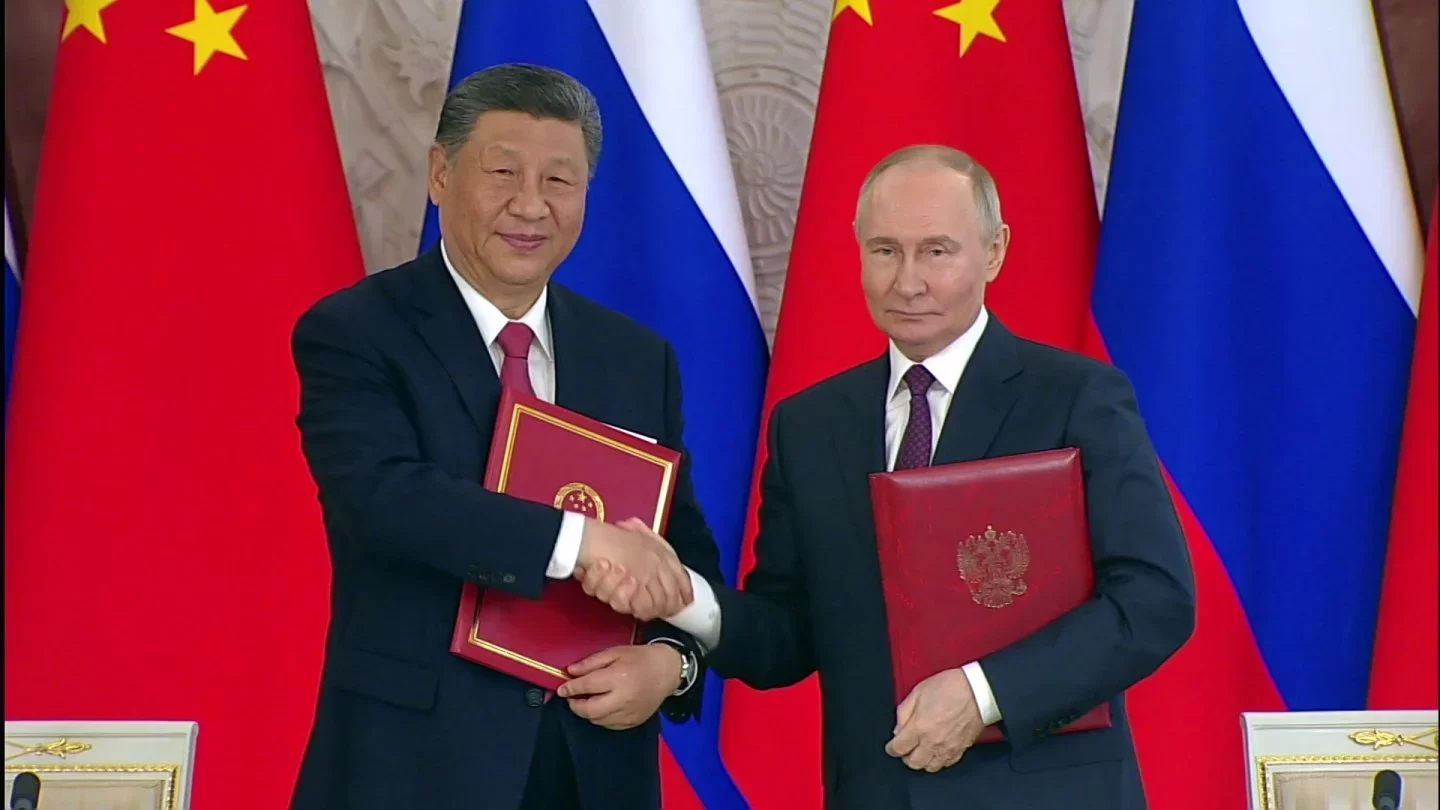 Screenshot: Kremlin video.
On May 8, the Kremlin hosted Russian-Chinese high-level talks. Russian President Vladimir Putin and Chinese Chair Xi Jinping discussed and signed intergovernmental agreements, reports Orda.kz.
In addition, a joint statement by the two countries was published on the Kremlin website. It addresses trade development, nuclear policy, and the arms race in space.
Mutual Support in Ensuring Territorial Integrity
The two sides reaffirm their “firm support for each other in ensuring sovereignty, territorial integrity, security and stability, and preventing any attempts by external forces to impede the normal development of relations between the two states and interfere in their internal affairs.”
The document notes that Russia recognizes Taiwan as an integral part of China, and the Chinese side opposes “outside interference in Russia’s internal affairs.”
Joint Military Exercises
The two countries will continue to "strengthen military and military-technical cooperation for the benefit of the peoples of Russia and China, as well as global and regional security." They also plan to "deepen mutual trust and interaction between the armed forces, expand the scale and geography of joint exercises, and regularly conduct joint maritime and air patrols."
Economics
The Russian Federation and the People's Republic of China agreed to improve the trade turnover structure, including by increasing the share of high-tech products and mutual supply of basic materials, mineral resources, and agricultural products.
They will continue to strengthen their "comprehensive energy partnership" and support economic actors from both countries in carrying out projects in oil, natural gas, LNG, peaceful nuclear energy, coal, electricity, and renewables.
The statement also outlines plans to deepen interbank cooperation, expand settlements in national currencies, improve transport infrastructure at the Russian-Chinese border, and enhance the efficiency of passenger and freight transport, customs clearance, and inspection procedures.
The UN
Russia and China, described as “main victorious states in World War II, founding members of the UN, and permanent members of its Security Council,” emphasize the importance of the UN’s 80th anniversary, to be marked in 2025.
They describe the founding of the UN as “one of the main results of the Victory in World War II” and affirm their commitment to the UN’s “central coordinating role in harmonizing the interests of member states and developing collective responses to the challenges of our time.”
Pressure on Other Countries
The parties stress the need for political solutions to crises through dialogue. They support "the constructive participation of the international community in the political settlement of 'hot conflicts' based on the principle of non-interference in internal affairs, as well as the elimination of not only their consequences, but also their root causes."
The document emphasizes that security in Eurasia cannot be achieved without addressing “the root causes of interstate contradictions and refusing to create threats to each other.”
Russia and China “strongly condemn any attempts at external forceful dictation aimed at undermining the processes of consolidation and equal cooperation in Eurasia.”
They also note that "unilateral coercive measures, including economic ones," that bypass the UN Security Council violate the UN Charter and international law and harm international security. Both countries oppose such actions and condemn the use of pressure through intimidation, restrictions, and threats.
The SCO
Russia and China, together with other SCO members, will continue working to strengthen the organization’s international influence. At the same time, they emphasize the importance of preserving the UN’s central role and strictly following international law. The parties "will actively promote deepening cooperation within the SCO."
Together with other SCO members, they plan to accelerate the establishment of a Universal Center for Countering Security Challenges and Threats in Tashkent and an Anti-Drug Center in Dushanbe.
Both sides “attach great importance to the consistent expansion of SCO membership” by bringing in states that share the organization’s goals and principles, including mutual trust, mutual benefit, equality, mutual consultation, cultural diversity, and joint development.
The document also states that the introduction of unjustified customs duties by certain countries violates WTO rules, harms the legitimate interests of other nations, and threatens global economic stability.
The two parties strongly oppose “illegitimate unilateral bullying, abuse of customs tariffs and export controls, and other unilateral protectionist measures that destroy the rules-based international trade system and negatively impact global production and supply chains.”
Individual Nuclear States Are Fueling The Arms Race
The parties note that the actions of some nuclear-armed states “undermine global strategic stability, fuel the arms race, increase the risk of conflict, and threaten international peace and security.”
They call on such countries to abandon Cold War thinking and zero-sum logic, resolve disputes through dialogue, and build trust to avoid strategic miscalculations and risks.
According to the document, one of the most serious risks is the expansion of military alliances near the borders of other nuclear states in ways that apply pressure or provoke.
Russia and China also condemn “certain nuclear states” for building global missile defense systems, deploying land-based intermediate- and short-range missiles abroad, and carrying out destabilizing actions under so-called “joint nuclear missions” and “extended nuclear deterrence.”
They oppose these and other provocative actions that raise tensions and increase strategic risk among nuclear-armed states.
The document also notes that the creation of military blocs with anti-Russian and anti-Chinese agendas, especially those involving nuclear elements, is unacceptable.
Space
Both countries reject the militarization of space and urge all nations to commit not to be the first to deploy weapons in orbit.
Russia and China advocate for the start of multilateral negotiations to develop “a legally binding international instrument to prevent an arms race in outer space.”
Decisive Opposition to Washington
Russia and China express concern over “the confrontational policies and rhetoric of individual countries and their alliances.” They call for ending interference in other nations’ internal affairs, preserving existing security structures, and avoiding new divisions or bloc-based confrontations.
The parties firmly oppose “the imposition of hostile approaches toward Russia and China on third countries, as well as efforts to discredit Russian-Chinese cooperation.” They intend to strengthen coordination to counter Washington’s “dual containment” strategy.
NATO
The statement criticizes the “extremely negative impact on peace, stability and prosperity in the Asia-Pacific region” of U.S. and allied efforts to extend NATO's presence there, form exclusive military coalitions, and promote Indo-Pacific strategies.
Ukraine
The parties believe that long-term peace in Ukraine requires addressing the conflict’s root causes and fully observing the UN Charter, including the principle of indivisible security and the legitimate concerns of all states.
They support “all efforts that contribute to the establishment of peace.”
Original Author: Oksana Matvienko
Latest news
- Kazakhstan’s Pilot Online ID Renewal Service Is Still Far From Stable
- Auditors Explain How Students in Kazakhstan Bypass University Entry Rules
- Where Direct Flights to Kazakhstan’s New Resort Airports Will Operate
- Some Kazakh Civil Servants Will Face Mandatory Drug Tests
- Kazakh Businessman Jailed for Defrauding Swiss Investor Out of 3.5 Billion Tenge
- Tokayev Helped Secure Release of Detained Kazakh Diplomat
- Rising River Washes Away Temporary Bridges in Tourist Area of Turkestan Region
- More Than Half of Heavy Trucks Checked in Astana Broke Weight Rules
- Young Doctors in Kazakhstan Could Be Allowed to Work After Internship
- Two Kazakhstanis Convicted in Kyrgyzstan for Selling Fake Dollars
- Kazakh Diplomat Accused of Espionage in Poland Released in Prisoner Swap
- Trump’s Sons Enter Kazakhstan’s Subsoil Project With U.S. Government Money
- Where Kazakhstan’s Biggest Ethnic Communities Are Concentrated
- Number of Children With Autism in Kazakhstan Has Nearly Doubled in Three Years
- Soyuz-5 Makes First Test Launch Under the Baiterek Project
- “We are different, but we are united”: Tokayev Congratulates Kazakhstanis on Unity Day
- Kazakhstan’s Planned Route to Mongolia Will Pass Through Russia
- Almaty Starts Testing a Low-Emission Zone in the City Center
- Senate Calls for Safety Audit of Almaty Metro
- Large Banks in Kazakhstan Lose Profit While Smaller Ones Grow
