

When Will Kazakhstan Become a Space Power? The Future of Baikonur and How Much We Will Earn
 Photo: Roscosmos / Ivan Timoshenko
In the first ten days of September, the republic hosted the international forum Space Days Kazakhstan 2025. The event, first held in Astana in 2010, went on hiatus after 2019 and returned five years later with new projects.
Among the first announcements were a new international cosmodrome and the scientific AstroHub. Participants visited the Assy-Turgen Plateau observatory and a rocket launch in Baikonur. Why the forum became a mirror of the aerospace industry and how it unfolded — in Orda.kz’s photo report.
About Space Days
For ordinary people, space inspires wonder; for governments, it is about security and prestige. At the Space Days forum, even the university library hosting the event resembled a space station—complex, enclosed, and tightly connected.
Hall after hall was filled with symposiums and lectures by scientists and businesses. More than 700 people from 50 countries gathered for the space forum, which had not been held in Kazakhstan for five years.


It all began in the capital in 2010, alongside the KADEX defense exhibition. Since 2013, “Space Days” became an annual seminar, sometimes discussing navigation, sometimes the first indigenous spacecraft.
By then, Kazakhstan had already launched two Earth remote sensing satellites and commissioned a ground control center in Astana.
In 2016, marking the 25th anniversary of independence, investments and startups were the focus. By 2017, the format had grown beyond a narrow industry seminar and became multidisciplinary, covering science, ecology, infrastructure, and communications.


In 2018, the forum was again integrated into KADEX, held on the runway of the capital’s airport. In 2019, the forum focused on Baikonur. Then came a pause — the pandemic, cancellations, and an attempt to restart in 2024 marred by floods.
The forum returned in 2025 in Almaty with a focus on partnership. For the first time, it unveiled ambitious plans for a new international cosmodrome, the AstroHub, and an astronaut training center—marking a bold step that still fits within the forum’s established trajectory.
Day One
The event began with a practical approach—a job fair for key industry organizations: JSC NC Kazakhstan Garysh Sapary, JSC Republican Center for Space Communications, JSC JV Baiterek, JSC National Center for Space Research and Technology, the Fesenkov Astrophysical Institute, the Institute of the Ionosphere, and Ghalam LLP.


The forum officially opened with an exhibition in memory of Talgat Musabayev, the first cosmonaut of independent Kazakhstan.
Surrounded by colleagues and guests, his family shared memories. Stands displayed photographs, footage of orbital work, and a film chronicling his life’s work in space and the national industry.


His contribution went far beyond flights. A Halyk Kaharmany (Hero of Kazakhstan) and a Hero of the Russian Federation, Musabayev became a symbol of the joint space program of the two countries.
After retiring, he was entrusted with leading the Russian-Kazakh joint venture created to build the new Baiterek complex.
About Baiterek
The project was originally conceived as an alternative to the Proton rocket and its ground infrastructure. Under the agreement, Russia was to provide the launch vehicle, while Kazakhstan supplied the launch complex.
At first, the prototype was placed on the left flank of the Proton sector—Pad No. 200, where the future launch was envisioned. It later shifted to Pad No. 95, then to the grand but idle Universal Complex No. 250, where in 2011–2012 there were plans to revive the Angara rocket.
That, however, never materialized.
Amid these constant shifts, supply chains for components were disrupted. A series of substitutions followed—from Angara to Zenit, then Proton-Light, and finally Sunkar. The project ultimately took shape at Zenit’s Pad No. 45, where Kazakhstan is now reviving the launch site for the Soyuz-5.
This medium-class rocket carries the RD-171MV engine, which has passed fire tests and is capable of producing nearly 800 tons of thrust — one of the most powerful in the world.
Its first launch is scheduled for December 25.
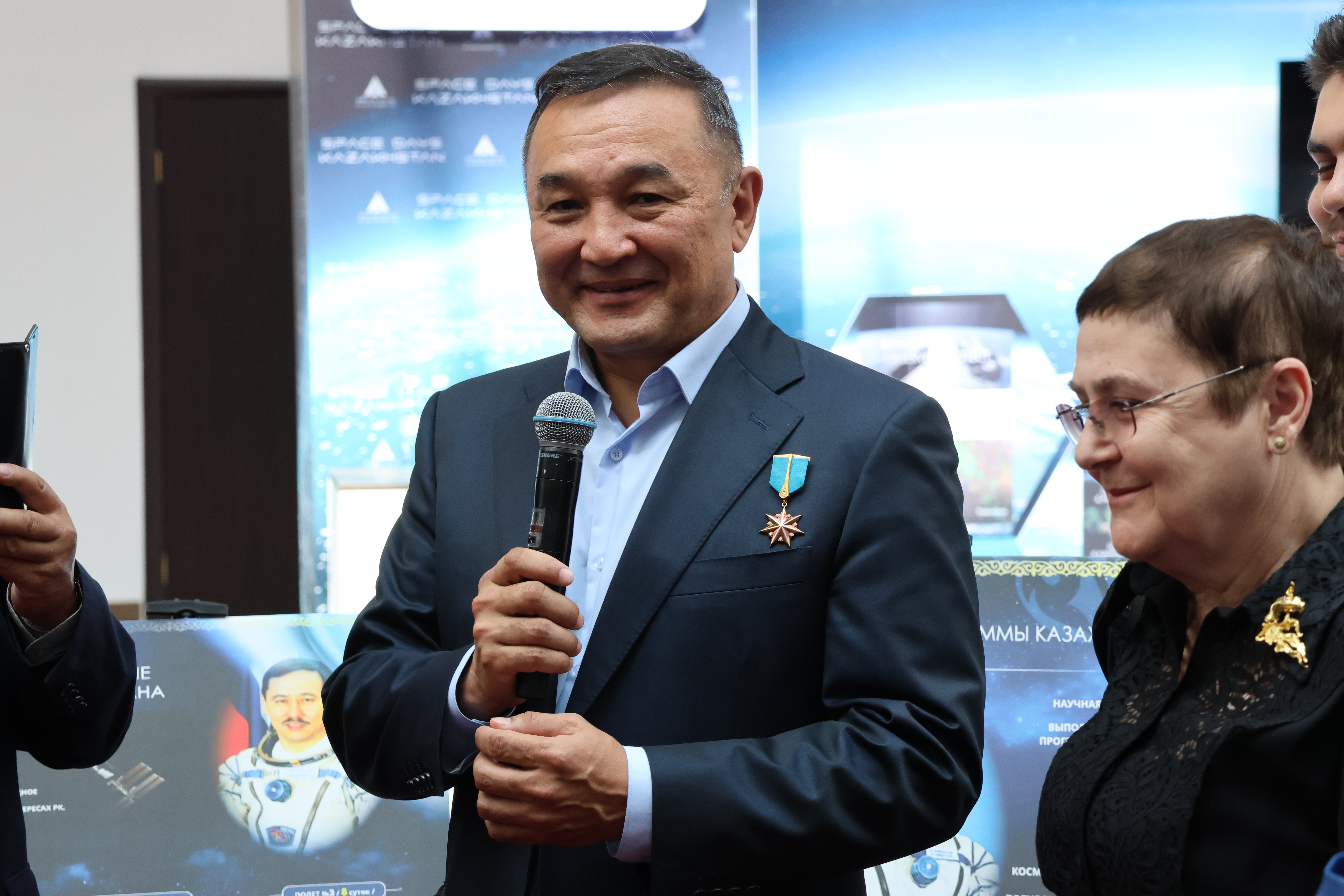
Today, cosmonaut Aidyn Aimbetov accepted the project that had been redesigned for many years.
In our design bureau, Kazakhstani engineers are already working on several satellite projects for foreign partners. When the Baiterek project is completed and we achieve the full cycle — from development to launch — Kazakhstan will become a space power, said Aidyn Aimbetov.
Finances
Beyond the technical details, the real pulse of the industry was felt at the investment roundtable. For Kazakhstan, space is not only about rockets and satellites — it is also about “long-term money.”
Regulators, bankers, and engineers sat together, discussing new partnership models where the state covers risks and private capital brings flexibility.


They spoke in detail about how to develop the existing foundation: the Assembly and Test Complex (ATC) with its design bureau, remote sensing constellations, and ground-based data reception infrastructure.
I visited the ATC myself — I was shocked. There aren’t many such centers in the world. Some assemble small satellites weighing up to 300 kilograms, while ours can handle up to six tons. I saw how they are tested, checked for protection against vibration, radiation, and other impacts. It’s truly impressive, said Madiyar Sultanbek, Deputy Chairman of the Board of JSC NC Kazakh Invest.
Incidentally, Kazakhstan will earn $75 million from just three satellites for Mongolia, Congo, and Nigeria — a figure that essentially marks a new level of commercialization for the industry.
According to forecasts by consulting company Nova Space, the global space economy could reach $1 trillion within the next decade. These figures reflect not only growing investment but also intensifying competition between countries and companies in orbit.
At the same time, industry experts emphasize that space has long transcended science and economics — it remains a defense tool, from satellite reconnaissance to navigation and communication systems essential for modern armies.


The official statements at the forum reinforced this trend toward expanding partnerships. An agreement with Singapore’s ORBVIEW will bring Kazakhstan’s remote sensing data to global markets through an international distributor network.
A memorandum with South Korea’s Nara Space opens the door to next-generation microsatellites and environmental monitoring. These steps create the “data–technology–services” nexus, without which it is impossible to transform space from an image project into an independent economic cluster.
Day Two
On September 9, delegations from Bahrain, Egypt, Korea, China, and Europe joined the forum. Each speaker presented their own slice of space ambition — from government agencies to private corporations.


Europe is trying not to fall behind, but the pace is set by the United States and China.
Elon Musk, with SpaceX, Falcon 9, Starship, and Starlink — the largest orbital satellite constellation in history — remains at the forefront of the industry. China, meanwhile, is not only catching up but at times redefining leadership in space. Beijing has announced plans to send a lunar mission as early as 2029.
But the struggle for leadership is measured by more than just the number of launches. Orbit is increasingly becoming a field of military competition—from anti-satellite weapon tests to military satellite constellations. A trend at the forum was clear: developing infrastructure that works for everyone matters more today.
Being the first country to build a base on the Moon is certainly important. But that’s not everything. It only means that China will plant the first flag. Building a lunar base must be the work of all humanity, of all countries. That requires the joint efforts of the world.
noted a representative of Shenzhen magicCubeSat.
Alongside billions of investments, a small relic was also born at the forum. A commemorative stamp was issued to mark the 10th anniversary of Aidyn Aimbetov’s flight.


Cosmonauts later shared memories of their careers and stories from orbit. Among them were Jügderdemidiin Gürragchaa of Mongolia, Dumitru Prunariu of Romania, Belarusian cosmonaut candidate Olga Mastitskaya, Russians Anton Shkaplerov and Sergey Volkov, and Kazakhstan’s Toktar Aubakirov and Aidyn Aimbetov.
Almaty had rarely hosted so many space pioneers.
Baikonur
In a parallel session, experts discussed creating a new international cosmodrome in Kazakhstan on Baikonur territory not leased to Russia.
The project, New Spaceport, will be operated by JSC National Center for Space Research and Technology. One of the first companies expected to develop a reusable system for launching spacecraft into orbit and returning cargo to Earth at the site could be the private firm Aspire Launch Ltd.
Unlike Baikonur’s heavy concrete architecture, the new project emphasizes lighter, functional design.


There’s not a single unnecessary building, structure, or hangar here — everything is accessible and transparent. This also minimizes the railway component at modern cosmodromes: any cargo, components, and elements are delivered by road. Therefore, firstly, there’s no need to maintain the entire vast railway infrastructure—locomotives, drivers, and so on. Secondly, and it’s a well-known fact, building roads is much cheaper than building railways, commented engineer Oleg Balitsky.


Automation and efficiency were also highlighted. Future rocket components may be produced with AI and 3D printing.
Japan’s JAXA Epsilon rocket, developed since 2007, was cited as an example: assembly in seven days, pre-launch checks in three hours, and only eight specialists required on the launch pad. Still, experts agreed that full removal of human oversight remains unrealistic.


After the technical discussion, attention shifted to access rules for land no longer under lease. Prime Minister Olzhas Bektenov’s proposal to create a special economic zone was also recalled — an idea raised in previous years but never put into practice.
In that time, Baikonur has lost much of its appeal.
Many specialists have left, and the city itself has visibly deteriorated.
Although formally located in Kazakhstan, it remains closed — the keys to access the city and launch pads are still held by the Russian side. For foreign specialists, this can mean months of approvals, making it an issue that will have to be resolved at the highest level.
Still, Baikonur retains a critical advantage — the “Great Red Road to Space,” a 51.6° orbit inclination used by the ISS. This path covers most inhabited territories in one pass, reduces fuel needs for corrections, and maximizes cargo delivery efficiency.


To attract investment, Kazakhstan is offering incentives: VAT exemptions on imported components for up to five years, zero duties on equipment, government grants covering up to 30% of investments, and tax breaks on corporate, land, and property taxes.
Foreign labor rules will be eased, though training programs in Qyzylorda are planned.
Day Three. Observatory
On September 10, forum participants traveled from Almaty to the Tien Shan foothills, where the Assy-Turgen Observatory of the Fesenkov Astrophysical Institute operates at over 2,700 meters altitude. The facility detects space debris as small as 10 centimeters — objects that could destroy satellites worth hundreds of millions of dollars.
Almost everything is automated and runs on scripts.


The institute manages a network of observation bases, with Assy-Turgen as the flagship. Its mountainous location, 80 kilometers from Almaty, provides dark skies and minimal light pollution, enabling nearly year-round observations.
By the 1960s, Almaty had become too bright for precise work, prompting astronomers to seek darker skies. Assy-Turgen offered average visibility of under two arcseconds, compared with three to four at most plain observatories.


Construction began in 1975, and six years later the Zeiss-1000 telescope, a one-meter Ritchey–Chrétien reflector, was installed.
This design, later used for the Hubble Space Telescope, provides sharp, undistorted images.


Work on the larger AZT-20 telescope stalled in the 1990s, but resumed in 2014, with first light achieved in 2016.
The observatory has long been part of the international network. Telescopes positioned across continents fill blind spots and ensure continuous monitoring. Data from Assy-Turgen contribute to the global scientific community through collaborations with France, China, Poland, and Russia.
Kazakhstan’s location closes a key “longitudinal gap” that would otherwise leave holes in the global space map.


Modern instruments, including compact telescopes, work alongside the main optics to rapidly respond to sudden events such as solar flares.
This step has brought Kazakhstan back into global networks that track short-lived cosmic phenomena—an important contribution to fundamental science developed here for generations.
The effects are tangible. Solar flares impact Earth not only with magnetic storms or auroras but also by increasing atmospheric drag on satellites, sometimes knocking them off course.
This happened with Starlink, when several satellites were lost due to heightened solar activity.
Day Four. Launch
The forum culminated in a visit to Baikonur, still accessible only to a select few.


In three months, the Baiterek project is scheduled to launch nearby. Named after the mythological tree where the Samruk bird lays a golden egg, it symbolizes renewal.
The forum suggested Kazakhstan now has the chance to turn that symbol into reality.
Meanwhile, a Russian spacecraft lifted off from Baikonur. The launch underscored that true partnership is measured not just by presence but by sharing knowledge and experience.
As science reminds us, knowledge grows stronger when shared. Appropriately, the rocket bore the name Progress.


Original Author: Kamila Yermakhanova
Latest news
- Tokayev Criticizes Banks For Delaying QR Payments
- Kazakhstan Launches New Preferential Loans For Livestock Breeders
- Rare New Guinea Monitor Lizards Arrive At Almaty Zoo
- Malaysian Automaker Proton Eyes Kazakhstan Production With Allur
- A Russian Teen Who Crossed Into Kazakhstan on Foot Wins Appeal Against Expulsion
- Regional Revenues, Global Instability, And The Referendum: What Tokayev Told Deputies
- Digitalization Of Customs Or New Barriers? What Entrepreneurs Fear In Kazakhstan’s New KEDEN System
- Astana Could Become An International Aviation Leasing Hub
- Kazakhstan’s First Tagged Eurasian Black Vulture Found Dead in India
- Kazakhstan Replaces Russian Turbines With Chinese Equipment for Ekibastuz Power Plant No. 2
- How Kazakhstan, Uzbekistan, And Azerbaijan Will Export Electricity To Europe
- Kazakhstan Explains How Russians Who Fled Mobilization Can Be Deported
- Kazakhstan and Japan discuss hydrogen partnership with export potential
- Russia Thanks Tokayev for Initiative to Support Russian Language
- Almaty Could Restrict Cars Under Beijing-Style Anti-Smog Plan
- Tigers in Kazakhstan Are in No Rush to Breed
- What Changes Are Being Prepared Under the New Tax Code
- Alcohol and Tobacco Prices in Kazakhstan See Sharpest Monthly Rise in 15 Years — Analysts
- Middle East Conflict Will Not Lead to Higher Gasoline Prices in Kazakhstan — Minister
- Five Regions of Kazakhstan Face Higher Flood Risk This Spring
