

Private Paradise: The Story Behind The "Kulibayevs’ Lakeside Dacha"
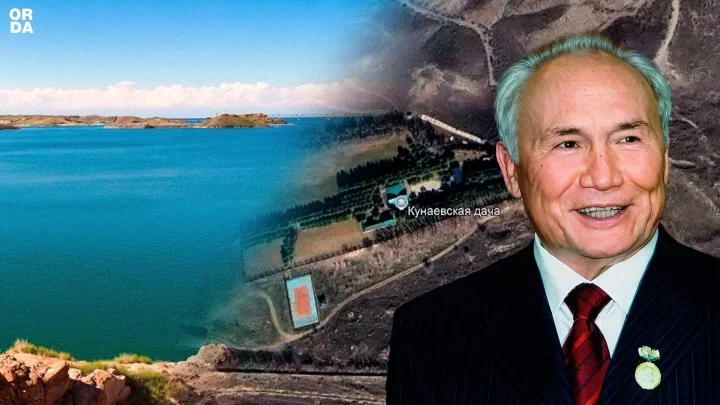 Photo: Orda.kz
Not far from the railway bridge on the Qapchagay Reservoir sits a fenced-off recreation area. Satellite images show a secluded, picturesque location tucked into a quiet bay. According to a recent decision by the Almaty Regional Court, the land beneath this retreat currently belongs to Askar Kulibayev, father of Timur Kulibayev, for now.
Orda.kz explains how this land came into the elder Kulibayev’s possession, which members of the family were involved, and why the court has found the deal unlawful.
A Closed Retreat
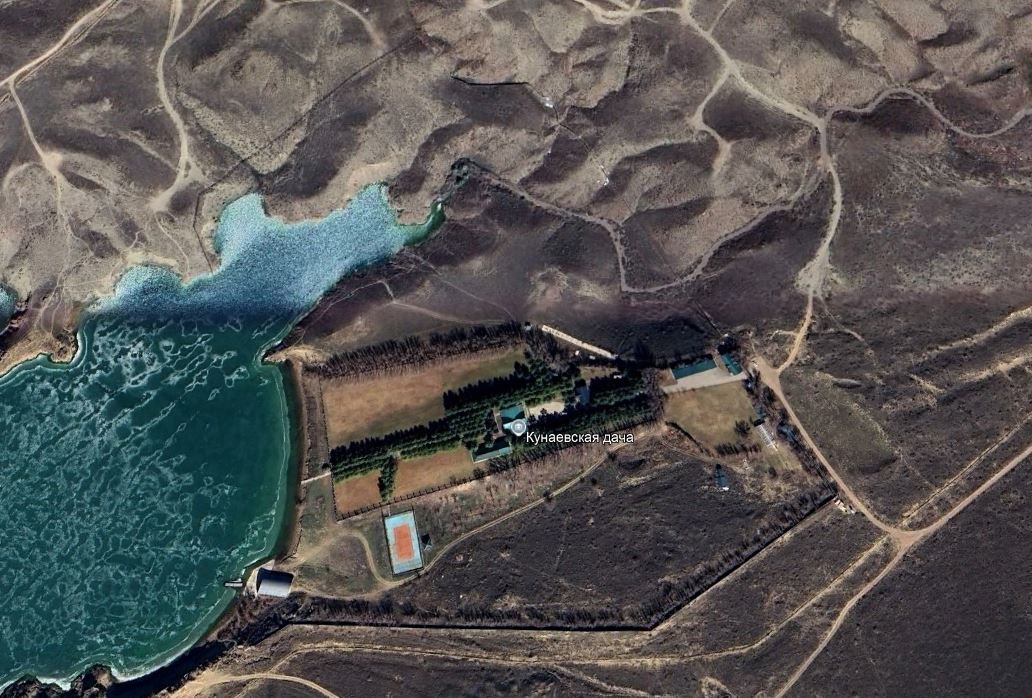
The bay where this compound sits offers a natural shield from public view, curving into the reservoir’s shoreline.
Judging by the satellite images, there is a fairly large green area, a hangar by the water, and even a tennis court. And also several buildings.
Court documents describe the property as housing a residential building, a heating station, quarters for staff and security, a garage, and a bathhouse.
On Google Earth, the site is labeled as Qonayev's Dacha — a name we’ll also use.
Public cadastral maps confirm that the site spans three plots, all designated for recreational use.
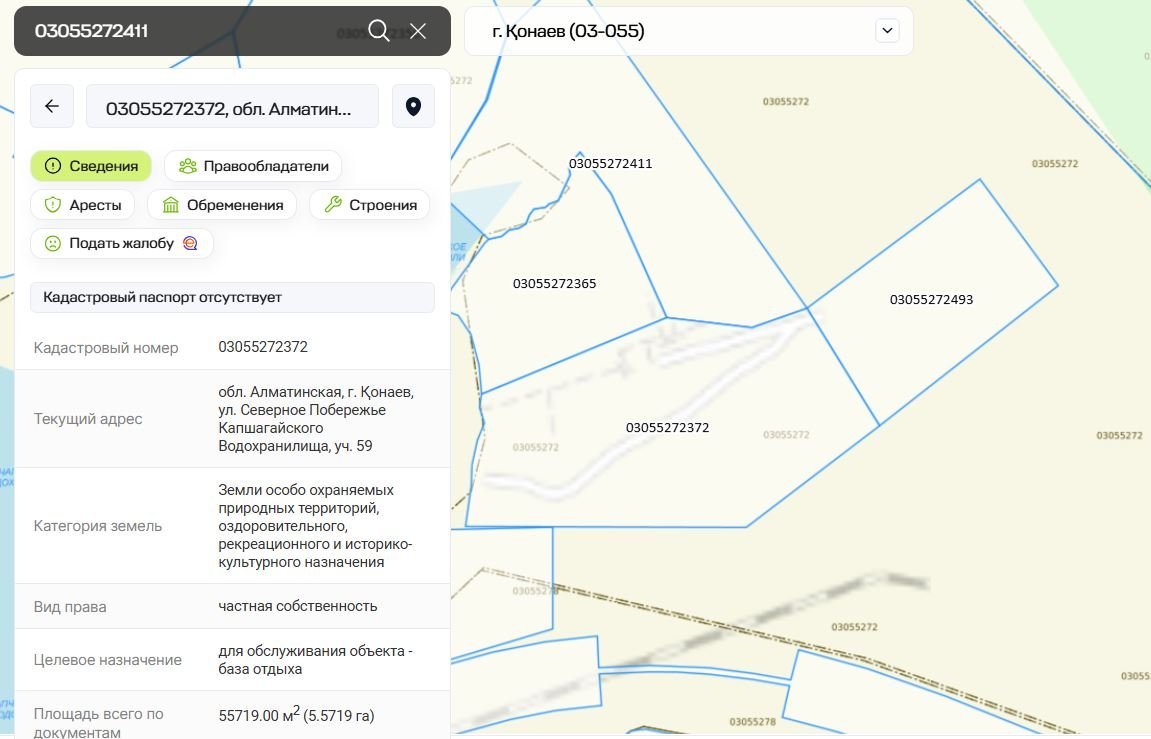
Despite the label, Qonayev's Dacha isn’t open to tourists. Orda.kz journalists searched rental platforms and found no listings. Even approaching the base is difficult — it’s fenced off with two barriers. One fence encloses the buildings; another secures the larger land plots, cutting across hills, ravines, and even a stream that feeds into the reservoir. One plot even includes a portion of the reservoir itself.
Technically, the eastern side of the bay remains public, which means it does not belong to Askar Kulibayev. But the only way to access it is from the water.
The Land Trail
Documents show the land was privatized in the mid-2000s, during the tenure of Kapchagay’s controversial former Akim, Sergey Zelensky, known for generously handing out prime lakefront property.
As early as 2013, the Balkhash-Alakol environmental inspection attempted to challenge the legality of several shoreline privatizations. Some of their claims were rejected, but lawsuits did proceed. Yet Tamyz-KA LLP, the company that eventually owned Qonayev's Dacha, was not among the defendants.
Here’s the sequence of how the land came into private ownership:
On October 8, 2004, the Qapshagay Akimat transferred a land plot with cadastral number 03-055-272-372, covering 5.5719 hectares, to Silk Road–Kazakhstan National Company LLP. The purchase and sale agreement between the company and the Akimat was officially signed on May 18, 2005.
Then, according to the land transfer agreement dated January 4, 2006, the plot was passed to Transkhleb LLP, and later, on March 28, 2006, it was transferred to Tamyz-KA LLP,the court documents state.
On December 27, 2004, the Akimat transferred another land plot, cadastral number 03-055-272-365, measuring 2.3037 hectares, to an individual named Kadyr Alimbayev, who currently owns the Onim farm. The purchase agreement with the Akimat was finalized on March 5, 2005. In 2006, Alimbayev also sold this land to Tamyz-KA LLP.
On June 30, 2006, the Akimat transferred yet another plot — cadastral number 03-055-272-411, spanning 4.4402 hectares — again to Silk Road–Kazakhstan. The sales contract was signed on August 3, and by September 1, 2006, the land had been sold to Tamyz-KA LLC.
According to the SIOPSO, Silk Road – Kazakhstan LLP and Transkhleb LLP were officially liquidated on April 25 and April 30, 2007, respectivelyreads the decision by the Almaty Regional Court.
On May 8, 2016, Askar Kulibayev purchased all three of these plots. Eight years later, the Almaty Regional Prosecutor’s Office challenged the legality of those transactions in court. According to documents from the Qonayev City Court, the core of the claim was that these privately owned plots were located within a water protection zone.
Under Kazakh law, land in such zones may only be leased from the state, not privately owned.
However, the lower court did not find grounds for a violation. First, it ruled that the transactions had been made in good faith. Second, it noted that the boundaries of the water protection zone had only been officially established by the Qapshagay Akimat in 2009, well after the land had already been transferred.
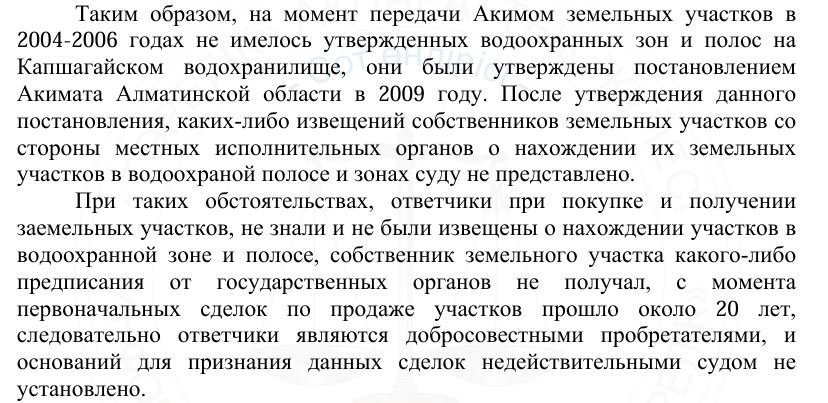
Third, the Qonayev court found that less than one-fourth of the land acquired by Kulibayev Sr. fell within the water protection zone. Moreover, he had expressed willingness to divide the plots and return the relevant portion to the state.
As a result, the court rejected the prosecutor’s claim. But the prosecutor’s office filed an appeal, and it was in the regional court that many new details began to surface.
Grandfather, Son, Grandson, Brother, and Fyodor
The companies Silk Road-Kazakhstan, Transkhleb, and Tamyz-KA were all affiliated with Askar Kulibayev. The court decision lays out how the Kulibayev family’s ties were deeply intertwined with the land near the bay.
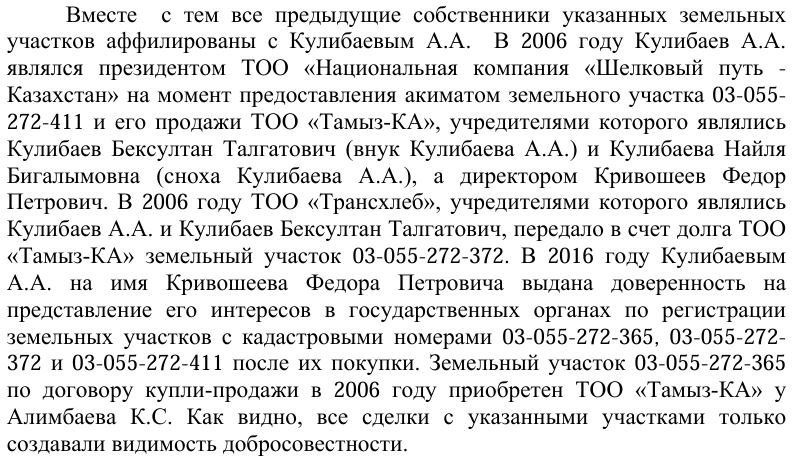
To start with, from January 24, 2002, to December 5, 2005, Askar Kulibayev himself was listed as the founder of Tamyz-KA LLC. Representatives of the Kulibayev family only stopped appearing among the company’s founders and executives in 2020.
Alongside Askar, the company’s management at different times also included Beksultan Kulibayev, Nailya Kulibayeva, Alibek Kulibayev (Beksultan’s brother), and Talgat Kulibayev, the brother of Timur Kulibayev and father to Beksultan and Alibek.
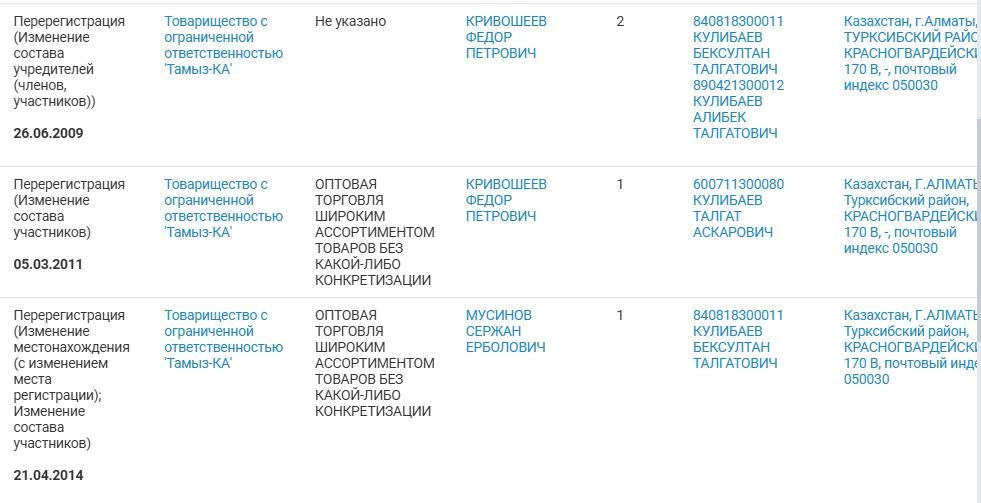
Talgat Kulibayev deserves special attention. At the time these land deals were being made — between his father, son, and daughter-in-law—he held high-ranking posts in Kazakhstan’s Ministry of Internal Affairs. Up until May 2005, he was the head of the Department of Internal Affairs in the Jambyl Region.
Later, he led the South-Eastern Department of Internal Affairs, overseeing railway and airport security in South Kazakhstan, East Kazakhstan, Jambyl, and Almaty regions.
From 2010 to 2018, he served as the head of the Almaty Police Academy. Notably, between 2011 and 2014, he was also listed as a founder of Tamyz-KA LLP—precisely when the Balkhash-Alakol Basin Inspectorate was trying to reclaim the land on the Kapchagay Reservoir through the courts.
But let’s return to “Qonayev's Dacha.” The Almaty Regional Court overturned the lower court’s assertion that the water protection zone on the Qapchagay shoreline had only been designated in 2009. The regional court cited four documents proving otherwise.
First, a Resolution by the Cabinet of Ministers of Kazakhstan, dated May 12, 1992, which set the maximum water level of the Qapchagay Reservoir at 479 meters and specified that water protection strips should be 55 to 100 meters wide.
Second, the court decision states that water protection strips are allocated in the Land Code of the Republic of Kazakhstan at least in the 2003 edition.
Thirdly, there is a reference to a document of the Balkhash-Ili Basin Inspectorate from 2003.
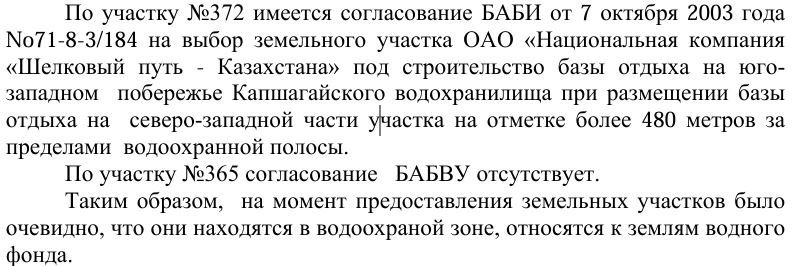
And, fourthly, it says that the Rules for establishing water protection zones and strips were approved by the Decree of the Government of the Republic of Kazakhstan on January 16, 2004 — that is, 10 months before the first plot passed into private hands.
For reservoirs and lakes, the minimum width of the water protection zone is 300 meters if the area is up to two square kilometers, and 500 meters for water bodies larger than that. The inner boundary of the zone runs along the shoreline at the average long-term water level,the court decision explains.
As for the earlier proposal to divide the plots, the regional court ruled that this was not within the court’s authority, but rather a matter for the Akimat and its designated commission. That division never took place.
As a result, the Almaty Regional Court ordered the cancellation of all land transactions related to Qonayev's Dacha, the confiscation of the plots from Askar Kulibayev, and their return to state ownership.
It also ordered that 528,643 tenge in legal fees be recovered from all previous owners, including Tamyz-KA LLP, which, at least on paper, no longer belongs to the Kulibayevs.
Original Author: Igor Ulitin
Latest news
- Orda.kz Editorial Team to Cease Operations on September 1
- The Price of a Degree: How Students in Kazakhstan Pay for University
- Second Przewalski’s Horse Foal Born as Species Returns to Kazakhstan
- Kazakh Mining Companies Can Recalculate Purchases if Tenge Weakens
- Kazakhstan Names First Vice President in Three Decades
- What Almaty’s Bus Shelters Are Missing
- 400-Truck Queue Builds at Kazakh–Kyrgyz Border
- Kazakhstan Ready to Help Feed and Rebuild Gaza
- Tokayev Establishes New Presidential Security Body
- Almaty Takes Back Its Nearly Century-Old Hippodrome
- No More Guesswork on Savings: Kazakhstan Tightens Energy Audits for Businesses
- Public Money Could Be Used to Rescue Failing Kazakh Banks
- Third Kazakh Woman Reported Missing in Nepal-China Flood Zone
- Falconer Convicted Over 35 Protected Birds, Spared Punishment Under Amnesty
- Kazakh Citizen Detained in Yakutia in Phone Fraud Case
- Yuan Instead of Dollars? KazMunayGas Draws Record Demand in Asia
- China Gains Oil-Market Influence as OPEC+ Weakens
- Kazakhstan to Divide Smartphones Into White, Gray and Black Lists
- Kazakhstan’s Government Formally Resigns as First Kurultai Session Opens
- Rare Lynx Sighting Recorded in Northern Kazakhstan
