

Semey’s Cruel Irony: How Victims Of The Nuclear Test Site Bear The Cost Of Their Own Suffering
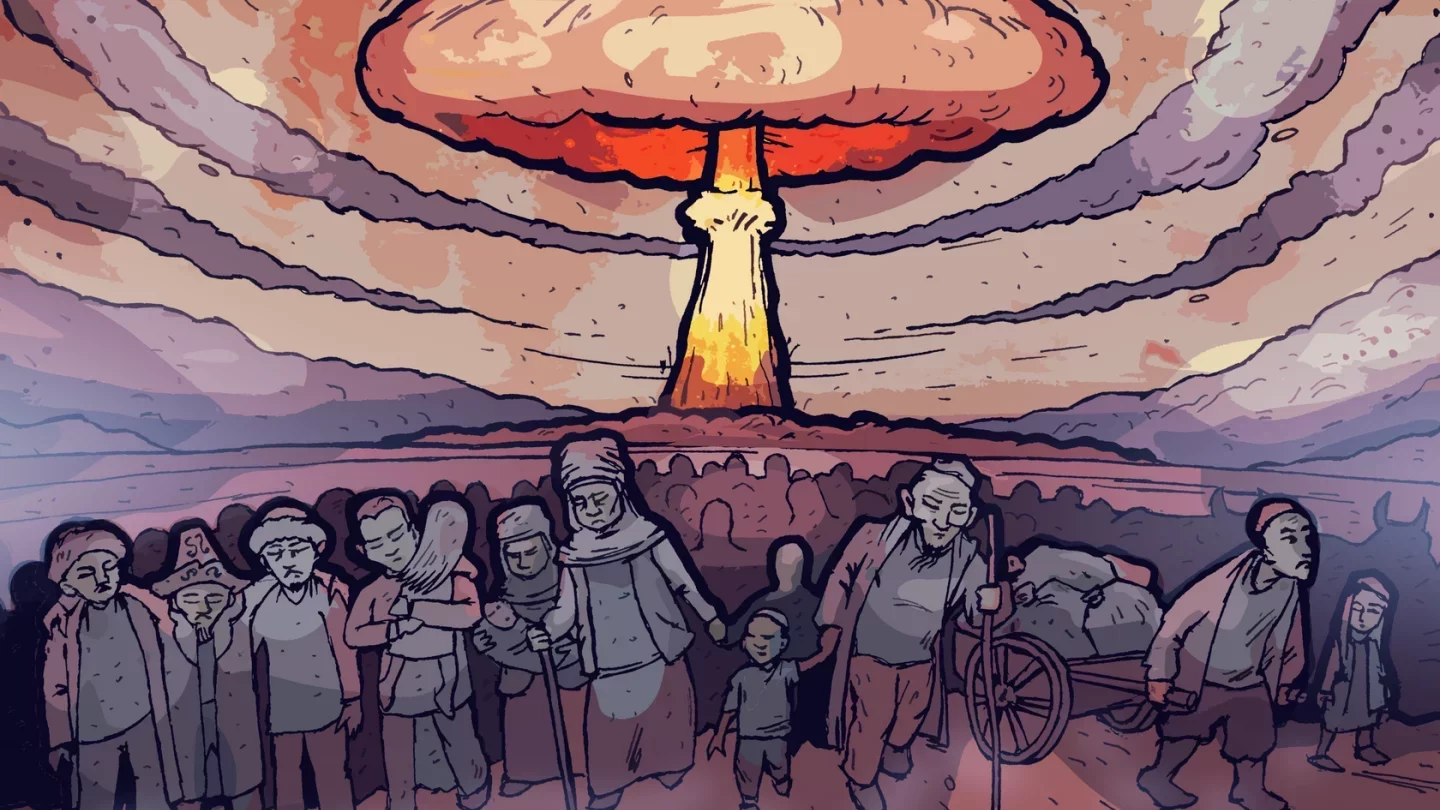 Photo: Work by Semey artist Pavel Ukolov
On August 29, Kazakhstan commemorates two historic dates: the first Soviet atomic bomb test, conducted in 1949, and the closure of the Semipalatinsk nuclear test site in 1991. Between these two milestones lie 40 years of testing and millions of victims.
Yet an even more bitter irony is that the law, supposedly designed to protect test site victims, has long worked against them: compensation is canceled out, benefits disappear, and people are left essentially paying themselves for the damage inflicted by the state.
Orda.kz investigated why this happened — and how it might be fixed.
More than 460 nuclear, thermonuclear, and hydrogen devices were detonated at the site — on the ground, underground, in the air, and near aquifers. The fallout spread far beyond the test area. Radioactive clouds and the gas fractions of underground explosions drifted across nearby territories, while radioactive dust spread over a vast region that today encompasses parts of four Kazakh regions.
At 6:50 a.m., just ten minutes before the first test blast, Lavrentiy Beria turned to Igor Kurchatov and said:
— “Nothing will work out for you, Igor Vasilyevich.”
— “It will definitely work out,” Kurchatov replied.
(From the memoirs of Soviet physicist Igor Golovin)
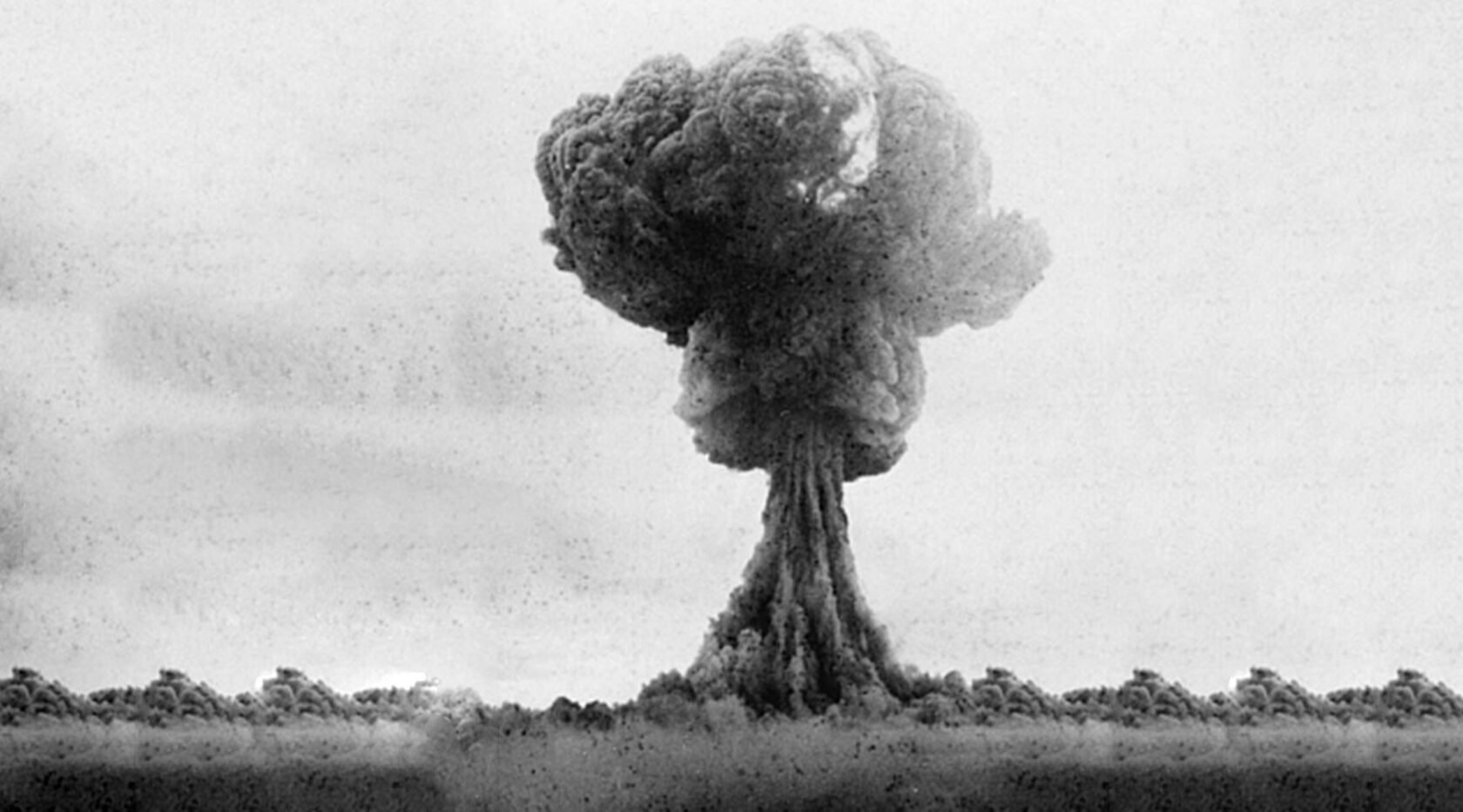
The entire Semey region — as well as parts of Pavlodar, Qaraganda, and East Kazakhstan — was affected.
Today, the total number of victims of the Test Site is estimated at nearly 1.5 million people.
However, the official registry, which defines who is eligible for compensation and benefits, covers only about 30% of that figure. Even if all 1.5 million were included, it would still fail to reflect the true scale: in reality, many more people were affected.
Sociologist Alexey Konovalov from the Abay region explains:
In Belarus, 3.7 million people — almost 40% of the population — are officially recognized as victims of the Chornobyl disaster. They are listed in the state registry. This includes the first, second, third, and even fourth generations — the children and grandchildren of those who were in the impact zone. And this is correct. No one can guarantee that a grandfather exposed to radiation could not genetically pass it on to his descendants.
At the start of the current decade, Konovalov’s surveys showed that 55% of Semey residents he interviewed did not even have a Test Site certificate. That meant they were not entitled to the meager benefits available.
Conditions in rural areas were even worse.
More than 30 years after the test site was shut down, order in this sphere has still not been restored.
There Is A Law...
We spoke with civil activist and chair of the public association DOM, Maira Abenova, who was among the founders of the movement Polygon 21 Committee.
Since 2023, Maira has represented Semey on the interdepartmental commission tasked with addressing the problems of nuclear test site victims (chaired by the Vice Minister of Ecology).
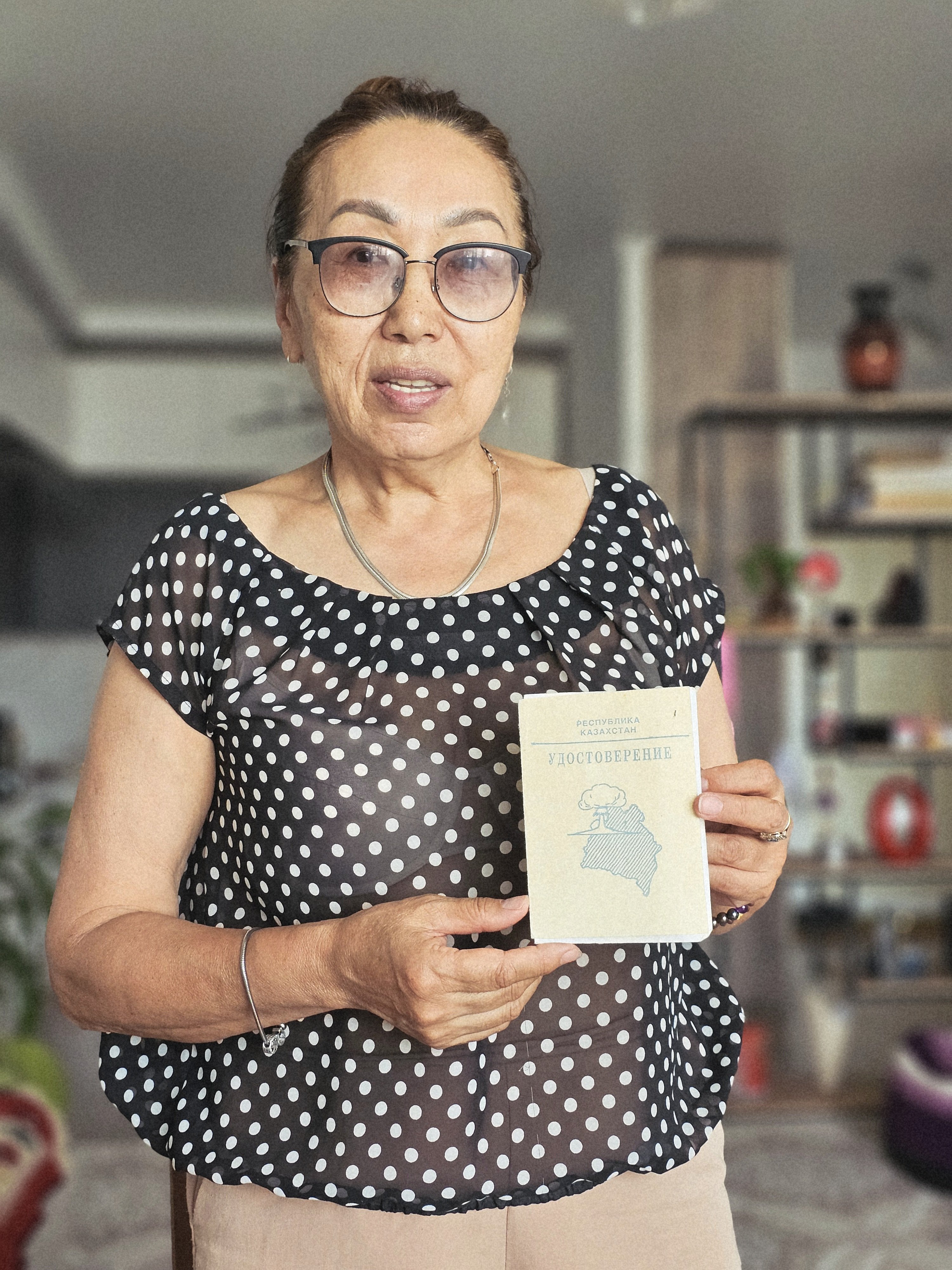
Maira Zhamantayevna received us in a deeply upset state. For reasons still unclear, local officials in Semey refused permission to screen a short film about women affected by the test site.
The film is called JARA, which translates as Wound. It was made by our compatriot, Aigerim Seitenova. She’s an international lawyer by profession, but is now active in the anti-nuclear movement and the youth coalition. In March she spoke at the UN with proposals from all of us. Her film tells the stories of six women — how the test site shaped their lives. The UN hall where it was screened was full, and I think there was no one who didn’t cry. We wanted to show it here on August 29, the International Day Against Nuclear Tests. But for some reason, the Akimat banned the screening on Arbat. They referred vaguely to the police or some other reason… There are no appeals, no slogans, not even tears — only the stories of women who lived through this, Maira said.
This news set the tone for our entire conversation. Instead of discussing the anniversary, we spoke about the current problems surrounding the test site.
Since 2021, Maira has been working actively to revise legislation on the social protection of test site victims.
She first seriously considered the issue in 2011, during the 20th anniversary of the site’s closure, when Semey residents realized amendments to the law were urgently needed. But her personal involvement deepened later, after she suffered heavy personal losses.
My relatives — my sister, brother, husband — all began leaving this world, one after another, from cancer… Maira recalled with pain.
She points to the outdated law 'On Social Protection of Citizens Who Suffered as a Result of Nuclear Tests at the Semipalatinsk Nuclear Test Site' as the main stumbling block for everyone trying to improve the fate of survivors.
This law was adopted in 1992. Under it, victims were defined as those living iin the territories specified in the law — covering four regions. They were entitled to a certificate, but people had to go and apply for it themselves. By comparison, in Japan people don’t have to apply for such a certificate — the state issues it to them automatically., Maira explained.
One Letter
Take the issue of compensation. In the 1990s, payments were designed to be calculated based on the minimum wage.
Then deputies in the Majilis changed the law by literally adding one letter: they replaced MW (minimum wage) with MCI (monthly calculation index). And people were left with pennies! Not just a small amount — a humiliating amount for people who suffered for 40 years, Maira said indignantly.
To understand the scale: in 2025, the minimum wage in Kazakhstan is 85,000 tenge. The MCI is 3,932 tenge. The difference is nearly 22-fold.
Pensions and environmental allowances also create major problems. Payments depend on which of four risk zones one is registered in: extraordinary, maximum, increased, and minimum risk.
Do you know what the paradox is? Elderly people tend to move from villages and districts (classified as maximum radiation risk zones – Ed.) to live with their children in Semey. But Semey itself is only classified as an increased-risk zone. And if they register here, they lose their pension supplement! So these old people become ‘hares’—they live in the city but are officially registered in their village, probably trembling every day that inspectors might come to check on them, Maira explained.
Semey Under A Lead Cap?
Her words point to another inconsistency in the law. Benefits and payments depend entirely on which pollution risk zone one is classified in. But for some reason, Semey was placed only in the increased-risk category — despite the fact that, according to older studies, the city is surrounded on all sides by maximum-risk zones.
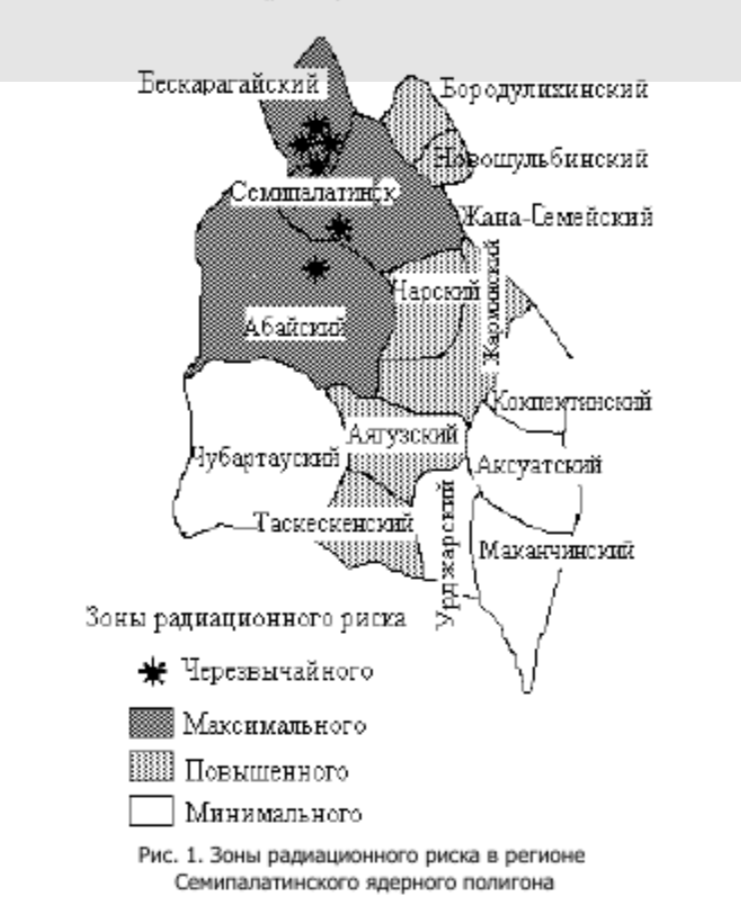
“How did it happen that all around us there are maximum-risk zones, yet Semey itself somehow ended up under a kind of ‘lead cap’? Apparently for 40 years we were ‘covered by an umbrella,’” Maira remarks sarcastically.
According to her, during the 1990s, the law was rewritten several times to minimize compensation as much as possible. First, the minimum wage was replaced with the MCI.
Then they “downgraded” Semipalatinsk (now Semey) — the largest populated center in the area — reducing its official level of contamination. Along with that downgrade came a reduction in compensation for Semey residents. In other words, the state saved money at their expense.
Sleight of Hand
The problem of compensation, Maira argues, is deeply flawed. Even additional wage payments, meant to offset harm, have been turned upside down.
The obligation to provide compensation payments was placed on employers. But entrepreneurs are victims too — what do they have to do with the tests? They aren’t responsible for them. Most business owners don’t pay this compensation at all, and from what I can see, there’s little oversight. And even if they do pay, any entrepreneur with common sense will find a way to recoup those costs. How? By raising the prices of their products, goods, and services. And who ends up paying in the end? Us — the victims. Whose lives are improved? No one’s! Abenova reasons.
In effect, the additional compensation for test site damage is not paid by the state, and not really by businesses either — it’s paid by Semey residents themselves, through more expensive goods and services.
This makes life in Semey, already difficult, even costlier, and hinders the city’s development.
Over time, Abenova notes, the law has lost both force and meaning. Amendments have not expanded benefits for victims — they’ve cut them back. Wording has been narrowed to exclude many who suffered.
For example, the original text said ‘residents and those who lived’ — recognizing damage caused to anyone who had lived in the zone. But when it came to social protection, only ‘current residents’ were left. Yet during 40 years of tests, people had every right to move elsewhere, and in the 33 years since closure many did. What did they do, leave their radiation exposure behind like old clothes? Of course not — they carried it with them. But if they register in Astana or Aqtobe, the law no longer applies, and they lose benefits! she said indignantly.
For Abenova, the problem is not just the size of payments but the very logic of the law. What was supposed to protect victims has instead created contradictions and inequalities. People who endured decades of nuclear explosions must constantly prove their right to aid.
“Laws should make people’s lives better. They should be fair and clear. But what do we have? A discriminatory law,” she concludes.
At a 2021 conference, the Polygon 21 Committee — the public movement of which Abenova is a leader — identified three key priorities for systemic change.
First, they demanded the reinstatement of the Semipalatinsk Region — a demand that has since been met. Second, they called for solving accumulated problems through sustainable territorial development, overseen by a permanent state commission.
That commission was eventually established, including many government officials.
In September 2023, the Ministry of Ecology contacted me with a document, stating that at the instruction of Deputy Prime Minister and Minister Dyusenova, an interdepartmental working commission was being created. The ministry began this work only after I spent nearly three months explaining what we needed. But at least the commission was formed — it was created at our request,Abenova noted.
The third demand, she emphasized, is the adoption of a new law — one that is fair, comprehensive, and future-oriented.
Yet when asked how many times the commission has met in three years, she answered frankly: only twice.
In May this year, we submitted a 38-page proposal — a comparative table with specific legal changes that must be made. Now Kazakhstan is planning to build nuclear power plants. Who can guarantee that something won’t happen tomorrow? The future law must take this into account. It should not apply only to Semipalatinsk but be broader. People who will work at those plants, who will live nearby, need to know in advance how the law will protect them.
But despite all the criticism of the law, it still provides some benefits. On August 23, the media reported that victims of the test site in Astana would receive one-time social assistance.
According to the capital’s Akimat, the payment will amount to 2.5 MCI — roughly 10,000 tenge.
Around three thousand city residents will receive this assistance. All of them are officially recognized as victims of nuclear tests at the Semipalatinsk site and have confirmed their status.
Previously, each of them had already received a one-time compensation for damage caused by nuclear weapons testing.
The Akimat also noted that these individuals are entitled to free parking in areas where other residents of the city must pay.
Original Author: Ilya Barokhovsky
Latest news
- Tokayev Criticizes Banks For Delaying QR Payments
- Kazakhstan Launches New Preferential Loans For Livestock Breeders
- Rare New Guinea Monitor Lizards Arrive At Almaty Zoo
- Malaysian Automaker Proton Eyes Kazakhstan Production With Allur
- A Russian Teen Who Crossed Into Kazakhstan on Foot Wins Appeal Against Expulsion
- Regional Revenues, Global Instability, And The Referendum: What Tokayev Told Deputies
- Digitalization Of Customs Or New Barriers? What Entrepreneurs Fear In Kazakhstan’s New KEDEN System
- Astana Could Become An International Aviation Leasing Hub
- Kazakhstan’s First Tagged Eurasian Black Vulture Found Dead in India
- Kazakhstan Replaces Russian Turbines With Chinese Equipment for Ekibastuz Power Plant No. 2
- How Kazakhstan, Uzbekistan, And Azerbaijan Will Export Electricity To Europe
- Kazakhstan Explains How Russians Who Fled Mobilization Can Be Deported
- Kazakhstan and Japan discuss hydrogen partnership with export potential
- Russia Thanks Tokayev for Initiative to Support Russian Language
- Almaty Could Restrict Cars Under Beijing-Style Anti-Smog Plan
- Tigers in Kazakhstan Are in No Rush to Breed
- What Changes Are Being Prepared Under the New Tax Code
- Alcohol and Tobacco Prices in Kazakhstan See Sharpest Monthly Rise in 15 Years — Analysts
- Middle East Conflict Will Not Lead to Higher Gasoline Prices in Kazakhstan — Minister
- Five Regions of Kazakhstan Face Higher Flood Risk This Spring
